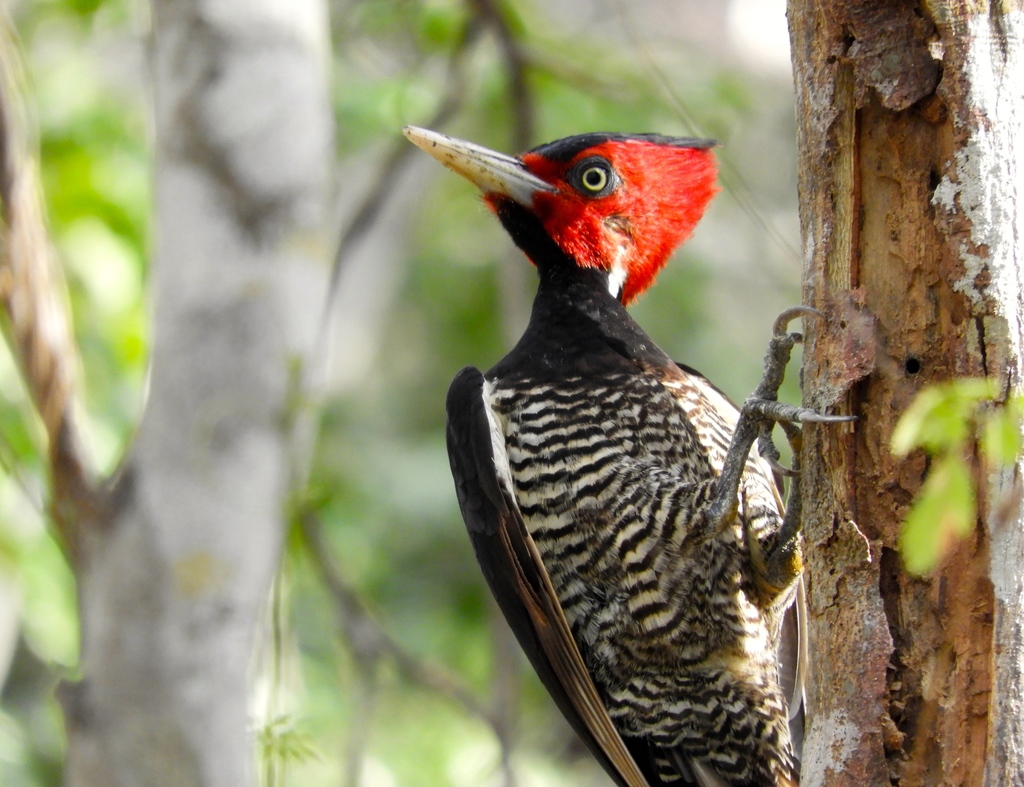
Pale-billed Woodpecker
Photo © Francisco Farriols Sarabia
Photo © Francisco Farriols Sarabia — CC BY 4.0 — Source: iNaturalist photo #63504859Identification
The pale-billed woodpecker is a large woodpecker, measuring 35.5 to 38 cm long, with distinctive plumage and a striking pale bill. Both sexes display black upperparts from nape to rump, interrupted by vertical white or buffy-white stripes on the neck and back that form a characteristic "V" pattern. The tail is dull brown, while the wings are largely black except for the outer primaries, which show dull brown outer webs above and greenish olive-yellow below. The underparts are light yellowish buff with narrow black barring, and the throat and upper breast are black. The long, ivory-yellow chisel-like bill is the species' most distinctive feature, along with light cream-buff irises and greenish-gray legs.
Sexual dimorphism is readily apparent: adult males sport a striking red head with a bushy crest, while females have a black forecrown, crown center, foreneck, and throat. Subspecies vary slightly in size and coloration; the nominate race C. g. guatemalensis is larger than C. g. nelsoni, which shows browner black parts and whiter stripes, while C. g. regius is larger overall.
Range & Habitat
This species ranges from Mexico to Panama, with three subspecies occupying distinct regions: C. g. regius in eastern Mexico (Tamaulipas to Veracruz), C. g. nelsoni in western Mexico (Sonora to Oaxaca), and C. g. guatemalensis from Veracruz and the Yucatán Peninsula southward through Central America into western Panama. Year-round residents throughout their range, these woodpeckers show no seasonal migration.
The pale-billed woodpecker inhabits the interior and edges of diverse forested landscapes, with lowland tropical evergreen forest being most common. On the drier Pacific slopes, it also occurs in tropical deciduous forest and mangroves, while montane evergreen and pine-oak forests provide habitat in Honduras. The species ranges from sea level to 2,000 m in Mexico, descending to lower elevations toward the Caribbean. It strictly avoids extensive deforested areas and disappears where heavy logging has occurred.
Behaviour & Diet
The pale-billed woodpecker typically forages singly or in pairs in the mid- to upper forest levels, though it will descend to ground level at stumps and fallen logs. It deliberately searches tree trunks and large limbs, excavating decayed wood and scaling bark from dead trees in search of prey. Pairs may forage several meters apart and do not join mixed-species feeding flocks. Its diet consists primarily of large larvae of wood-boring beetles, supplemented with termites and small fruits, though details remain incompletely documented.
Breeding seasonality varies with latitude: from December to June in southern Mexico and August to September in Costa Rica. Both sexes excavate nest cavities in large trees, typically 3 to 12 meters above ground. Clutch size is two eggs, incubated by both parents, though incubation period and fledging details remain unknown.
Best Time & Places to See It
The pale-billed woodpecker's year-round residency makes it potentially visible throughout its range in any season, though breeding activity in your target region may focus your visit timing. Lowland tropical evergreen forests in Central America offer the best opportunities, particularly in protected areas across Guatemala, Costa Rica, and Panama. On the Pacific slope, tropical deciduous forest and mangrove margins also harbor the species. Early morning foraging activity and the bird's loud vocalizations make dawn visits most productive.
Photography Tips
The pale-billed woodpecker's large size and striking color pattern—particularly the red-crowned males—make it an attractive photographic subject. Focus on the mid- to upper canopy where the species typically forages on large tree trunks and limbs. The pale ivory bill stands out against dark plumage and provides excellent contrast. Anticipate movement among large dead or heavily-worked trees where bark scaling and excavation occur. The species' loud nasal calls can aid in locating individuals; listen for the characteristic "kip kip kip kip-hey'eh'eh" or the loud, rapid double-rap drumming. Patience and early morning light will reward photographers seeking this impressive woodpecker.
Arenal Volcano National Park
Barbilla National Park
Barra del Colorado National Wildlife Refuge
Braulio Carrillo National Park
Cahuita National Park
Caño Negro National Wildlife Refuge
Carara National Park
Corcovado National Park
Curú National Wildlife Refuge
Nothing matches these filters.
No community photos yet. Log in to add the first one.
No community observations of this species yet.