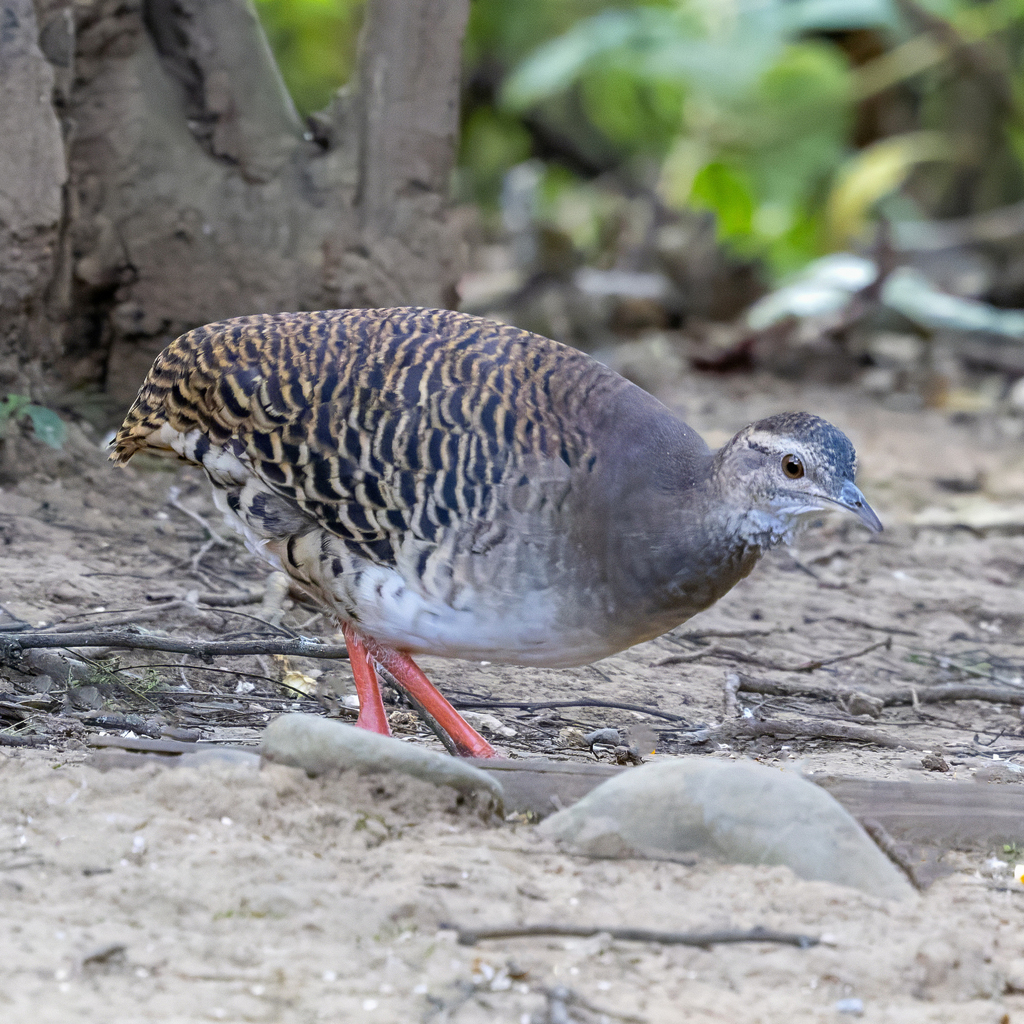
Pale-browed Tinamou
Photo © Dan Vickers
Photo © Dan Vickers — CC BY 4.0 — Source: iNaturalist #309349019Identification
The pale-browed tinamou is a small bird, approximately 28 cm (11 inches) in length. Its most distinctive features include a prominent white supercilium (eyebrow stripe) that gives the species its common name, a greyish-brown upper coat finely vermiculated with black, and a very brown crown. The throat is white, while the remaining underparts are greyish to buffy in tone. The flanks are barred, and the legs are notably pink, providing a helpful identifying mark in the field.
Range & Habitat
The pale-browed tinamou is endemic to northwestern South America, found in western Ecuador and northwestern Peru. In Ecuador, it occurs in southern Manabí, Guayas, coastal and extreme western El Oro, and extreme northwestern Loja. In Peru, its range includes Tumbes and western (except coastal) Piura. The species inhabits subtropical and tropical arid and dry forests at elevations up to 1,500 metres (4,900 feet), occupying the Ecuadorian dry forests and Tumbes–Piura dry forests ecoregions.
Behaviour & Diet
Like other tinamous, the pale-browed tinamou is primarily frugivorous, foraging for fruit from the ground and low-lying bushes. It supplements its diet with small amounts of invertebrates, flower buds, tender leaves, seeds, and roots. This species exhibits unusual breeding behaviour among birds: the male incubates eggs that may originate from as many as five different females, and subsequently raises the chicks until they are independent. The nest is constructed on the ground, typically located in dense brush or between raised root buttresses, providing concealment for this ground-dwelling species.
Best Time & Places to See It
The pale-browed tinamou is found in dry forest habitats across a range of approximately 41,900 square kilometres (16,200 square miles) in Ecuador and Peru. Birders and nature travellers seeking this species should focus on the Ecuadorian dry forests and Tumbes–Piura dry forests ecoregions. As a ground-dwelling forest bird, it may be more easily detected during early morning hours when it is more vocal and active, though its cryptic plumage and ground-foraging habits make it a challenging species to observe.
Photography Tips
Photographing the pale-browed tinamou requires patience and attention to ground-level activity within dry forest habitats. The species' cryptic coloration—greyish-brown vermiculation and buffy underparts—provides excellent camouflage, making it essential to look carefully among leaf litter and low vegetation. The white supercilium and pink legs are useful identifying features to watch for when framing shots. Early morning light is ideal for capturing details of this small bird. Photographers should be prepared to work with relatively short distances and be mindful of the bird's ground-nesting behaviour to avoid disturbing breeding birds.
No community photos yet. Log in to add the first one.
No community observations of this species yet.