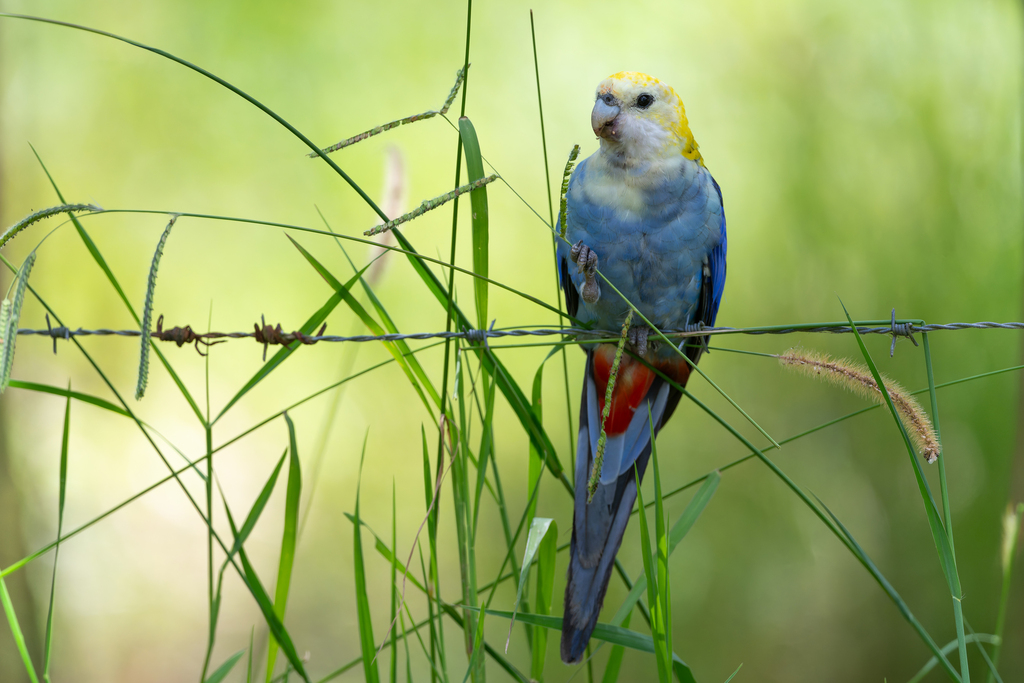
Pale-headed Rosella
Photo © Adam Jackson
Photo © Adam Jackson — CC0 1.0 — Source: iNaturalist photo #470901455Identification
The pale-headed rosella is a moderate-sized parrot, 33 cm long including a 15 cm tail. Its most distinctive features are the pale cream-yellow head and wholly white cheeks, contrasting sharply with pale blue underparts. The back displays a striking scalloped pattern created by black feathers edged with bright yellow. The tail is blue-black and green, while the vent is blood red. The bill is pale blue-white and the eyes are yellow-brown. Sexes are similar, though females are slightly smaller and duller in plumage.
Two subspecies exist: the nominate adscitus in the north has paler yellow margins on the back with a pale blue tinge, and partly blue-flushed cheeks; the southern palliceps has wholly white cheeks and brighter yellow scalloping.
Range & Habitat
Native to northeastern Australia, the pale-headed rosella is found from Cape York Peninsula south through Queensland to the vicinity of the Clarence River in northeastern New South Wales. The nominate subspecies adscitus occupies the Cape York Peninsula south to Cardwell, while palliceps ranges from Townsville inland and southward. The species is common throughout its range.
It prefers open forest and woodland habitats but has adapted remarkably well to human-modified landscapes. The species has become established in rural and agricultural areas, sometimes becoming a pest to orchards and cereal crops. Watering troughs support populations in the drier western portions of its range.
Behaviour & Diet
Like other rosellas, the pale-headed rosella nests in deep hollows of large trees, typically over 1 metre deep and up to 30 metres above ground. Breeding timing varies by region: southern populations nest from September to December, while northern birds nest later, from February to June. Clutches typically consist of five or six white, slightly glossy eggs, though up to nine have been recorded.
The species is primarily granivorous and frugivorous, feeding on grass seeds, tree seeds, and fruits including river red-gum, river she-oak, melaleucas, and rough cockleburr. Birds readily consume the introduced Scotch thistle. The species is relatively hardy in captivity and has proven popular in aviculture, though it can be aggressive and should be housed separately from other birds.
Best Time & Places to See It
The pale-headed rosella is common throughout its northeastern Australian range and relatively easy to locate. In open woodlands and modified agricultural landscapes from Cape York to the Clarence River region, these conspicuous parrots are often seen feeding in small flocks. Visiting orchards, cereal crops, and areas near watering troughs increases encounter rates, particularly in drier inland regions.
Breeding season timing offers opportunities for different experiences: September to December in southern regions and February to June in northern areas provide chances to observe nesting behaviour and family groups.
Photography Tips
The pale-headed rosella's striking pale yellow head and white cheeks create excellent photographic subjects against darker foliage. Early morning and late afternoon light best emphasize the scalloped back pattern and pale blue underparts. Position yourself near flowering trees, seed-bearing plants, and watering holes where birds congregate to feed.
Capture the distinctive colour contrasts by photographing against darker green eucalypt canopy. The bird's moderate size and relatively approachable nature in agricultural areas make it accessible for wildlife photography. Look for opportunities to photograph family groups during breeding season, when nesting sites in tree hollows provide contextual composition possibilities.
Kroombit Tops National Park
Valentine Plains, Australia
+152 birds+6 mammals
Where eucalypt woodlands rise into sandstone plateaus, Kroombit Tops unfolds across nearly 906 square kilometres of northeastern Queensland's most biodiverse terrain. The park's defining feature is…
VIEW NATIONAL PARKCania Gorge National Park
Australia
+131 birds+7 mammals
Where sandstone ridges rise above the Queensland inland plains, Cania Gorge National Park carves a compelling landscape across 51 square kilometres of dry eucalypt woodland and…
VIEW NATIONAL PARKCarnarvon National Park
Philadelphia, Australia
+179 birds+17 mammals
Across 15,000 square kilometres of inland Queensland, rugged sandstone plateaus rise above eucalypt woodlands and open grasslands, carved by creeks that have worn deep gorges into…
VIEW NATIONAL PARKMount Coolum National Park
Sunshine Coast, Australia
+124 birds+3 mammals
Rising abruptly from the hinterland plateau of Queensland's Sunshine Coast, Mount Coolum commands attention as a distinctive volcanic remnant clothed in open eucalypt woodland and heathland…
VIEW NATIONAL PARKNerang National Park
Gold Coast, Australia
+126 birds+13 mammals
Steep subtropical rainforest clads the hinterland ridges of southeast Queensland's Gold Coast, where Nerang National Park sprawls across 34 square kilometres of protected bushland between the…
VIEW NATIONAL PARKBunya Mountains National Park
Australia
+149 birds+11 mammals
Where subtropical rainforest meets open eucalyptus woodland on the elevated plateau of southeastern Queensland, Bunya Mountains National Park unfolds across 483 square kilometres of some of…
VIEW NATIONAL PARKDaintree National Park
Dedin, Australia
+362 birds+37 mammals
Daintree National Park is one of the world’s oldest and most biologically diverse tropical rainforests, protecting an extraordinary landscape where ancient forests meet the Great Barrier…
VIEW NATIONAL PARKSpringbrook National Park
Australia
+195 birds+25 mammals
Subtropical rainforest meets open eucalypt woodland across a mountainous terrain where the McPherson Range rises sharply from the Queensland coast, creating a patchwork of microclimates and…
VIEW NATIONAL PARKLamington National Park
Australia
+227 birds+24 mammals
Where subtropical rainforest rises steeply from the Queensland coast, Lamington National Park spreads across 541 square kilometres of one of Australia's most biodiverse mountain landscapes. The…
VIEW NATIONAL PARKLockyer National Park
Australia
+130 birds+5 mammals
Steep ridges and weathered escarpments rise from the Brisbane Valley in southeastern Queensland, where Lockyer National Park sprawls across 267 square kilometres of eucalypt woodland and…
VIEW NATIONAL PARKSundown National Park
Australia
+211 birds+9 mammals
Granite ridges and eucalypt woodlands define this 305-square-kilometre expanse of southeastern Queensland, where the landscape descends from sandstone plateaus into open forests and grassy clearings that…
VIEW NATIONAL PARKAnnan River (Yuku Baja-Muliku) National Park
Australia
+78 birds
Where the Annan River winds through northeastern Queensland's coastal hinterland, a compact national park of roughly 246 square kilometers protects a mosaic of subtropical rainforest, eucalypt…
VIEW NATIONAL PARKEndeavour River National Park
Philadelphia, Australia
+203 birds+1 mammals
Where the Endeavour River winds through northeastern Queensland's tropical lowlands, a compact mosaic of rainforest, open woodland, and riverine corridor creates one of Australia's most ecologically…
VIEW NATIONAL PARKRinyirru National Park
Lakefield, Australia
+258 birds+7 mammals
Where the savanna grasslands of far north Queensland meet seasonal wetlands and eucalypt woodlands, Rinyirru National Park sprawls across more than 12,500 square kilometres of rugged,…
VIEW NATIONAL PARKBald Rock National Park
Australia
+122 birds+15 mammals
Granite peaks and weathered stone dominate the landscape of this 202-square-kilometre national park in inland New South Wales, where rugged tors and rocky outcrops rise dramatically…
VIEW NATIONAL PARKGirraween National Park
Australia
+193 birds+21 mammals
Granite boulders rise like the bones of the earth across these 278 square kilometres of southeastern Queensland, where the Great Dividing Range descends towards the coastal…
VIEW NATIONAL PARKGlass House Mountains National Park
Australia
+151 birds+8 mammals
Conical peaks of volcanic origin rise dramatically from the coastal lowlands of southeastern Queensland, their weathered slopes cloaked in eucalyptus woodland and open sclerophyll forest that…
VIEW NATIONAL PARKBribie Island National Park
Brisbane, Australia
+284 birds+20 mammals
Across tidal flats and shallow waterways north of Brisbane, Bribie Island National Park spreads across nearly four hundred square kilometres of subtropical coastal wilderness—a patchwork of…
VIEW NATIONAL PARKGreat Sandy National Park
Australia
+306 birds+40 mammals
Where coastal dunes rise inland from the Queensland coastline, Great Sandy National Park encompasses a landscape of remarkable ecological diversity shaped by subtropical humid conditions year-round.…
VIEW NATIONAL PARKGirringun National Park
Australia
+231 birds+10 mammals
Where granite gorges cleave through subtropical woodland in North Queensland, Girringun National Park unfolds across rugged terrain shaped by millions of years of weathering and erosion.…
VIEW NATIONAL PARKWooroonooran National Park
Australia
+240 birds+28 mammals
Where the Great Dividing Range rises sharply inland from Queensland's tropical coast, Wooroonooran National Park encompasses a landscape of steep, forested gorges and cascading waterways carved…
VIEW NATIONAL PARKNoosa National Park
Marcus Beach, Australia
+216 birds+8 mammals
Subtropical eucalypt woodland and open forest meet coastal heathland along the Noosa Peninsula, where the temperate waters of the Tasman current moderate the Queensland climate into…
VIEW NATIONAL PARKNo community photos yet. Log in to add the first one.
No community observations of this species yet.