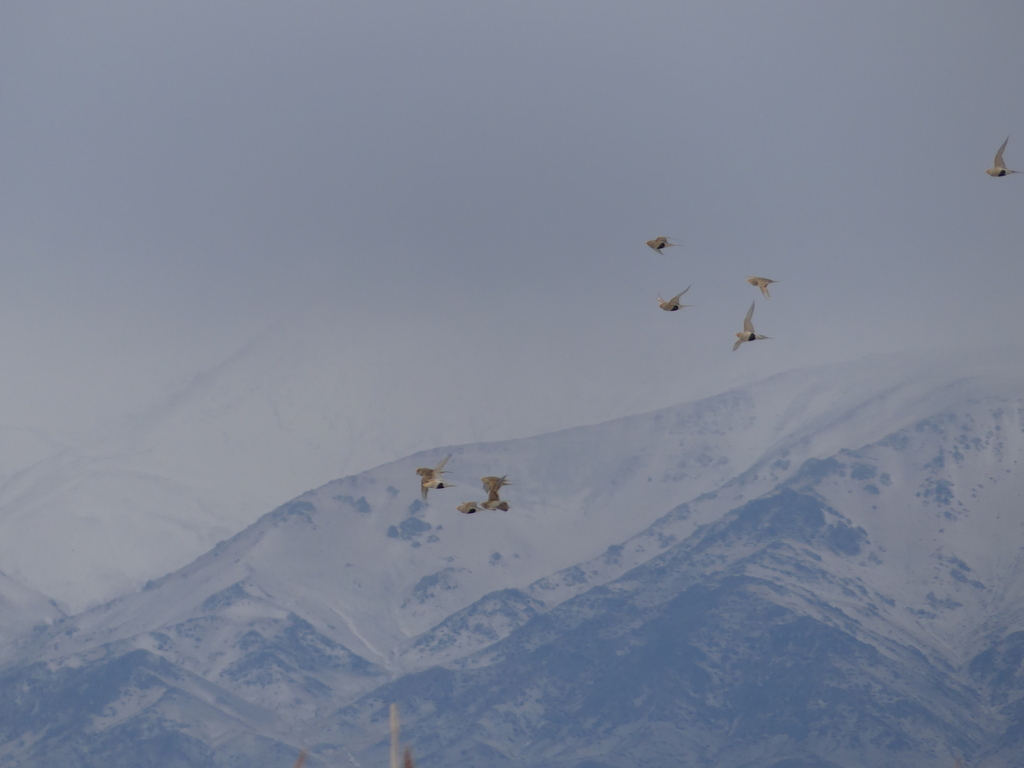
Pallas’s Sandgrouse
Photo © Anastasiia Samokhvalova
Photo © Anastasiia Samokhvalova — CC BY 4.0 — Source: iNaturalist #180538879Pallas's sandgrouse (Syrrhaptes paradoxus) is a medium to large bird in the sandgrouse family. == Naming == Marco Polo mentions a bird called Bargherlac (from Turkmen bağırlak) in The Travels of Marco Polo, published around 1300. This is probably Syrrhaptes paradoxus (S. pallasii). Pallas's sandgrouse is named after the German zoologist Peter Simon Pallas. The scientific name is from Ancient Greek. The genus Syrrhaptes is from surrhaptos, meaning "sewn together" (the feathered toes of both species in the genus are fused together) and paradoxus is from paradoxos, meaning "strange". == Description == Pallas's sandgrouse is 30–41 cm (12–16 in) long with small, pigeon-like head and neck, but sturdy compact body. It has long pointed wings and tail and legs and toes are feathered. Its plumage is buff-coloured, barred above with a black belly patch and pale underwings. The black belly and pale underwing distinguish this species from the related Tibetan sandgrouse. The male Pallas's sandgrouse is distinguished by its grey head and breast, orange face and grey breast band. The female has duller plumage and lacks the breast band though it has more barring on the upperparts. The small feet lack a hind toe, and the three front toes are…
Altai Tavan Bogd National Park
Gobi Gurvan Saikhan National Park
Hustai National Park
Khangai Nuruu National Park
Qinghai Lake National Nature Reserve
Nothing matches these filters.
No community photos yet. Log in to add the first one.
No community observations of this species yet.