Palm-nut Vulture
Photo © Jean-Paul Boerekamps
Photo © Jean-Paul Boerekamps — CC0 1.0 — Source: iNaturalist #72156436Identification
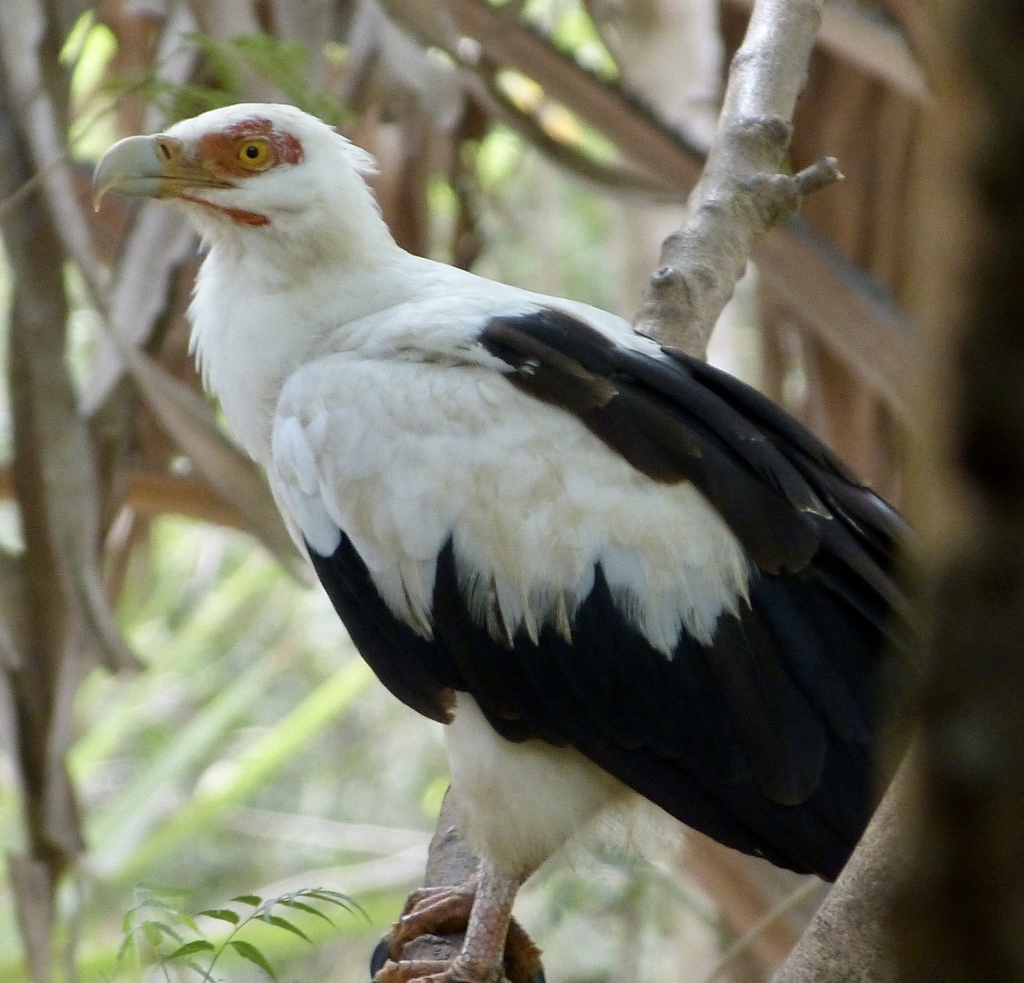
The palm-nut vulture is nearly unmistakable as an adult, making it one of the most distinctive raptors in Africa. At 60 cm in length with a wingspan of 1.50 m and weighing 1.3–1.7 kg, it is the smallest Old World vulture. Adults are predominantly white with black areas in the wings and tail, and a striking red patch around each eye. In flight, it resembles an eagle more than a typical vulture, with sustained flapping flight that does not depend on thermals. While it can be crudely confused with the African fish-eagle or Egyptian vulture, it clearly lacks the chestnut body of the former and the white tail of the latter.
Juveniles present a completely different appearance and take 3–4 years to reach full maturity. Young birds are predominantly brown with partially black wings and yellow eye-patches, making them look quite different from their parents. The sexes are identical in appearance, with females matching males in size.
Range & Habitat
Palm-nut vultures are found throughout most of the coastal areas of Africa from The Gambia to Kenya and as far south as South Africa, with an estimated total African population of 80,000 pairs. Their distribution closely tracks the presence of oil and Raffia palms, making them most common in coastal forests and mangrove swamps below 1,500 m, though they also occur in wet savannas. The bird can be quite approachable and is sometimes seen near human habitation, even on large hotel lawns in tourist areas such as The Gambia.
In southern Africa, resident breeding pairs are found only in South Africa and Mozambique, with approximately 40 birds in South Africa alone, concentrated at seven known nesting sites. The species' presence in some areas depends on the artificial cultivation of Raffia palms, underscoring the tight ecological relationship between this vulture and its palm food sources.
Behaviour & Diet
The palm-nut vulture is highly unusual among birds of prey in being primarily frugivorous. Fruits make up over 60% of the adult bird's diet and over 90% of the juvenile's diet, particularly the fleshy fruit-husks of oil palms and the palm-fruits of Raffia palms, along with wild dates, oranges, and other fruits, grains, and acacia seeds. Despite this specialization, the species is opportunistic and has been recorded feeding on crabs, molluscs, frogs, tadpoles, fish, insects, small mammals, birds, snakes, reptiles and their eggs, and occasionally domestic poultry and carrion.
Breeding pairs construct large stick nests high in tall trees, often at the base of palm fronds where Raphia palms are present, and exhibit strong attachment to nesting sites, sometimes staying year-round. At the beginning of breeding season, pairs perform acrobatic aerial displays of rolling and diving. Each breeding cycle produces a single white and brown egg, incubated by both sexes for four to six weeks, with chicks typically fledging around 85–90 days after hatching.
Best Time & Places to See It
The palm-nut vulture is widespread and fairly common throughout most of Africa, making it accessible to wildlife travellers across the continent. Tourist areas in The Gambia offer particularly reliable sightings, where birds can be seen near hotel lawns and other habitats close to human settlement. The species' affinity for coastal forests, mangrove swamps, and areas with oil and Raffia palms should guide your search, particularly in regions where these palms are cultivated or occur naturally.
The bird's dependence on specific palm species means searching near palm groves or cultivated palm plantations will increase your chances. Since this vulture does not depend on thermals for flight like typical vultures, it can be active throughout the day rather than only during afternoon thermal hours, providing more opportunities for observation and photography.
Photography Tips
The palm-nut vulture's striking adult plumage—white body with black wings and tail contrasting against the red eye-patches—creates excellent photographic opportunities. Its eagle-like flight silhouette differs from typical vultures, so capturing the bird in flight will help showcase its distinctive profile and wing pattern. The sustained flapping flight means you'll have more chances to photograph active birds rather than relying solely on soaring individuals.
When photographing juveniles, note their entirely different brown and yellow plumage; capturing both age classes would make a compelling portfolio. The bird's approachable nature in many areas, particularly near human habitation, may allow closer approach than with more wary raptors. Early morning activity and the bird's willingness to feed in open areas near palm groves offer good opportunities for clear shots with natural lighting.
Serengeti National Park
Tanzania
+558 birds+57 mammals
Across Tanzania's northern plateau, where volcanic soils meet acacia woodland and open grassland, unfolds one of Earth's most dynamic ecosystems. The Serengeti National Park sprawls across…
VIEW NATIONAL PARKArusha National Park
Tanzania
+555 birds+16 mammals
Where the slopes of Mount Mawenzi rise above the Arusha region, a compact yet ecologically rich national park unfolds across montane forest, moorland, and alpine zones.…
VIEW NATIONAL PARKRubondo Island National Park
Tanzania
+99 birds+8 mammals
Across the waters of Lake Victoria's northeastern arm, Rubondo Island rises as a freshwater wilderness where papyrus swamps grade into acacia woodlands and dense thickets of…
VIEW NATIONAL PARKVirunga National Park
Uganda
+418 birds+13 mammals
Where the Western Rift Valley fractures the landscape of North Kivu, Virunga National Park sprawls across terrain as geologically dramatic as it is ecologically vital. Volcanic…
VIEW NATIONAL PARKBwindi Impenetrable National Park
Kanyashogi, Uganda
+603 birds+26 mammals
Steep ridges cloaked in montane forest rise from Uganda's southwestern borderlands, where the landscape grows so dense and tangled that early explorers named it impenetrable. At…
VIEW NATIONAL PARKKidepo Valley National Park
Uganda
+478 birds+24 mammals
Where the Narus and Kidepo rivers carve through northeastern Uganda's semi-arid lowlands, a landscape of sparse acacia woodland, grassland, and riverine thickets creates one of East…
VIEW NATIONAL PARKMurchison Falls National Park
Uganda
+608 birds+33 mammals
Where the Victoria Nile compresses through a narrow gorge and explodes across a 45-meter precipice, the landscape speaks in thunder. Murchison Falls National Park sprawls across…
VIEW NATIONAL PARKMgahinga Gorilla National Park
Cyanika, Uganda
+429 birds+6 mammals
Where the Virunga Mountains rise steeply from the Uganda–Rwanda–Democratic Republic of Congo frontier, montane forest cloaks the volcanic slopes in a dense, moisture-laden embrace. Mgahinga Gorilla…
VIEW NATIONAL PARKLake Mburo National Park
Uganda
+505 birds+24 mammals
Rolling acacia woodland and scattered lakes define this intimate savanna preserve in southwestern Uganda, where the rift valley's geological drama shapes every water source and grassland.…
VIEW NATIONAL PARKTsavo East National Park
Athi ward, Kenya
+468 birds+50 mammals
Across the semi-arid lowlands of southeastern Kenya, where acacia woodland fragments into scrubland and the landscape rolls toward the Indian Ocean horizon, lies one of Africa's…
VIEW NATIONAL PARKTsavo West National Park
Mwatate, Kenya
+513 birds+49 mammals
Where volcanic ridges and weathered lava flows meet the semi-arid lowlands of south-central Kenya, Tsavo West National Park unfolds across a landscape sculpted by fire and…
VIEW NATIONAL PARKAmboseli National Park
Etonet/Lenkism ward, Kenya
+501 birds+43 mammals
Where the Amboseli basin opens toward the Tanzanian frontier, a shallow alkaline lake mirrors vast skies across one of East Africa's most iconic savanna landscapes. The…
VIEW NATIONAL PARKTarangire National Park
Tanzania
+527 birds+50 mammals
Acacia woodland and grassland sweep across the Manyara Region where the Tarangire River carves through low hills and volcanic soils, creating one of East Africa's most…
VIEW NATIONAL PARKNgorongoro Conservation Area
Tanzania
+626 birds+55 mammals
Volcanic calderas and open grassland dominate this high plateau in northern Tanzania, where the landscape rises above 2,000 metres and ancient geological forces have shaped both…
VIEW WILDLIFE MANAGEMENT AREAToro-Semliki Proposed National Park
Uganda
+474 birds+5 mammals
Where the Albertine Rift's western escarpment rises above the Semliki River valley, a vast mosaic of forest, savanna and wetland converges to create one of East…
VIEW NATIONAL PARKQueen Elizabeth National Park
Uganda
+672 birds+30 mammals
Across the southwestern escarpment of Uganda, where the Western Rift Valley descends through ancient volcanic terrain, Queen Elizabeth National Park sprawls across more than 8,300 square…
VIEW NATIONAL PARKMabamba Swamp
Memere, Uganda
+464 birds+2 mammals
Across the Central Region of Uganda spreads one of Africa's most biodiverse freshwater wetlands, a sprawling nature reserve of roughly 283 square kilometres where papyrus swamps…
VIEW NATURE RESERVEGarden Route National Park
George, South Africa
+353 birds+54 mammals
Sweeping across the Western Cape's coastal and mountainous terrain, this sprawling national park encompasses over five thousand square kilometers of extraordinarily diverse landscape—from coastal limestone cliffs…
VIEW NATIONAL PARKKruger National Park
Ba-Phalaborwa Local Municipality, South Africa
+540 birds+91 mammals
Across the low-lying savanna of northeastern South Africa unfolds one of Africa's largest and most ecologically intact protected areas, where acacia woodlands merge into mopane scrub…
VIEW NATIONAL PARKBontebok National Park
Swellendam Local Municipality, South Africa
+204 birds+11 mammals
Where the Cape Fold Mountains give way to coastal lowlands, a landscape of rolling sandstone hills and fynbos heathland creates one of South Africa's most compact…
VIEW NATIONAL PARKZiwa Rhino and Wildlife Ranch
Nakasongola, Uganda
+359 birds+11 mammals
Where papyrus wetlands merge into sprawling savanna, Uganda's central landscape opens into one of East Africa's most vital rhino recovery zones. Ziwa Rhino and Wildlife Ranch…
VIEW WILDLIFE SANCTUARYNairobi National Park
Nairobi, Kenya
+515 birds+35 mammals
Just minutes from Kenya's capital, where the Nairobi River winds through acacia woodland and open grassland, lies one of Africa's most paradoxical wildlife sanctuaries. The park's…
VIEW NATIONAL PARKLake Nakuru National Park
Nakuru West, Kenya
+494 birds+32 mammals
Alkaline waters ringed by acacia woodland and grassland create one of East Africa's most distinctive wetland ecosystems, where the interplay of geology and climate sustains a…
VIEW NATIONAL PARKMeru National Park
Igembe Central, Kenya
+408 birds+38 mammals
Granite outcrops and acacia woodland rise across the northern reaches of Meru, where semi-arid savanna transitions into drier scrubland under the fierce equatorial sun. The park's…
VIEW NATIONAL PARKSamburu National Reserve
Samburu, Kenya
+430 birds+42 mammals
Across the arid plains of northern Kenya, where scattered acacia woodland gives way to rocky outcrops and dry riverbeds, Samburu National Park unfolds as one of…
VIEW NATURE RESERVEArabuko Sokoke Forest Reserve
Kilifi, Kenya
+383 birds+29 mammals
Coastal forest rises from the Indian Ocean plains of Kilifi County, where sandy soils and seasonal rainfall have sculpted a woodland ecosystem unlike anywhere else on…
VIEW NATURE RESERVEWatamu Marine National Park
Dabaso ward, Kenya
+328 birds+12 mammals
Where mangrove channels meet coral gardens and sandy shallows blend into the warm waters of the Indian Ocean, Watamu Marine National Park unfolds across the Kilifi…
VIEW NATIONAL PARKNo community photos yet. Log in to add the first one.
No community observations of this species yet.