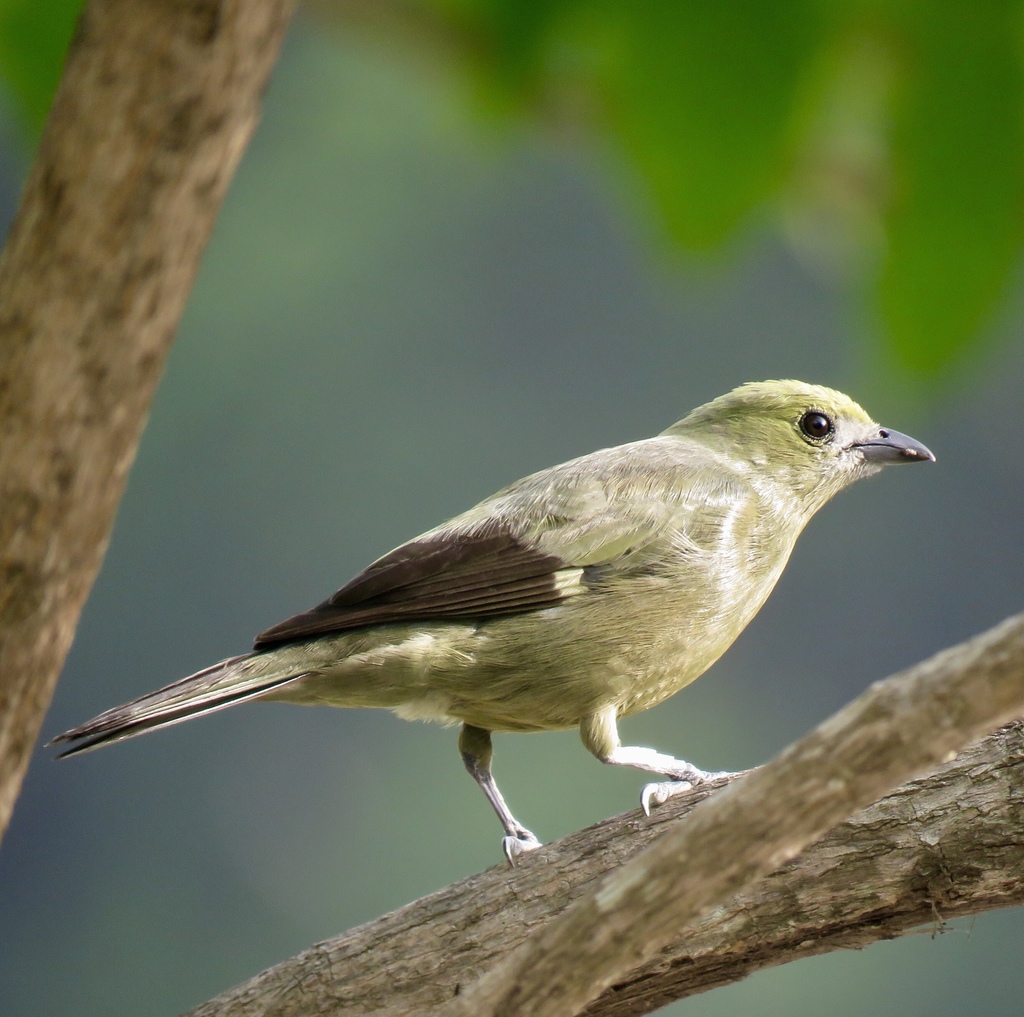
Palm Tanager
Photo © Aitor
Photo © Aitor — CC BY 4.0 — Source: iNaturalist photo #21981538Identification
The palm tanager is a medium-sized passerine, measuring 19 cm (7.5 inches) in length and weighing around 36 grams. Its plumage is distinctly understated: predominantly grey to dull olive-green throughout the body. The flight feathers are blackish, while the long tail is blackish with green edging—a detail that becomes particularly visible in flight. A striking yellow wingbar appears when the bird takes to the air, providing a useful field mark for identification. The sexes are similar in appearance, though females may be noticeably paler than males, a difference worth noting for discerning observers.
Range & Habitat
This species is a resident breeder distributed from Nicaragua southward through Central and South America to Bolivia, Paraguay, and southern Brazil. It also established populations on Trinidad, and has colonised Tobago since 1962, making it a relatively recent arrival to that island. The palm tanager favours semi-open areas, including cultivated lands and gardens, where it builds its characteristic bulky cup nest, typically placed in a tree—often a palm species, as its name suggests—or sometimes under the eaves of a house. Females lay three eggs, occasionally two, which are cream-coloured with brown blotches. The incubation period lasts 14 days, followed by a further 17 days until the young fledge.
Behaviour & Diet
Palm tanagers are highly social and restless birds, though notably unwary of humans, which makes them relatively approachable for observation and photography. They have an omnivorous diet centred on small fruits, supplemented by nectar, flower petals, and a variety of insects, including caterpillars. This dietary flexibility allows them to thrive in disturbed and cultivated habitats. Their presence is often announced by their distinctive fast, squeaky song, which carries well through semi-open vegetation.
Best Time & Places to See It
Given their broad range across Central and South America and their presence on Trinidad and Tobago, palm tanagers are accessible to travellers visiting tropical regions from Nicaragua southward. Their affinity for semi-open areas, gardens, and cultivated lands means they are often encountered near human settlements and agricultural areas, rather than requiring deep forest exploration. Their social nature and lack of wariness make them reliable subjects for wildlife observation.
Photography Tips
The yellow wingbar is the most striking field mark and is best captured when the bird is in flight. Position yourself in semi-open habitat or gardens where palm tanagers are active, and try to photograph them taking flight to showcase this diagnostic feature. Their restless behaviour means patience and a reasonable shutter speed will be necessary. The dull olive-green plumage can appear quite subtle in certain light conditions, so optimal lighting will help reveal the bird's understated beauty and subtle colour gradations between the body and darker flight feathers.
Amacayacu National Park
Amazônia National Park
Anavilhanas National Park
Antisana National Park
Arenal Volcano National Park
Bahuaja Sonene National Park
Barbilla National Park
Baru Volcano National Park
Brasília National Park
Nothing matches these filters.
No community photos yet. Log in to add the first one.
No community observations of this species yet.