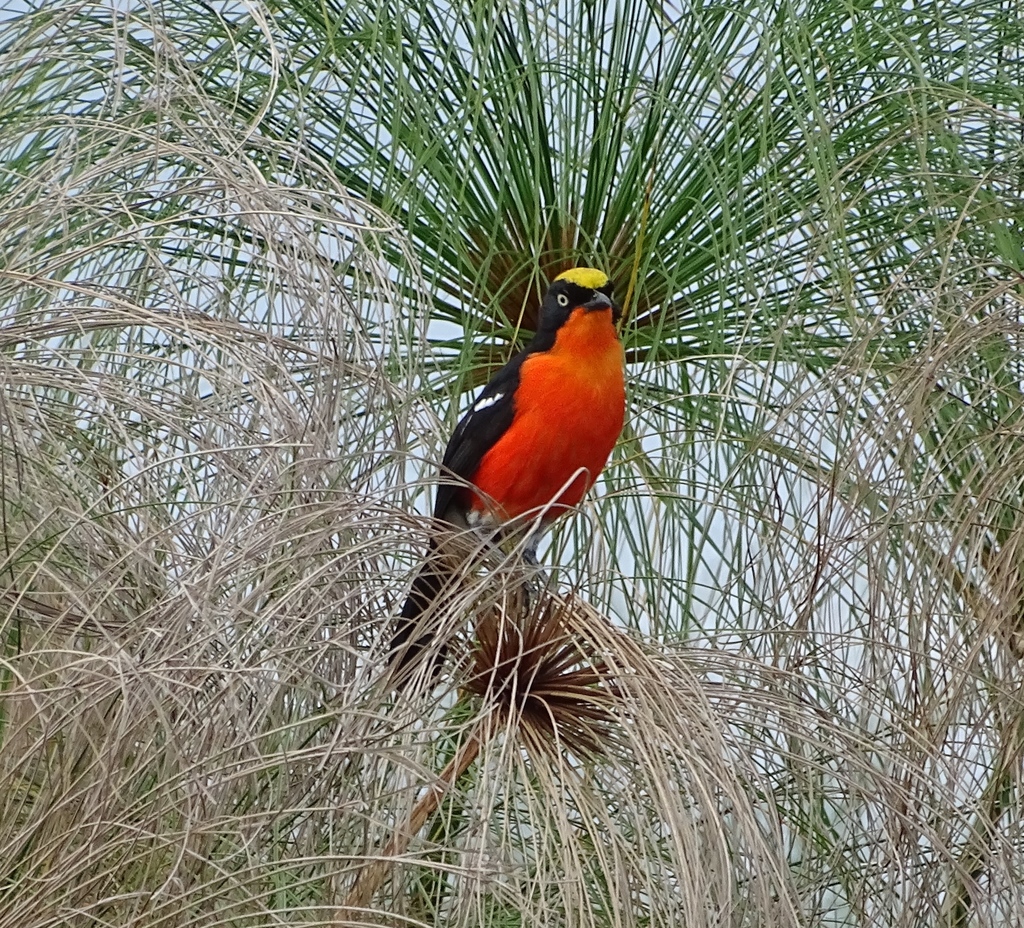
Papyrus Gonolek
Photo © Sandra Keller
Photo © Sandra Keller — CC BY 4.0 — Source: iNaturalist #26945646Identification
The papyrus gonolek is a medium-sized bushshrike measuring 18 cm (7 inches) in length. Both sexes are similar in appearance, making field identification straightforward. Look for a dull yellow crown contrasting with an otherwise black head, upper parts, wings and tail. A distinctive broad white bar crosses the wings. The most striking feature is the vivid orange-crimson breast and upper belly, which sharply contrasts with the whitish lower belly.
Range & Habitat
This species is found in East-Central Africa, with populations recorded in Burundi, the Democratic Republic of the Congo, Kenya, Rwanda, Tanzania, and Uganda. The papyrus gonolek is highly specialised, occurring exclusively in papyrus swamps associated with river systems and lake shores. This extreme habitat restriction makes it a bird for dedicated wetland explorers rather than general savanna visitors.
Behaviour & Diet
The papyrus gonolek is a secretive and difficult species to observe, and consequently remains poorly studied. It occurs singly or in pairs, spending most of its time lurking among dense papyrus vegetation and flying only occasionally—typically short distances over water between papyrus patches. Its presence is often detected by ear rather than eye; listen for brief whistles and distinctive grating, tearing sounds rendered as "U-tzeu-U-tzee," sometimes performed as duets by pairs. The diet consists primarily of insects including beetles, flies and ants, supplemented by snails, fruit and seeds when available.
Best Time & Places to See It
Finding this species requires patience and access to papyrus wetlands in appropriate regions. Birdwatchers should focus on extensive papyrus swamps in Uganda, Kenya, Tanzania, Rwanda and Burundi, particularly around major lake systems and river valleys. Early morning visits when birds are most vocal offer the best chance of detection, though even then sightings remain uncommon. The species is not currently threatened but has become rare in many areas due to wetland drainage, habitat burning and agricultural pollution.
Photography Tips
Photographing the papyrus gonolek presents significant challenges due to its secretive nature and dense habitat. A telephoto lens (at least 300–400mm) and patience are essential. Early morning light in papyrus environments can be dim and diffuse, requiring higher ISO settings and wide apertures. Focus on listening for calls and watching for brief flights between papyrus stands, as these fleeting moments offer the best photographic opportunities. Wear neutral colours to blend with wetland surroundings, move slowly and deliberately, and be prepared for long waits between sightings.
Virunga National Park
Uganda
+418 birds+13 mammals
Where the Western Rift Valley fractures the landscape of North Kivu, Virunga National Park sprawls across terrain as geologically dramatic as it is ecologically vital. Volcanic…
VIEW NATIONAL PARKBwindi Impenetrable National Park
Kanyashogi, Uganda
+603 birds+26 mammals
Steep ridges cloaked in montane forest rise from Uganda's southwestern borderlands, where the landscape grows so dense and tangled that early explorers named it impenetrable. At…
VIEW NATIONAL PARKMurchison Falls National Park
Uganda
+608 birds+33 mammals
Where the Victoria Nile compresses through a narrow gorge and explodes across a 45-meter precipice, the landscape speaks in thunder. Murchison Falls National Park sprawls across…
VIEW NATIONAL PARKMgahinga Gorilla National Park
Cyanika, Uganda
+429 birds+6 mammals
Where the Virunga Mountains rise steeply from the Uganda–Rwanda–Democratic Republic of Congo frontier, montane forest cloaks the volcanic slopes in a dense, moisture-laden embrace. Mgahinga Gorilla…
VIEW NATIONAL PARKLake Mburo National Park
Uganda
+505 birds+24 mammals
Rolling acacia woodland and scattered lakes define this intimate savanna preserve in southwestern Uganda, where the rift valley's geological drama shapes every water source and grassland.…
VIEW NATIONAL PARKToro-Semliki Proposed National Park
Uganda
+474 birds+5 mammals
Where the Albertine Rift's western escarpment rises above the Semliki River valley, a vast mosaic of forest, savanna and wetland converges to create one of East…
VIEW NATIONAL PARKQueen Elizabeth National Park
Uganda
+672 birds+30 mammals
Across the southwestern escarpment of Uganda, where the Western Rift Valley descends through ancient volcanic terrain, Queen Elizabeth National Park sprawls across more than 8,300 square…
VIEW NATIONAL PARKMabamba Swamp
Memere, Uganda
+464 birds+2 mammals
Across the Central Region of Uganda spreads one of Africa's most biodiverse freshwater wetlands, a sprawling nature reserve of roughly 283 square kilometres where papyrus swamps…
VIEW NATURE RESERVEZiwa Rhino and Wildlife Ranch
Nakasongola, Uganda
+359 birds+11 mammals
Where papyrus wetlands merge into sprawling savanna, Uganda's central landscape opens into one of East Africa's most vital rhino recovery zones. Ziwa Rhino and Wildlife Ranch…
VIEW WILDLIFE SANCTUARYNo community photos yet. Log in to add the first one.
No community observations of this species yet.