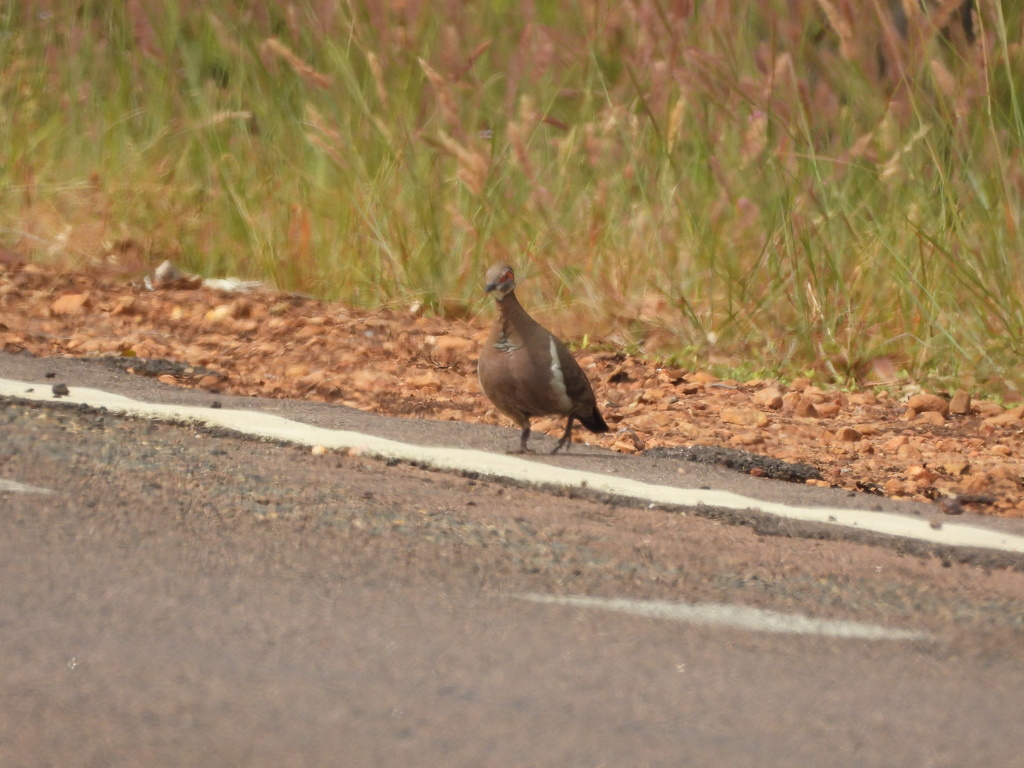
Partridge Pigeon
Photo © Mark Clarke
Photo © Mark Clarke — CC BY 4.0 — Source: iNaturalist #292509546The partridge pigeon (Geophaps smithii) is a species of bird in the family Columbidae. It is endemic to Australia. Its natural habitats are subtropical or tropical dry shrubland and subtropical or tropical dry lowland grassland. It is threatened by habitat loss. == Taxonomy and systematics == The partridge pigeon is one of three species in the genus Geophaps. Within the genus, the partridge pigeon is most closely related to the squatter pigeon, with these two species forming a clade that is sister to the spinifex pigeon. These three are most closely related to the crested pigeon. Alternative names for the partridge pigeon include bare-eyed bronzewing, bare-eyed partridge bronzewing, and bare-eyed partridge pigeon. === Subspecies === There are two subspecies, differing mainly in the colour of their orbital skin. The two subspecies are also sometimes treated as color morphs instead of races, making the species monotypic. G. s. smithii – Jardine and Selby, 1830: The nominate subspecies, it is found in extreme northeastern Western Australia and in north Northern Territory. G. s. blauwii – Mathews, 1912: It is found in northern Kimberley, in Western Australia.
Kakadu National Park
Kakadu, Australia
+273 birds+46 mammals
Kakadu National Park is Australia’s largest national park and one of the world’s most remarkable protected areas, covering nearly 20,000 square kilometres in the tropical north…
VIEW NATIONAL PARKLitchfield National Park
Australia
+175 birds+15 mammals
Where weathered sandstone plateaus rise above the savanna woodlands of Australia's Top End, Litchfield National Park unfolds as a landscape of dramatic contrasts shaped by a…
VIEW NATIONAL PARKNitmiluk National Park
Australia
+186 birds+27 mammals
Dramatic sandstone gorges carved by the Katherine River slice through the tropical savanna of Australia's Top End, creating a landscape where escarpments tower above crystalline pools…
VIEW NATIONAL PARKNo community photos yet. Log in to add the first one.
No community observations of this species yet.