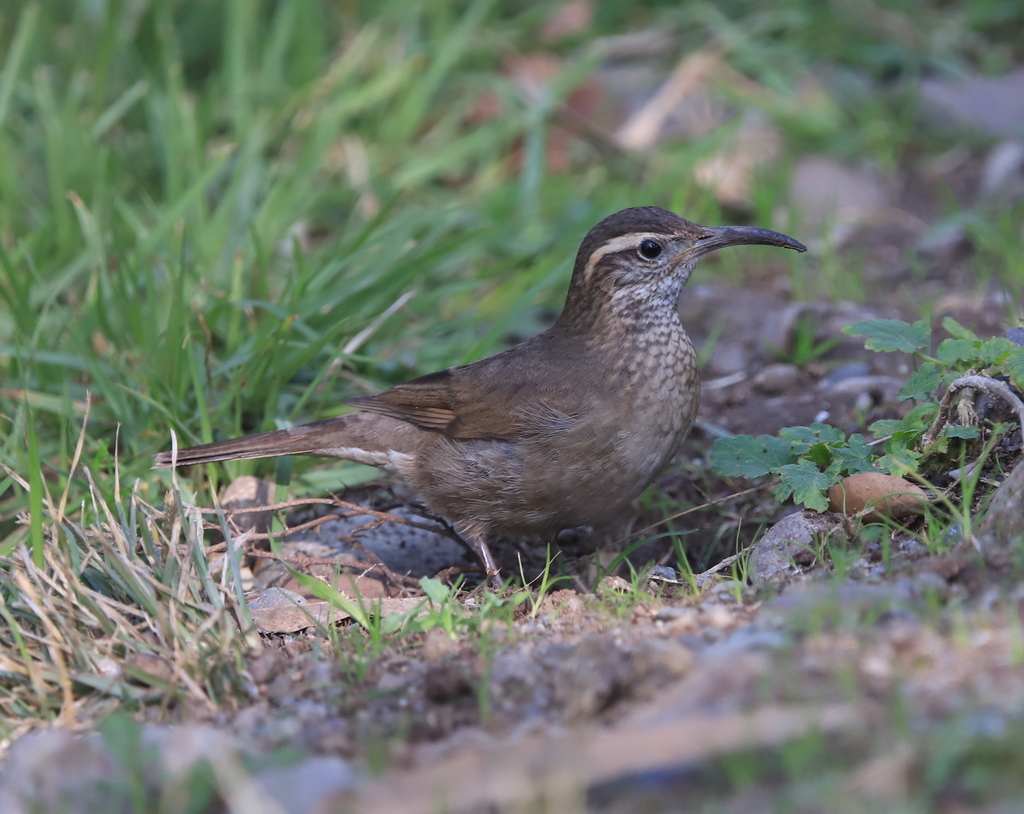
Patagonian Forest Earthcreeper
Photo © Steven Bodzin
Photo © Steven Bodzin — CC BY 4.0 — Source: iNaturalist photo #44639276Identification
The Patagonian forest earthcreeper is a large earthcreeper measuring 20 to 22 cm in length, characterized by a medium-length, moderately decurved bill. Both sexes share identical plumage. The bird's face is grayish-white and dark grayish-brown with a distinctive whitish supercilium, while the crown is dull dark grayish-brown with faint mottling. The nape, back, rump, and uppertail coverts are dark brownish-gray with an olive tinge. The tail's central feathers are dusky brown, contrasting with blackish-brown outer feathers, while the wings are grayish-brown with dull rufous bases on the flight feathers.
The underparts show subtle variation: the chin is whitish, the throat whitish with thin dark bars, the breast dark grayish with a scalloped brown appearance, the belly grayish, and the flanks grayish-brown. The undertail coverts are dull gray-brown. The iris is dark brown, the bill blackish, and the legs and feet dark brown. Juveniles are similar to adults but possess an even shorter bill, making them slightly easier to distinguish if age can be determined.
Range & Habitat
This species is found in central Chile between Concepción and Valdivia provinces, with scattered records as far north as Santiago, and in western Argentina between Neuquén and Chubut provinces. Evidence strongly suggests the bird breeds exclusively in Argentina during the austral summer, then crosses the Andes to winter in Chile's dry deciduous forests and matorral near the coast. The species occurs at elevations between 250 and 1,800 metres.
The Patagonian forest earthcreeper favours Nothofagus forest but inhabits other forest types as well, preferring forest edges including clearings with adjacent forest, typically near bodies of water. This habitat preference makes it relatively localized but predictable for those searching in appropriate locations.
Behaviour & Diet
The Patagonian forest earthcreeper is a ground forager, typically searching alone or in loose pairs, usually near tall trees, around bushes, or in boggy ground at the forest's edge. It vigorously probes the earth for prey and sometimes turns over chunks of soil or stones in its search. Between feeding bouts, it often perches in trees and occasionally takes prey from the ground up to a perch. Its diet, though not formally described, is presumed to consist of larval and adult arthropods.
The species sometimes sings from high perches, producing a distinctive song of "1–2 sharp, short and lower-pitched initial notes followed by either a syncopated or a continuously delivered series of triplets," rendered as 'p-p-tirik-tirik-tirik-tirik-tirik-tiruk'. Its contact call is a hollow 'pep' given singly or in series, which may help locate birds in forested terrain where visual contact is difficult.
Best Time & Places to See It
The best season for observing this species depends on location. In Argentina, search during the austral summer breeding season when birds are most active and vocal. In Chile, winter months offer the greatest opportunity, as the species moves there to spend the non-breeding season. The bird is generally considered reasonably numerous throughout its range and occurs in several protected areas, making these reserves logical starting points for searches.
Look for the species at forest edges, particularly near bodies of water, in and around Nothofagus forests, and in areas with clearings adjoining forest. Boggy ground at the forest margin is particularly productive. Early morning hours when birds are most vocal and active will maximize your chances of encounter.
Photography Tips
Photographing this ground-foraging species requires patience and careful positioning. Since the Patagonian forest earthcreeper typically forages on or near the ground around bushes and boggy areas, a low camera angle will often be necessary to capture natural behaviour. The bird's subtle plumage—primarily grayish-brown tones with fine details like throat barring and breast scalloping—requires good light and sufficient resolution to render these delicate markings clearly.
When the bird perches in trees between feeding bouts, use these moments to capture portraits showing field marks like the whitish supercilium and facial pattern. The species' habit of sometimes singing from high perches provides additional photographic opportunities. Approach slowly and cautiously to avoid flushing birds back into dense cover, and remember that early morning light will best reveal the subtle coloration and markings that distinguish this attractive earthcreeper.
Laja National Park Lagoon
Antuco, Chile
+123 birds+1 mammals
Where the Andes descend into the Biobío Region's temperate forests, a vast lagoon fills the caldera of the extinct Antuco volcano, cradled by steep native woodland…
VIEW NATIONAL PARKPuyehue National Park
Puyehue, Chile
+110 birds+4 mammals
Across the volcanic spine of the Los Lagos Region, where the Andes descend toward temperate rainforest, Puyehue National Park encompasses nearly 2,600 square kilometers of one…
VIEW NATIONAL PARKPatagonia National Park
Cochrane, Chile
+133 birds+8 mammals
Where the Andes meet the Patagonian steppe, vast grasslands and shrublands sweep across rolling terrain carved by ancient glaciation, their contours softened by distance and dramatic…
VIEW NATIONAL PARKParque Municipal Llao Llao
San Carlos de Bariloche, Argentina
+73 birds+1 mammals
Where the Andes meet the Patagonian lakes, granite peaks rise above temperate rainforest in a landscape of startling contrasts. Parque Municipal Llao Llao, sprawling across 23…
VIEW NATIONAL PARKNahuel Huapi National Park
Argentina
+124 birds+11 mammals
Where the Andes descend toward Patagonia, vast glacial lakes cut through a landscape of southern beech forest and granite peaks, creating one of South America's most…
VIEW NATIONAL PARKLanín National Park
Argentina
+128 birds+7 mammals
Where the volcanic spine of the Andes plunges into Patagonian steppe, Lanín National Park sprawls across nearly 4,700 square kilometers of one of Argentina's most visually…
VIEW NATIONAL PARKLago Puelo National Park
Argentina
+109 birds+1 mammals
Where temperate forests descend to crystalline waters in the foothills of the Andes, Lago Puelo National Park sprawls across nearly 300 square kilometers of pristine wilderness…
VIEW NATIONAL PARKLos Alerces National Park
Argentina
+84 birds+3 mammals
Where the temperate rainforests of southern Patagonia sweep down towards crystalline lakes, Los Alerces National Park unfolds across nearly 3,000 square kilometres of one of South…
VIEW NATIONAL PARKNo community photos yet. Log in to add the first one.
No community observations of this species yet.