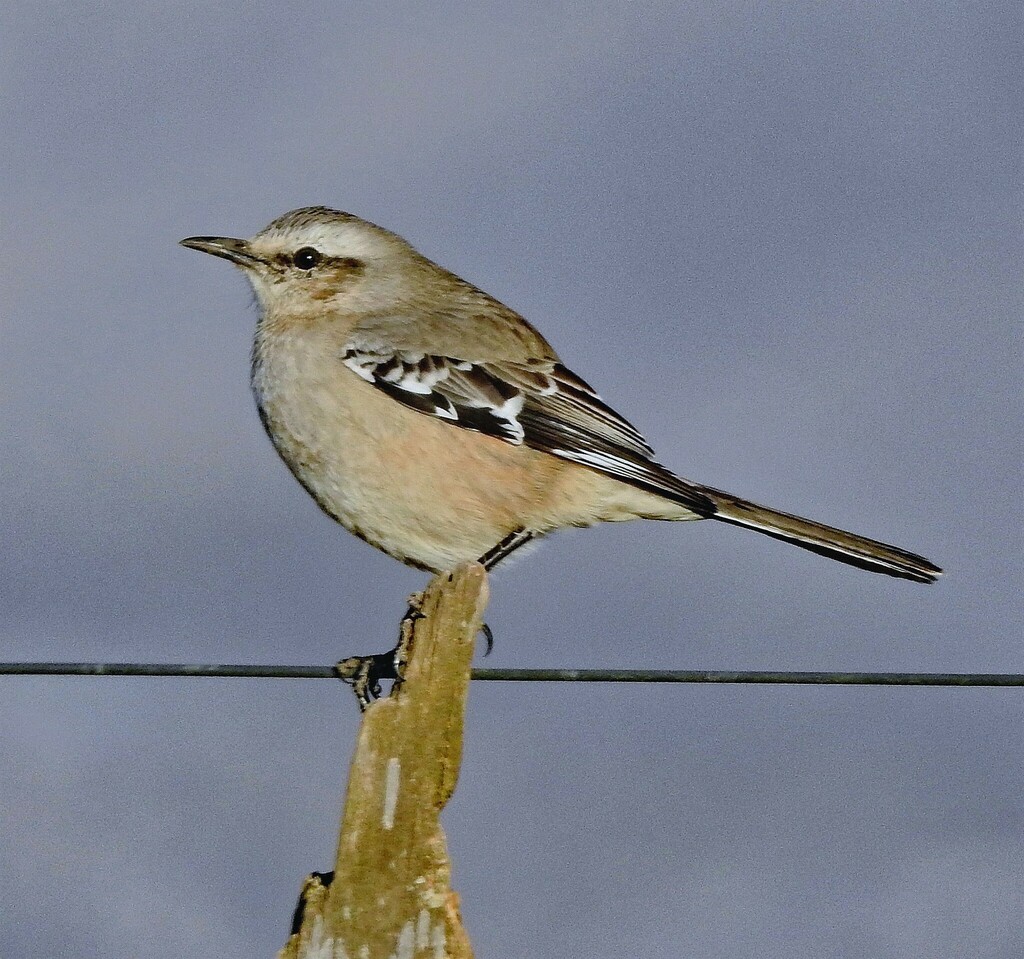
Patagonian Mockingbird
Photo © Hugo Hulsberg
Photo © Hugo Hulsberg — CC0 1.0 — Source: iNaturalist #128993009Identification
The Patagonian Mockingbird is a medium-sized songbird measuring 22 to 25 cm in length, with males weighing 44.4 to 61.8 g and females 43.8 to 65.4 g. Adults are characterized by a brown crown, a whitish supercilium (eyebrow stripe), and a distinctive blackish line running through the eye. The upperparts are plain grayish brown, becoming paler toward the rump, while the blackish wings display two thin pale bars when folded. The tail is primarily blackish with white outer edges on the outermost feathers and white tips on the others. Below, the bird is buffy gray, paler on the throat and belly. Juveniles are similar to adults but feature blackish spots on the breast.
Range & Habitat
The Patagonian Mockingbird is a year-round resident of northwestern and central Argentina, breeding in southern Argentina and southern Chile as far south as the Strait of Magellan. During the non-breeding season, it migrates northward to central and somewhat into northeastern Argentina. It is a casual visitor to Tierra del Fuego and has been recorded occasionally in the Falkland Islands. The species generally inhabits open shrublands and bushlands, particularly the Patagonian steppe, and in southeastern Argentina can also be found in somewhat open woodland. Its elevation range extends from sea level to 1,800 m.
Behaviour & Diet
The Patagonian Mockingbird is primarily a ground feeder with a diet that shifts seasonally. During the breeding season, insects form its primary diet, while fruits and berries become important additions during the non-breeding season. The species is monogamous and appears to be territorial, with family groups remaining together outside the breeding season. Breeding occurs in January in northern Argentina and between October and December in Chile. Nests are open cups constructed from twigs and lined with softer materials, positioned low in vegetation, typically containing clutches of three to six eggs.
Best Time & Places to See It
The Patagonian Mockingbird is fairly common throughout much of Argentina, making it a reliable sighting in appropriate habitat, though it is less common in Chile. The species' migratory pattern means that timing and location go hand in hand: observe it in southern Argentina and Chile during the breeding season (October to December in Chile, January in northern Argentina), then follow its northward migration to central Argentina during the non-breeding season. Open shrubland and steppe habitats offer the best opportunities for encounters.
Photography Tips
The bird's preference for singing from open perches or exposed positions within vegetation makes it relatively approachable for photographers. Its continuous vocalizations and mimicry behavior mean that patience will likely be rewarded with sightings. The distinctive facial markings—the supercilium and eye-line—and tail pattern with white tips are key features to capture. Early morning when the bird is actively singing from prominent perches offers the best lighting and behavioral opportunities for photography.
Torres del Paine National Park
Torres del Paine, Chile
+143 birds+10 mammals
Where granite spires pierce the Patagonian sky, Torres del Paine commands one of South America's most dramatic landscapes. Across 4,106 square kilometres of southern Chile, jagged…
VIEW NATIONAL PARKCerro Castillo National Park
Coyhaique, Chile
+89 birds+3 mammals
Granite peaks and windswept steppe converge across this vast Patagonian landscape, where the Andes' eastern flank drops into terrain sculpted by ice age glaciers and relentless…
VIEW NATIONAL PARKPatagonia National Park
Cochrane, Chile
+133 birds+8 mammals
Where the Andes meet the Patagonian steppe, vast grasslands and shrublands sweep across rolling terrain carved by ancient glaciation, their contours softened by distance and dramatic…
VIEW NATIONAL PARKReserva Nacional Magallanes
Punta Arenas, Chile
+78 birds+2 mammals
Where windswept steppe meets sub-Antarctic forest near the southern tip of continental South America, Reserva Nacional Magallanes unfolds across roughly 352 square kilometres of profound ecological…
VIEW NATIONAL PARKParque Provincial Península de Magallanes
Argentina
+125 birds+4 mammals
Granite peaks and windswept steppe converge across this 415-square-kilometre peninsula jutting into the cold Atlantic waters of southern Patagonia, where the Magallanes landscape embodies the raw,…
VIEW NATIONAL PARKParque Municipal Llao Llao
San Carlos de Bariloche, Argentina
+73 birds+1 mammals
Where the Andes meet the Patagonian lakes, granite peaks rise above temperate rainforest in a landscape of startling contrasts. Parque Municipal Llao Llao, sprawling across 23…
VIEW NATIONAL PARKMonte León National Park
Argentina
+100 birds+4 mammals
Where the Patagonian steppe meets the Atlantic, Monte León National Park protects a landscape of windswept coastal cliffs, rocky outcrops, and semi-arid grassland spanning over 1,200…
VIEW NATIONAL PARKLos Glaciares National Park
Argentina
+121 birds+3 mammals
Where granite peaks and sprawling ice fields dominate the landscape, Los Glaciares National Park encompasses over ten thousand square kilometres of Patagonian wilderness in southern Argentina.…
VIEW NATIONAL PARKLos Cardones National Park
Argentina
+193 birds+6 mammals
Where the Andes descend into northwestern Argentina, Los Cardones National Park sprawls across nearly 1,200 square kilometres of one of South America's most distinctive high-altitude desert…
VIEW NATIONAL PARKNahuel Huapi National Park
Argentina
+124 birds+11 mammals
Where the Andes descend toward Patagonia, vast glacial lakes cut through a landscape of southern beech forest and granite peaks, creating one of South America's most…
VIEW NATIONAL PARKLanín National Park
Argentina
+128 birds+7 mammals
Where the volcanic spine of the Andes plunges into Patagonian steppe, Lanín National Park sprawls across nearly 4,700 square kilometers of one of Argentina's most visually…
VIEW NATIONAL PARKSierra de las Quijadas National Park
Argentina
+168 birds+5 mammals
Sandstone cliffs and deeply incised canyons define this 1,137-square-kilometre expanse in San Luis Province, where the dry Chacoan landscape of central Argentina reveals an unexpected ecological…
VIEW NATIONAL PARKLago Puelo National Park
Argentina
+109 birds+1 mammals
Where temperate forests descend to crystalline waters in the foothills of the Andes, Lago Puelo National Park sprawls across nearly 300 square kilometers of pristine wilderness…
VIEW NATIONAL PARKNo community photos yet. Log in to add the first one.
No community observations of this species yet.