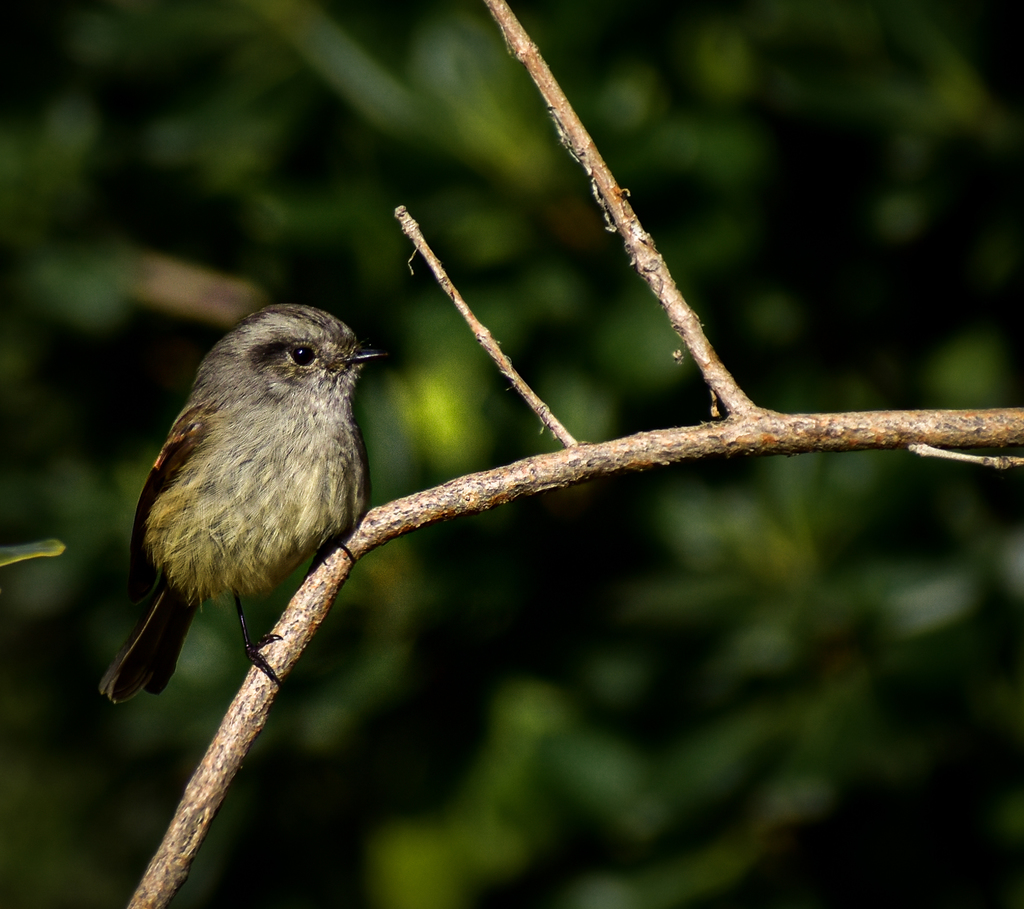
Patagonian Tyrant
Photo © Nicolás Villaseca Merino
Photo © Nicolás Villaseca Merino — CC BY-SA 4.0 — Source: iNaturalist #77311386Identification
The Peutrén is a small tyrant flycatcher, measuring just 12–13 cm in length. It is a compact bird with a mostly gray head, darker brownish-gray crown, and a distinctive blackish streak behind the eye. The upperparts are olive-brown, while the wings are blackish-brown with striking cinnamon-colored edges on the wing coverts that form two visible wing bars. The tail is blackish-brown. Below, the throat and underparts are grayish with a yellowish wash on the belly, flanks, and undertail coverts. The bird has a black iris, black bill, and black legs. Females sometimes show a darker throat than males. Juveniles differ slightly, with a crown matching the rest of the head, some rufous in the upperparts, and darker underparts with a stronger yellowish wash.
Range & Habitat
This species is endemic to the southern Andes, ranging from north-central Chile's Coquimbo Region and southern Argentina's Neuquén and Río Negro provinces south to Tierra del Fuego. During the breeding season, it almost exclusively inhabits Nothofagus (southern beech) forests. In the non-breeding season, it becomes more flexible, moving into diverse forest types, urban areas, parks, and gardens. Elevation ranges from sea level to 1,800 m during breeding, reaching 2,000 m or occasionally higher at other times.
Behaviour & Diet
The Peutrén is a nearly complete migrant, vacating most of its breeding range for the austral winter. It feeds primarily on insects and other arthropods, supplemented with small fruits such as maytén and leñadura. This flycatcher typically forages singly or in pairs, often joining mixed-species feeding flocks. It captures most prey through aerial sallies from a perch, though it also gleans food from vegetation and the ground. The breeding season spans at least October to February, with cup-shaped nests constructed from straw, dried grass, and plant fibers, often placed in Chusquea bamboo in the understory about 3 m above ground. Clutches contain two to three whitish or cream eggs spotted with red or reddish-brown markings. Both parents feed the nestlings.
Best Time & Places to See It
The Peutrén is uncommon in its breeding range and extremely rare in southern Tierra del Fuego. During winter, it becomes rare in the central and southern portions of its non-breeding range but somewhat more common in its smaller northern winter-only range from southern Los Lagos Region in Chile northward to the Coquimbo Region. Target the austral spring and summer (October to February) in Nothofagus forests of the breeding range, or search in winter in the northern non-breeding range where the species is more accessible. Urban gardens and parks in central Chile may occasionally host wintering birds.
Photography Tips
The Peutrén's small size and preference for dense forest understory present significant challenges for photographers. Focus on its distinctive field marks: the cinnamon wing bars, blackish eye-streak, and olive-brown upperparts are most visible when the bird perches openly. Early morning and late afternoon often provide the best light in forest habitats. Patience is essential—watch for the bird's characteristic feeding behavior of sallying from exposed perches. The bird's frequent vocalizations (a long, descending whistle repeated every few seconds) can help locate individuals in dense vegetation. A telephoto lens of at least 400–500 mm will be necessary to frame this tiny bird adequately from typical viewing distances in forest.
Chiloé National Park
Dalcahue, Chile
+122 birds+6 mammals
Temperate rainforest cloaks the Chiloé archipelago's northwestern reaches, where granite ridges thrust through dense, moisture-laden canopy and freshwater streams carve ravines toward the Pacific. Across approximately…
VIEW NATIONAL PARKAlerce Costero National Park
Corral, Chile
+34 birds
Where temperate rainforest descends to the Pacific coast in southern Chile, Alerce Costero National Park protects one of the continent's rarest and most ancient ecosystems across…
VIEW NATIONAL PARKTorres del Paine National Park
Torres del Paine, Chile
+143 birds+10 mammals
Where granite spires pierce the Patagonian sky, Torres del Paine commands one of South America's most dramatic landscapes. Across 4,106 square kilometres of southern Chile, jagged…
VIEW NATIONAL PARKLaja National Park Lagoon
Antuco, Chile
+123 birds+1 mammals
Where the Andes descend into the Biobío Region's temperate forests, a vast lagoon fills the caldera of the extinct Antuco volcano, cradled by steep native woodland…
VIEW NATIONAL PARKPuyehue National Park
Puyehue, Chile
+110 birds+4 mammals
Across the volcanic spine of the Los Lagos Region, where the Andes descend toward temperate rainforest, Puyehue National Park encompasses nearly 2,600 square kilometers of one…
VIEW NATIONAL PARKVicente Pérez Rosales National Park
Puerto Varas, Chile
+109 birds+8 mammals
Where the Andes descend toward the temperate rainforests of Chile's Lake District, nearly 4,641 square kilometers of pristine wilderness unfolds across Vicente Pérez Rosales National Park.…
VIEW NATIONAL PARKCerro Castillo National Park
Coyhaique, Chile
+89 birds+3 mammals
Granite peaks and windswept steppe converge across this vast Patagonian landscape, where the Andes' eastern flank drops into terrain sculpted by ice age glaciers and relentless…
VIEW NATIONAL PARKPatagonia National Park
Cochrane, Chile
+133 birds+8 mammals
Where the Andes meet the Patagonian steppe, vast grasslands and shrublands sweep across rolling terrain carved by ancient glaciation, their contours softened by distance and dramatic…
VIEW NATIONAL PARKReserva Nacional Magallanes
Punta Arenas, Chile
+78 birds+2 mammals
Where windswept steppe meets sub-Antarctic forest near the southern tip of continental South America, Reserva Nacional Magallanes unfolds across roughly 352 square kilometres of profound ecological…
VIEW NATIONAL PARKParque Provincial Península de Magallanes
Argentina
+125 birds+4 mammals
Granite peaks and windswept steppe converge across this 415-square-kilometre peninsula jutting into the cold Atlantic waters of southern Patagonia, where the Magallanes landscape embodies the raw,…
VIEW NATIONAL PARKParque Municipal Llao Llao
San Carlos de Bariloche, Argentina
+73 birds+1 mammals
Where the Andes meet the Patagonian lakes, granite peaks rise above temperate rainforest in a landscape of startling contrasts. Parque Municipal Llao Llao, sprawling across 23…
VIEW NATIONAL PARKLos Glaciares National Park
Argentina
+121 birds+3 mammals
Where granite peaks and sprawling ice fields dominate the landscape, Los Glaciares National Park encompasses over ten thousand square kilometres of Patagonian wilderness in southern Argentina.…
VIEW NATIONAL PARKNahuel Huapi National Park
Argentina
+124 birds+11 mammals
Where the Andes descend toward Patagonia, vast glacial lakes cut through a landscape of southern beech forest and granite peaks, creating one of South America's most…
VIEW NATIONAL PARKLanín National Park
Argentina
+128 birds+7 mammals
Where the volcanic spine of the Andes plunges into Patagonian steppe, Lanín National Park sprawls across nearly 4,700 square kilometers of one of Argentina's most visually…
VIEW NATIONAL PARKLago Puelo National Park
Argentina
+109 birds+1 mammals
Where temperate forests descend to crystalline waters in the foothills of the Andes, Lago Puelo National Park sprawls across nearly 300 square kilometers of pristine wilderness…
VIEW NATIONAL PARKLos Alerces National Park
Argentina
+84 birds+3 mammals
Where the temperate rainforests of southern Patagonia sweep down towards crystalline lakes, Los Alerces National Park unfolds across nearly 3,000 square kilometres of one of South…
VIEW NATIONAL PARKNo community photos yet. Log in to add the first one.
No community observations of this species yet.