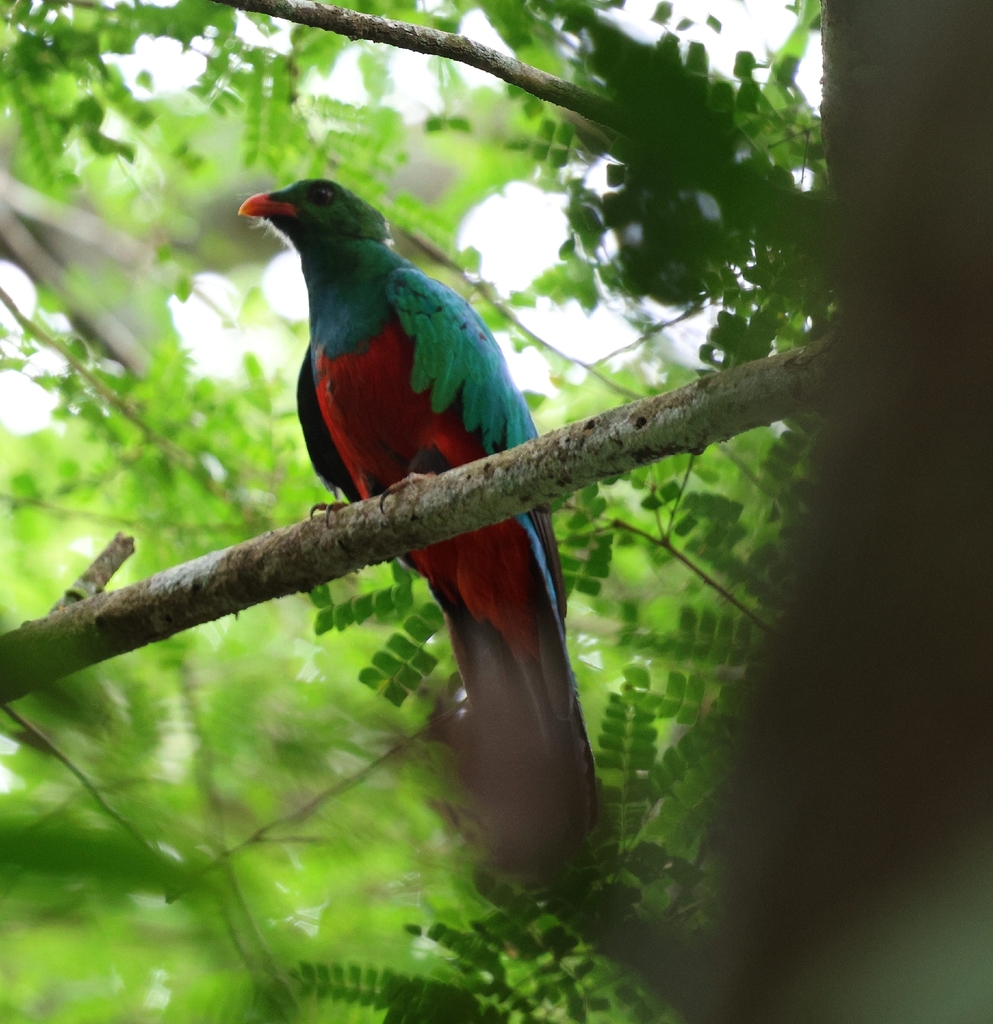
Pavonine Quetzal
Photo © Miguel
Photo © Miguel — CC BY-SA 4.0 — Source: iNaturalist #330159947The pavonine quetzal (Pharomachrus pavoninus) is a species of bird in the family Trogonidae, the trogons. It is also known at the peacock trogon, red-billed train bearer, or viuda pico rojo in Spanish. The pavonine quetzal lives in the Neotropics, more specifically in the northern region of the Amazon basin, spreading from Colombia to Bolivia. The most notable characteristics helpful in identifying this bird are its plumage, red beak (male; females have grey bills), and its distribution - it is the only quetzal occupying the lowland rainforest east of the Andes. == Taxonomy == The pavonine quetzal belongs to the Trogon family (Trogonidae) that falls in Trogoniformes, which differ from other birds primarily by the unique toe arrangement. As opposed to woodpeckers (family Picidae) who have the first and fourth toe facing backwards, trogons have the first and second toe positioned posteriorly, while the third and fourth remain anterior to the foot. Their toe arrangement makes them poorly suited for walking or hopping, and so trogons are most commonly seen flying or perched below canopy level. Some species, like the endangered resplendent quetzal have evolved some elaborate ornamental feathers, exemplifying how most of the species in this family have feathers…
Mapinguari National Park
Brazil
+354 birds
Vast tracts of western Amazonian rainforest blanket the remote terrain of this 56,827 square kilometre national park in Amazonas state, where seasonal rivers wind through dense…
VIEW NATIONAL PARKJaú National Park
Brazil
+354 birds+3 mammals
Vast floodplain forests and blackwater rivers define this remote corner of western Amazonas, where the Rio Negro and its tributaries have carved an intricate mosaic of…
VIEW NATIONAL PARKAnavilhanas National Park
Brazil
+468 birds+8 mammals
Across the Rio Negro in central Amazonas, an archipelago of over a thousand islands rises from the world's largest rainforest river system, creating a labyrinth of…
VIEW NATIONAL PARKCampos Amazónicos National Park
Amazonas, Brazil
+434 birds+7 mammals
Sprawling across the southwestern Amazon basin in Amazonas state, this 27,263-square-kilometre national park encompasses some of the region's most pristine lowland rainforest, where terra firme forest…
VIEW NATIONAL PARKSerra do Divisor National Park
Brazil
+448 birds+10 mammals
Where the western Amazon meets the Andes foothills, Serra do Divisor National Park sprawls across one of South America's most biodiverse and least accessible frontiers. Spanning…
VIEW NATIONAL PARKManu National Park
Manu, Peru
+892 birds+26 mammals
Across the eastern slopes of the Peruvian Andes, tropical rainforest descends into the Amazon basin with a complexity that few terrestrial ecosystems match. Manu National Park…
VIEW NATIONAL PARKSierra del Divisor National Park
Alto Tapiche, Peru
+298 birds+2 mammals
Where the western Amazon meets the Andes foothills, nearly 41,000 square kilometres of pristine rainforest rise across Peru's Alto Tapiche region in a landscape of extraordinary…
VIEW NATIONAL PARKBahuaja Sonene National Park
San Pedro de Putina Punco, Peru
+602 birds+8 mammals
Where the Madre de Dios and Heath rivers converge in southeastern Peru rises one of South America's most biodiverse wilderness regions: a vast protected realm of…
VIEW NATIONAL PARKCordillera Azul National Park
Pampa Hermosa, Peru
+322 birds+1 mammals
Where the eastern Andes descend into the western Amazon basin, Cordillera Azul National Park sprawls across nearly 38,000 square kilometres of some of Peru's most pristine…
VIEW NATIONAL PARKNo community photos yet. Log in to add the first one.
No community observations of this species yet.