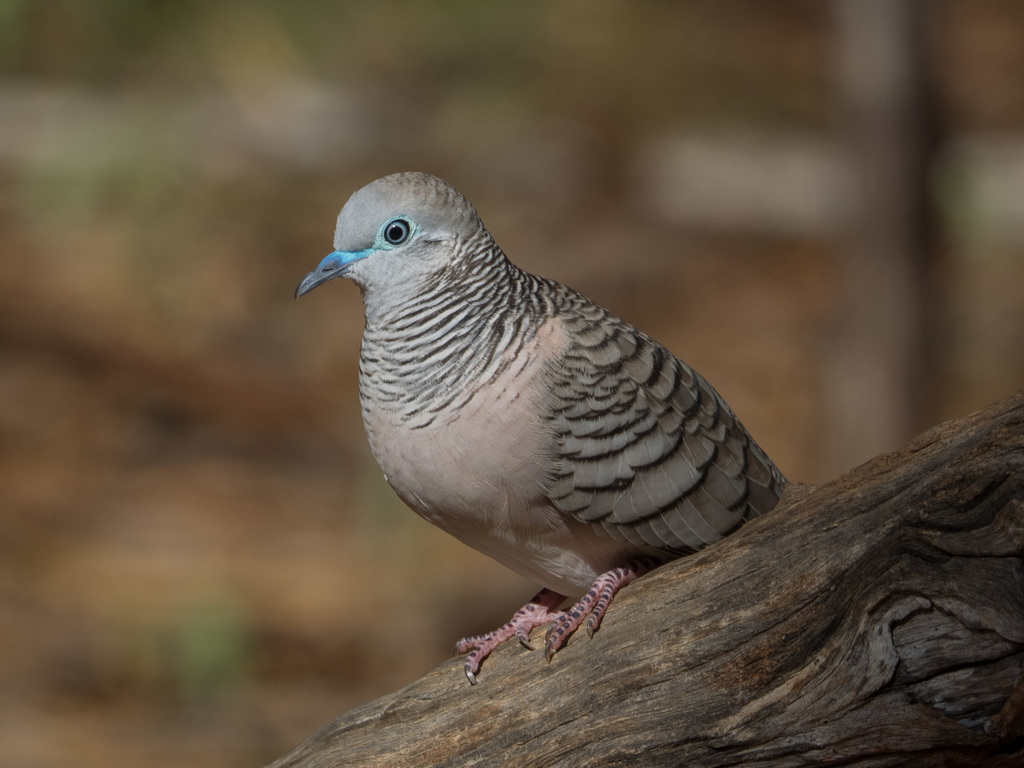
Peaceful Dove
Photo © Kerri-Lee Harris
Photo © Kerri-Lee Harris — CC BY 4.0 — Source: iNaturalist photo #113656869Identification
The Peaceful Dove is a relatively small pigeon, measuring 19 to 21 centimetres in length. It is distinguished by its pink-grey breast and chequered grey-brown wings. Thin black striations appear around the neck and nape, extending down the back. The eye is greyish-white with a blue-grey ring that tapers toward the beak and cere. Juveniles are paler with less prominent striations and a duller eye ring. The species can be told from the similar bar-shouldered dove by its striated throat feathers and grey-brown (rather than copper-coloured) nape.
The Peaceful Dove produces distinctive high-pitched calls including "doodle-doo", "co-co-coo", and "croorrr!". In flight, the wings create a characteristic flushing "frrr" sound as the bird moves in a rapid, undulating pattern.
Range & Habitat
Native to Australia and New Guinea, the Peaceful Dove is found across most of Australia except Tasmania, southern Victoria, and south-western Australia. In Papua, it is mainly distributed in the south, with populations at several northern sites and on the Aru Islands. Unfortunately, the species' range has been contracting due to competition with the introduced Spotted Turtle Dove.
This adaptable dove frequents a variety of habitats including streets, gardens, scrublands, woodlands, watercourses, railyards, and rainforest edges. Birds are commonly seen feeding on the ground and roosting in trees when not foraging.
Behaviour & Diet
The Peaceful Dove is sociable, occurring in pairs, groups, and flocks. It feeds on the ground and has adapted well to human-modified landscapes. The species is highly aggressive toward other birds during the breeding season, despite its gentle name.
Breeding in southern Australia runs from October to January, while northern populations breed from March to June. Nests are constructed on horizontal tree branches, and pairs lay two white eggs per clutch.
Best Time & Places to See It
The Peaceful Dove is most active during breeding season: October to January in southern Australia and March to June in the north. Look for them in gardens, parks, and scrubby areas where they forage on the ground or roost in trees. Early morning and late afternoon are ideal times for observation.
Urban and suburban gardens throughout mainland Australia (except the southern and south-western regions) offer reliable viewing opportunities. Watercourse vegetation and woodland edges are also good locations, particularly during breeding periods when birds are most visible and vocal.
Photography Tips
The small size and ground-feeding behaviour of the Peaceful Dove make it an accessible subject for photographers. Early morning light emphasises the delicate pink-grey breast and chequered wing pattern. Use a telephoto lens to avoid disturbing feeding birds, and be prepared for rapid, undulating flight when they flush.
Capture the distinctive blue-grey eye ring and black neck striations in close-up shots. Recording the bird's characteristic calls can complement visual documentation. During breeding season, patient observation near nesting trees may yield opportunities to photograph adults defending territory or attending to chicks.
Annan River (Yuku Baja-Muliku) National Park
Barrington Tops National Park
Belair National Park
Ben Boyd National Park
Blue Mountains National Park
Boodjamulla National Park
Bribie Island National Park
Bunya Mountains National Park
Cania Gorge National Park
Nothing matches these filters.
No community photos yet. Log in to add the first one.
No community observations of this species yet.