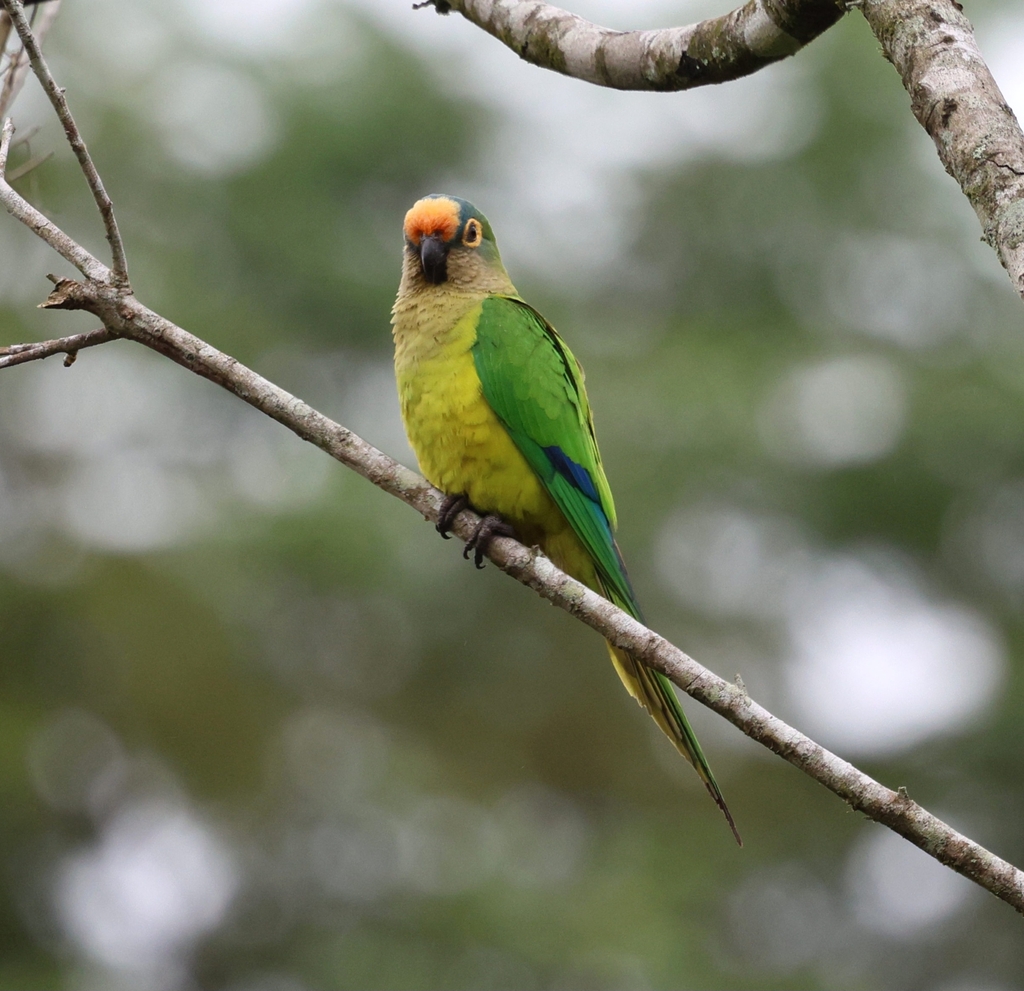
Peach-fronted Parakeet
Photo © Miguel
Photo © Miguel — CC BY-SA 4.0 — Source: iNaturalist #226992407Identification
The peach-fronted parakeet is a small parrot measuring 23 to 28 cm in length, weighing between 74 and 94 grams. Both sexes are identical in plumage. The most distinctive feature is the peachy-orange forehead and forecrown that gives the species its common name, contrasting sharply with a dull blue hindcrown. Yellow bare skin encircles each eye, creating an alert, expressive gaze. The nape, upperparts, and tail are predominantly dull green, while the cheeks and throat display pale olive-brown colouration that gradually transitions through greenish-yellow on the vent and undertail coverts. The wings are mostly green above with yellowish-green undersides and greenish-blue flight feathers. Immature birds resemble adults but display noticeably less orange and blue on the head, making age determination relatively straightforward in the field.
Range & Habitat
The peach-fronted parakeet is widely distributed across South America, occurring in Argentina, Bolivia, Brazil, Paraguay, Peru, Suriname, and adjacent regions. Its range extends from extreme southern Suriname southward through the eastern half of Brazil into eastern Bolivia and extreme southeastern Peru, with populations also present in central and eastern Paraguay and slightly into northeastern Argentina. This species demonstrates remarkable habitat flexibility, thriving in diverse landscapes from semi-open to fully wooded environments. It frequents Mauritia palm groves, cerrado grasslands, gallery forests, campo rupestre (a distinctive savanna-like habitat with scattered shrubs and trees), and increasingly in urban areas.
Behaviour & Diet
The peach-fronted parakeet is notably terrestrial among parrots, spending considerable time foraging on the ground. Its diet consists primarily of seeds from a wide variety of plants, supplemented by termites and insect larvae. The species readily exploits agricultural opportunities, feeding in cultivated fields both before harvest and gleaning seeds afterward. Rather than undertaking predictable migrations, these parakeets make irregular local movements in response to food availability. Breeding occurs seasonally, with nesting from June to July in Peru and September to December in central Brazil, though breeding timing remains undocumented for other regions. The species typically excavates nest cavities in termitaria, utilising both ground-level and arboreal structures. Clutches contain two to four eggs, with incubation lasting 23 days in captivity and fledging occurring approximately 48 days after hatching. The species produces a distinctive rolling call described as "vreet vreet-vreet-vreet-vreet," irregularly rising and falling between low and very high pitches.
Best Time & Places to See It
The peach-fronted parakeet is considered common in Suriname and abundant in Paraguay, making these locations particularly rewarding for observation. In Brazil, it is the most common species of Eupsittula parakeet, occurring throughout much of the eastern half of the country. The species is widespread enough that finding individuals is often possible across suitable habitat within its range. Breeding seasons vary geographically; targeting Peru between June and July or central Brazil between September and December may yield opportunities to observe nesting behaviour and family groups.
Photography Tips
The peach-fronted parakeet's striking peach and blue crown makes for compelling portraiture, particularly in good light where the colour contrast is maximised. Its habit of foraging on the ground provides exceptional opportunities for photography from lower angles. The bright yellow eye-ring and bare facial skin are diagnostic features worth capturing in detail. Early morning light often produces the best colour saturation for the orange and blue crown markings. The species' presence in agricultural areas and increasingly in urban habitats makes it accessible to photographers without necessarily requiring remote field expeditions.
Tijuca National Park
Brazil
+317 birds+13 mammals
Where the Atlantic forest rises steeply from Rio de Janeiro's urban edge, Tijuca National Park encompasses a landscape of dramatic granite peaks, cascading waterfalls, and closed-canopy…
VIEW NATIONAL PARKEmas National Park
Brazil
+333 birds+23 mammals
Across the high plateaux of central Brazil, where the cerrado grasslands roll toward distant horizons under an immense sky, Emas National Park anchors one of South…
VIEW NATIONAL PARKSerra do Cipó National Park
Brazil
+379 birds+5 mammals
Where granite escarpments rise above the Atlantic Forest transition zone in southeastern Brazil, Serra do Cipó National Park unfolds across a landscape of dramatic ridges, cascading…
VIEW NATIONAL PARKItatiaia National Park
Brazil
+519 birds+12 mammals
Where granite peaks pierce the Atlantic rainforest canopy in southeastern Brazil, Itatiaia National Park rises as one of the country's oldest and most ecologically vital protected…
VIEW NATIONAL PARKSerra da Bocaina National Park
Brazil
+441 birds+5 mammals
Where the escarpment of the Serra da Bocaina rises sharply from the Atlantic coastal plain, tropical rainforest cloaks steep mountainsides that climb toward peaks exceeding 2,000…
VIEW NATIONAL PARKIlha Grande National Park
Brazil
+233 birds
Across the subtropical plateaus and Atlantic forest remnants of southern Brazil, a vast protected landscape spanning nearly 4,600 square kilometers safeguards one of the continent's most…
VIEW NATIONAL PARKPau Brasil National Park
Brazil
+211 birds
Tropical Atlantic forest cloaks the rolling terrain of northeastern Bahia, where Pau Brasil National Park protects nearly 390 square kilometers of one of Brazil's most biodiverse…
VIEW NATIONAL PARKSerra dos Órgãos National Park
Brazil
+446 birds+13 mammals
Granite peaks thrust skyward through the Atlantic Forest canopy in the mountains immediately north of Rio de Janeiro, their bare rock faces rising above a landscape…
VIEW NATIONAL PARKSete Cidades National Park
Brazil
+125 birds+1 mammals
Sete Cidades sprawls across 113 square kilometres of northeastern Brazil's interior plateau, where weathered sandstone formations rise dramatically from the cerrado landscape. The park's geology tells…
VIEW NATIONAL PARKChapada dos Guimarães National Park
Brazil
+450 birds+1 mammals
Where weathered sandstone plateaus rise above the cerrado grasslands of central Brazil, Chapada dos Guimarães National Park protects 624 square kilometres of ecological transition zone that…
VIEW NATIONAL PARKChapada dos Veadeiros National Park
Brazil
+324 birds+6 mammals
Where granite plateaus rise above the cerrado savanna in central Brazil, Chapada dos Veadeiros National Park unfolds across 6,665 square kilometres of some of the world's…
VIEW NATIONAL PARKPantanal Matogrossense National Park
Brazil
+322 birds+17 mammals
Where the flooded forests of central Brazil meet vast seasonally inundated grasslands, Pantanal Matogrossense National Park sprawls across nearly 2,900 square kilometers of one of the…
VIEW NATIONAL PARKLençóis Maranhenses National Park
Brazil
+98 birds+2 mammals
Where white sand dunes rise in dramatic ridges across a coastal lowland, Lençóis Maranhenses National Park reveals one of Brazil's most otherworldly landscapes. Spanning 3,670 square…
VIEW NATIONAL PARKChapada Diamantina National Park
Brazil
+346 birds+5 mammals
Where granite peaks and sandstone cliffs rise abruptly from the Brazilian interior, Chapada Diamantina National Park sprawls across 4,215 square kilometers of some of Brazil's most…
VIEW NATIONAL PARKSerra do Gandarela National Park
Brazil
+333 birds+3 mammals
Where granite massifs rise through Atlantic Forest in southeastern Brazil's highlands, Serra do Gandarela National Park protects nearly 1,000 square kilometres of montane terrain that few…
VIEW NATIONAL PARKBrasília National Park
Plano Piloto, Brazil
+338 birds+15 mammals
Cerrado grassland and scattered woodland sweep across the central Brazilian plateau where this national park sprawls across more than a thousand square kilometres of the Federal…
VIEW NATIONAL PARKMapinguari National Park
Brazil
+354 birds
Vast tracts of western Amazonian rainforest blanket the remote terrain of this 56,827 square kilometre national park in Amazonas state, where seasonal rivers wind through dense…
VIEW NATIONAL PARKCampos Amazónicos National Park
Amazonas, Brazil
+434 birds+7 mammals
Sprawling across the southwestern Amazon basin in Amazonas state, this 27,263-square-kilometre national park encompasses some of the region's most pristine lowland rainforest, where terra firme forest…
VIEW NATIONAL PARKBahuaja Sonene National Park
San Pedro de Putina Punco, Peru
+602 birds+8 mammals
Where the Madre de Dios and Heath rivers converge in southeastern Peru rises one of South America's most biodiverse wilderness regions: a vast protected realm of…
VIEW NATIONAL PARKRío Pilcomayo National Park
Argentina
+271 birds+13 mammals
Where the Río Pilcomayo cuts through northeastern Argentina's subtropical lowlands, a sprawling mosaic of wetlands, grasslands, and seasonally flooded forests creates one of South America's most…
VIEW NATIONAL PARKNo community photos yet. Log in to add the first one.
No community observations of this species yet.