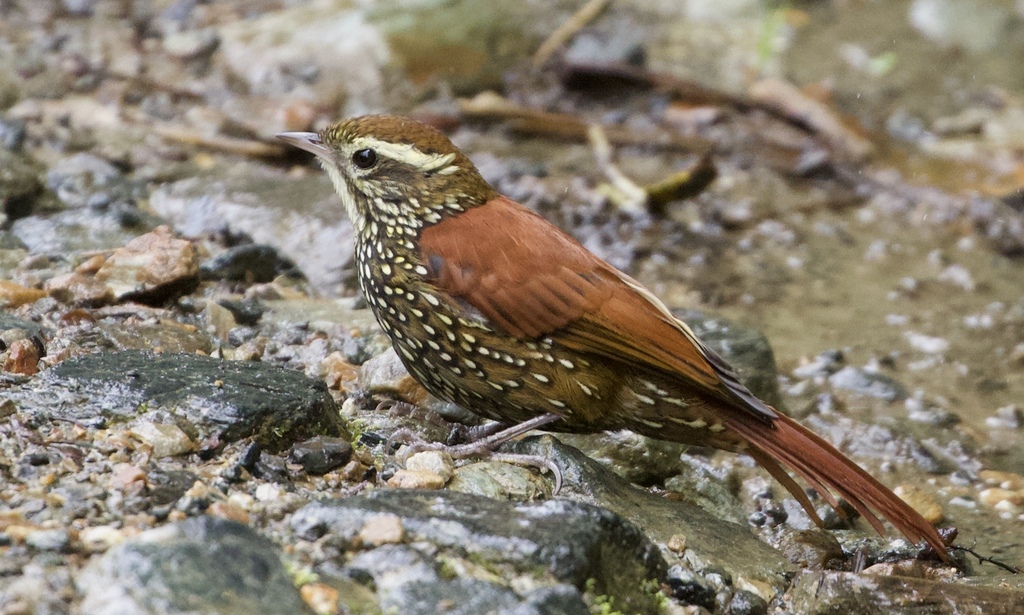
Pearled Treerunner
Photo © RJ Baltierra
Photo © RJ Baltierra — CC BY 4.0 — Source: iNaturalist photo #352722316Identification
The Pearled Treerunner is a small ovenbird measuring 15–16 cm long and weighing just 14–19 g, making it easy to overlook in its montane forest home. The nominate subspecies displays a distinctive yellowish-buff eyebrow stripe extending to the nape, a dark reddish-brown crown, and bright reddish-brown back and rump. The most striking feature is the densely spotted breast: oval yellowish spots with dark brown outlines cover the upper breast, becoming more stretched and subtle toward the belly. The throat is bright buff-yellow, and the tail feathers have a characteristic spiny appearance due to lacking barbs at their tips. Males and females are identical in plumage. The other subspecies—M. s. peruvianus and M. s. perlatus—are notably paler with less rufous toning and reduced spotting on the underparts.
Range & Habitat
This species is endemic to the Andes of northwestern South America, found from western Venezuela south through Colombia and Ecuador into Peru and Bolivia, with a single unconfirmed sighting in Argentina. Three subspecies occupy different elevational and geographic zones along this vast mountain range. The Pearled Treerunner inhabits montane evergreen forest and elfin forest between 2,500 and 3,500 meters, though it occasionally ventures as low as 1,500 m or as high as 3,800 m. It shows a strong preference for moss-laden forests and areas rich in epiphytes, and also frequents Polylepis woodland and secondary forest. This affinity for heavily vegetated, misty mountain slopes makes it a characteristic bird of the humid Andean cloud forest zone.
Behaviour & Diet
The Pearled Treerunner is a year-round resident that feeds acrobatically on small arthropods gleaned primarily from moss and epiphytes. It typically forages in pairs or small groups, often joining mixed-species feeding flocks as it moves through the mid-storey and canopy. Using its tail for support, it hitches up trunks and along branches with characteristic creeper-like movements, frequently hanging upside down to pluck prey from vegetation and dead leaves. Though not highly vocal, it produces a rapid series of thin, high-pitched 'tick' notes as its song, along with single 'tick' or 'tsit' calls and short trills. Little is known of its breeding biology beyond that it apparently breeds from December through June, is thought to be monogamous, and constructs a distinctive ball-shaped moss nest with a side entrance, placed beneath a limb or rock.
Best Time & Places to See It
The Pearled Treerunner is fairly common to common throughout its range and occurs in several protected areas, making it a realistic target for patient birdwatchers exploring the high Andes. The species is a permanent resident, so there is no seasonal migration to plan around. Search the mossy, epiphyte-draped forests of the cloud forest zone between 2,500 and 3,500 meters elevation, particularly in areas with dense vegetation and high humidity. The bird's preference for mixed-species flocks means that locating other small Andean species may lead you to Pearled Treerunners. Early morning hours typically offer the best activity levels, though this species is active throughout the day.
Photography Tips
Photographing this small, active bird requires patience and a fast shutter speed to freeze its acrobatic movements as it creeps along moss-covered branches. The dense cloud forest habitat presents challenging lighting conditions; use a high ISO and wide aperture to maintain shutter speeds of at least 1/500th of a second. Focus on areas with heavy moss and epiphytes where the bird forages; the distinctive spiny tail and spotted breast are key identification features worth capturing in detail. Position yourself to photograph the bird from multiple angles, as it frequently works upside down along branches—these dynamic poses make compelling images. The bird's small size and preference for the canopy mean a telephoto lens of at least 400–600 mm is essential for frame-filling shots in typical forest habitat.
Antisana National Park
Cajas National Park
Cotopaxi National Park
El Tamá National Park
Guácharos Cave National Natural Park
Llanganates National Park
Manu National Park
Natural Chingaza National Park
Natural el Cocuy National Park
Nothing matches these filters.
No community photos yet. Log in to add the first one.
No community observations of this species yet.