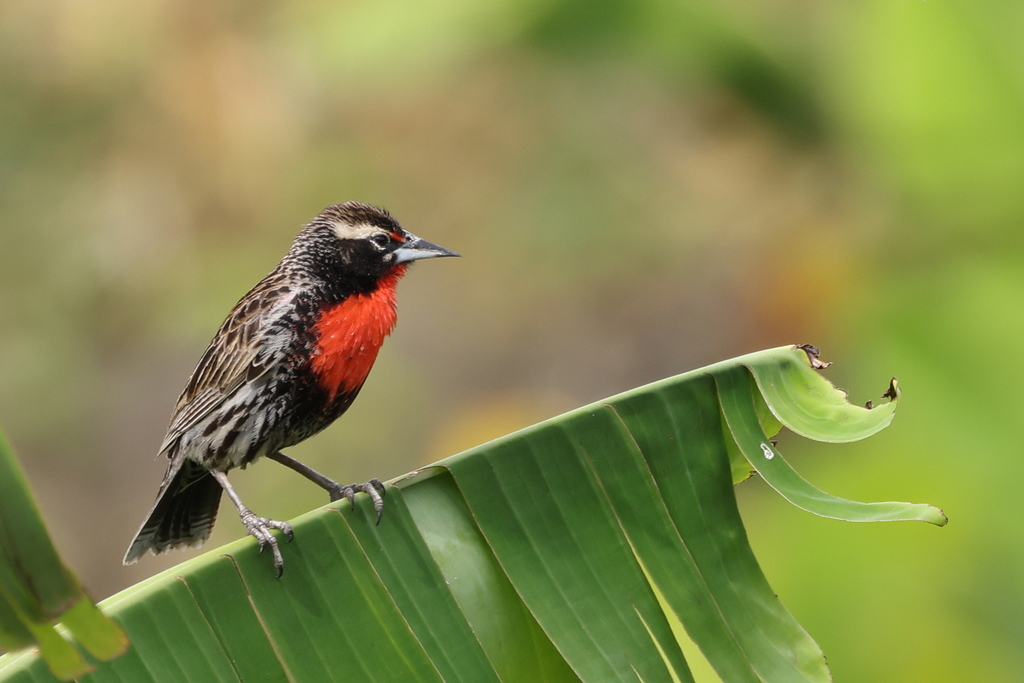
Peruvian Meadowlark
Photo © Manuel Roncal
Photo © Manuel Roncal — CC0 1.0 — Source: iNaturalist photo #247753431Identification
The Peruvian Meadowlark is a medium-sized songbird approximately 21 cm long, with males notably larger than females. Males of the nominate subspecies are strikingly patterned with a mostly black head, white forehead, and a distinctive long supercilium that transitions from red near the bill to white beyond the eye. A white lower eyelid and short white "moustache" complete the facial pattern. The bright red chin, throat, and breast contrasted with black sides make males unmistakable. Females are more subdued, with an all-white supercilium, paler upperparts, and a whitish throat with only pale red on the central belly. Both sexes share a dark brown iris, bluish ivory bill with dusky tip, and gray-brown to blackish legs. The smaller subspecies L. b. albipes shows similar markings but with less red overall.
Range & Habitat
This species is found across western South America, with the nominate subspecies ranging from southwestern Colombia through Ecuador and Peru, while L. b. albipes extends south to northern Chile. It inhabits grasslands, pastures, and agricultural areas across its range. In arid coastal regions, it favors oases and irrigated croplands. The species shows remarkable elevational range, occurring from sea level to 600 m in Colombia, up to 2,500 m in Ecuador, and reaching 2,800 m in Peru, making it adaptable to diverse landscape types.
Behaviour & Diet
The Peruvian Meadowlark is apparently a year-round resident, though highland populations likely make elevational movements seasonally. It forages primarily on the ground for seeds, arthropods, small vertebrates, and occasional fruit. Outside breeding season, birds form flocks that may exceed 50 individuals. Breeding occurs between March and May in Ecuador and October-November in Chile. Males perform distinctive vertical flight displays while singing. Nests are built on the ground as grass cups, often domed with side entrances, typically hidden in grass clumps or under shrubs. Clutches of three to five eggs are incubated for about 14 days, with fledging occurring roughly 12 days later.
Best Time & Places to See It
The Peruvian Meadowlark is "common and conspicuous" in Ecuador and "fairly common to common" in Peru, offering excellent viewing opportunities throughout these countries. Birds are most vocal and active during breeding seasons: March to May in Ecuador and October to November in Chile. Grassland and agricultural habitats at lower elevations are most reliable for encounters, though highland oases and irrigated areas in arid regions provide alternative viewing locations. Flocking behavior outside breeding season offers chances to observe multiple individuals simultaneously.
Photography Tips
The striking sexual dimorphism and bold plumage patterns of males make this species rewarding for photography. Capture males displaying in vertical flight to showcase their aerial behavior and vocalizations. Ground-foraging birds in grasslands offer opportunities for natural habitat shots. Early morning provides optimal lighting for recording the bright red breast and facial markings. During breeding season, patient observers may document nest-building behavior or adults delivering food to young. The species' conspicuous nature and non-shy behavior in agricultural areas make approach relatively feasible for ground-level photography.
Cajas National Park
Cerros de Amotape National Park
Cotopaxi National Park
Huascarán National Park
Lauca National Park
Llanganates National Park
Tingo Maria National Park
Nothing matches these filters.
No community photos yet. Log in to add the first one.
No community observations of this species yet.