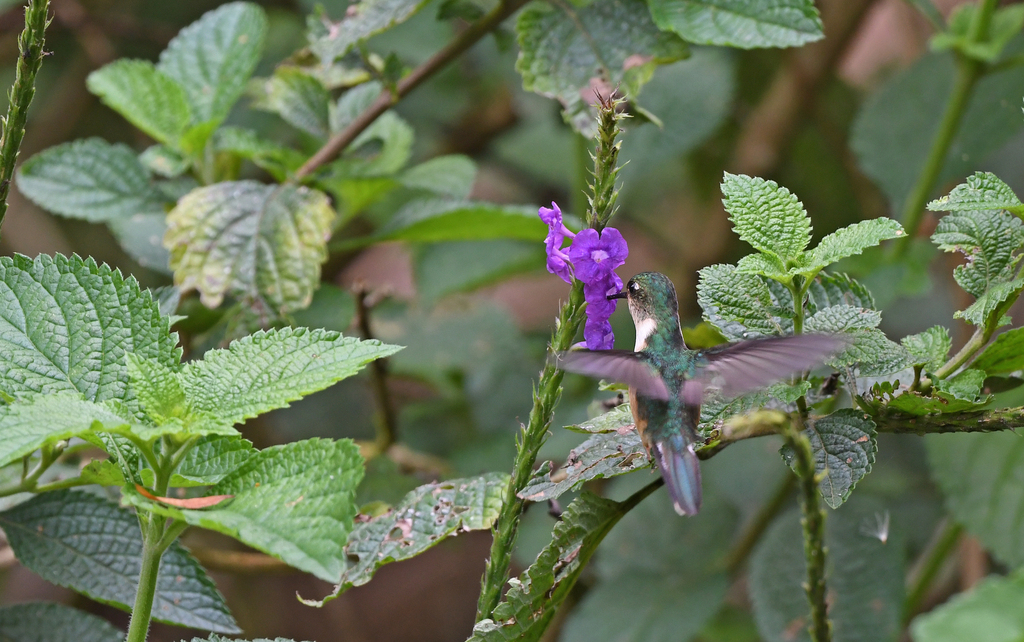
Peruvian Piedtail
Photo © Christoph Moning
Photo © Christoph Moning — CC BY 4.0 — Source: iNaturalist #186380852The Peruvian piedtail (Phlogophilus harterti), locally called Colibrí Colipinto Peruano, is a species of hummingbird in the "coquettes", tribe Lesbiini of subfamily Lesbiinae. It is endemic to Peru. == Taxonomy and systematics == The Peruvian piedtail shares its genus with the Ecuadorian piedtail (P. hemileucurus). It is monotypic. == Description == The Peruvian piedtail is 7.2 to 7.5 cm (2.8 to 3.0 in) long and weighs 2.2 to 2.7 g (0.078 to 0.095 oz). The adult male and female are alike. They have a short, straight, black bill. Their upperparts are green. They have a white spot behind the eye. The throat and center of the breast and belly are white and the rest of the underparts buff. The innermost pair of tail feathers are green with a wide black tip; the others are buff with a wide diagonal black band. Juveniles resemble the adults but their head and neck feathers have buff fringes. == Distribution and habitat == The Peruvian piedtail has a discontinuous distribution in central and southeastern Peru. It occurs in the east Andean foothills of Huánuco, Pasco, Cuzco, and Puno departments. It inhabits the interior of primary and secondary forest. In elevation it is most numerous…
Yanachaga–chemillén National Park
Palcazu, Peru
+639 birds+6 mammals
Where the eastern slopes of Peru's central cordillera plunge into cloud forest, Yanachaga–Chemillén National Park protects nearly three thousand square kilometres of montane wilderness that few…
VIEW NATIONAL PARKManu National Park
Manu, Peru
+892 birds+26 mammals
Across the eastern slopes of the Peruvian Andes, tropical rainforest descends into the Amazon basin with a complexity that few terrestrial ecosystems match. Manu National Park…
VIEW NATIONAL PARKBahuaja Sonene National Park
San Pedro de Putina Punco, Peru
+602 birds+8 mammals
Where the Madre de Dios and Heath rivers converge in southeastern Peru rises one of South America's most biodiverse wilderness regions: a vast protected realm of…
VIEW NATIONAL PARKNo community photos yet. Log in to add the first one.
No community observations of this species yet.