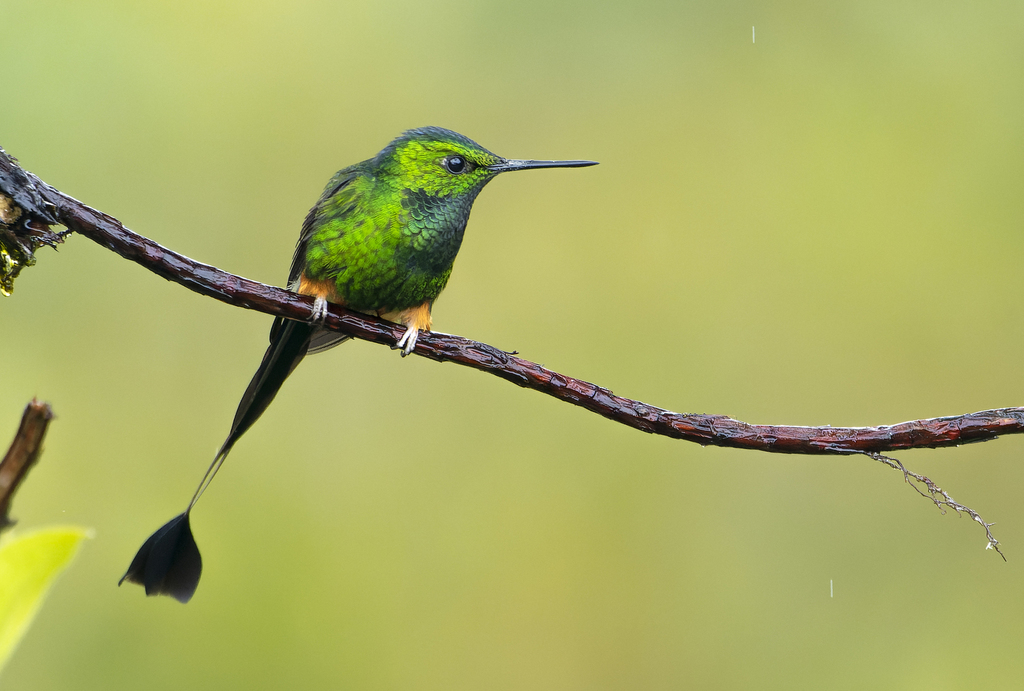
Peruvian Racket-tail
Photo © David F. Belmonte
Photo © David F. Belmonte — CC BY 4.0 — Source: iNaturalist photo #350483734The Peruvian racket-tail (Ocreatus peruanus) is a species of hummingbird in the "brilliants", tribe Heliantheini in subfamily Lesbiinae. It is found in Ecuador and Peru. == Taxonomy and systematics == The Peruvian racket-tail, as defined by the International Ornithological Committee (IOC) and the Clements taxonomy, is one of three species in genus Ocreatus. However, BirdLife International's Handbook of the Birds of the World (HBW) treats the taxon as one of eight subspecies of booted racket-tail (O. underwoodii). The IOC and Clements call underwoodii "white-booted racket-tail" and assign five subspecies to it. The South American Classification Committee of the American Ornithological Society (SACC) follows the eight-subspecies model of booted racket-tail but has requested a proposal to elevate O. peruanus and two other subspecies to species status. == Description == All racket-tails have pronounced sexual dimorphism. Only the male has elongated outer rectrices (tail feathers) that have bare shafts with terminal flags. On the Peruvian racket-tail, those feathers are straight and do not cross; the flags are narrow ovals that slightly overlap. Male Peruvian racket-tails are 11 to 15 cm (4.3 to 5.9 in) long including the 7 to 8 cm (2.8 to 3.1 in) long outer tail feathers, and weigh 2.5…
Sangay National Park
Cebadas, Ecuador
+320 birds+10 mammals
High in Ecuador's Andean spine, where the Western Cordillera rises to touch perpetual snow, a landscape of volcanic drama and ecological intensity unfolds across Sangay National…
VIEW NATIONAL PARKPodocarpus National Park
Zamora, Ecuador
+496 birds+6 mammals
Where the Andes descend toward the Amazon basin, Podocarpus National Park sprawls across nearly 2,800 square kilometres of the most biodiverse terrain in Ecuador's southern highlands.…
VIEW NATIONAL PARKSumaco Napo-Galeras National Park
Loreto, Ecuador
+563 birds+4 mammals
Where Ecuador's Amazon transitions into cloud forest, a massive shield volcano rises from the emerald lowlands of Orellana Province, anchoring one of the continent's most biodiverse…
VIEW NATIONAL PARKAntisana National Park
Quijos, Ecuador
+432 birds+21 mammals
Where the eastern Andean slopes descend into the Amazon basin, Antisana National Park sprawls across roughly 2,500 square kilometers of some of South America's most dramatic…
VIEW NATIONAL PARKCordillera Azul National Park
Pampa Hermosa, Peru
+322 birds+1 mammals
Where the eastern Andes descend into the western Amazon basin, Cordillera Azul National Park sprawls across nearly 38,000 square kilometres of some of Peru's most pristine…
VIEW NATIONAL PARKNo community photos yet. Log in to add the first one.
No community observations of this species yet.