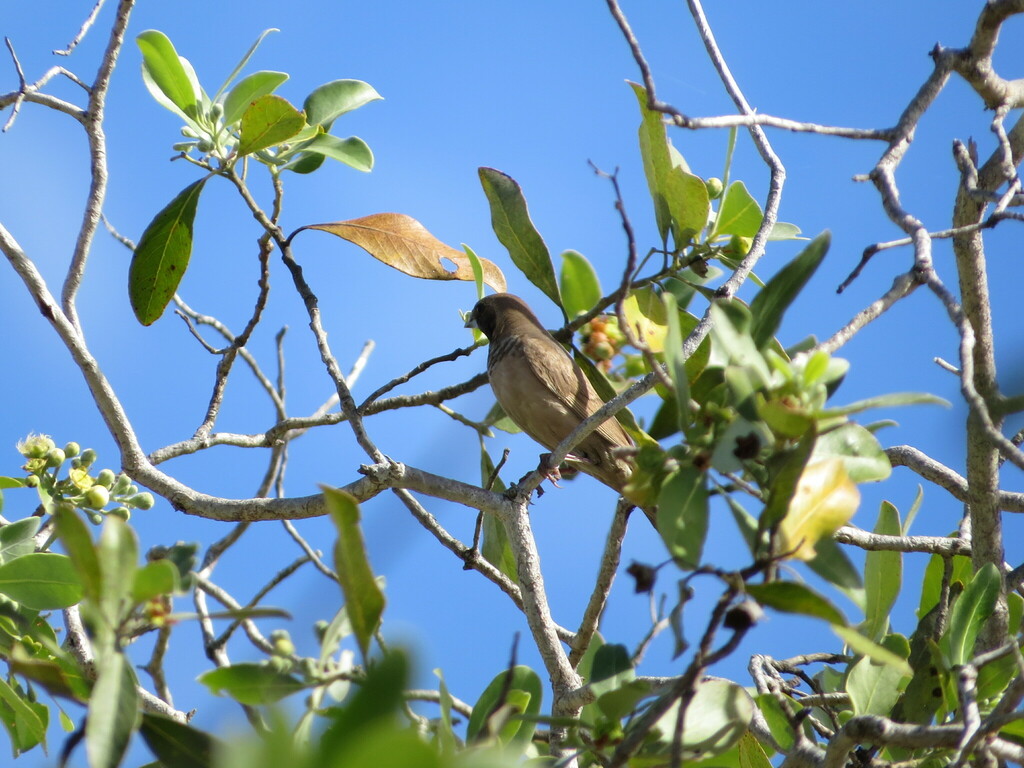
Pictorella Mannikin
Photo © pimelea
Photo © pimelea — CC BY 4.0 — Source: iNaturalist #207136911The pictorella mannikin, pictorella munia, or pictorella finch (Heteromunia pectoralis) is small brown and grey finch with a grey bill and distinctive scaly white breast plate which is endemic to northern Australia. It is a seed-eater found in pairs and small flocks in dry savannah and subtropical or tropical dry lowland grassland. == Taxonomy == The pictorella mannikin was formally described in 1841 by English ornithologist John Gould based on a specimen that had been collected in northwestern Australia by John E. Dring who had been a crew member on the third voyage of HMS Beagle. Gould coined the binomial name Amadina pectoralis. When in 1842 Gould described and illustrated the finch in the third volume of his book The Birds of Australia he instead placed the species in the genus Donacola. The pictorella mannikin is now the only species placed in the genus Heteromunia that was introduced by Gregory Mathews in 1913. The genus name combines the Ancient Greek ἑτερος/heteros meaning "different" or "another" with the genus name Munia that had been introduced in 1836 by Brian Houghton Hodgson. The specific epithet pectoralis is Latin meaning "of the breast" or "pectoral". The species is monotypic: no subspecies are recognised.…
Kakadu National Park
Kakadu, Australia
+273 birds+46 mammals
Kakadu National Park is Australia’s largest national park and one of the world’s most remarkable protected areas, covering nearly 20,000 square kilometres in the tropical north…
VIEW NATIONAL PARKBoodjamulla National Park
Australia
+142 birds+3 mammals
Where red sandstone gorges carve through the semi-arid interior of far north Queensland, Boodjamulla National Park reveals a landscape shaped by seasonal water availability and ancient…
VIEW NATIONAL PARKPurnululu National Park
Australia
+114 birds
Towering sandstone domes and dramatic gorges carved by seasonal watercourses define this remote corner of the Kimberley, where ancient rock formations create a maze of narrow…
VIEW NATIONAL PARKNo community photos yet. Log in to add the first one.
No community observations of this species yet.