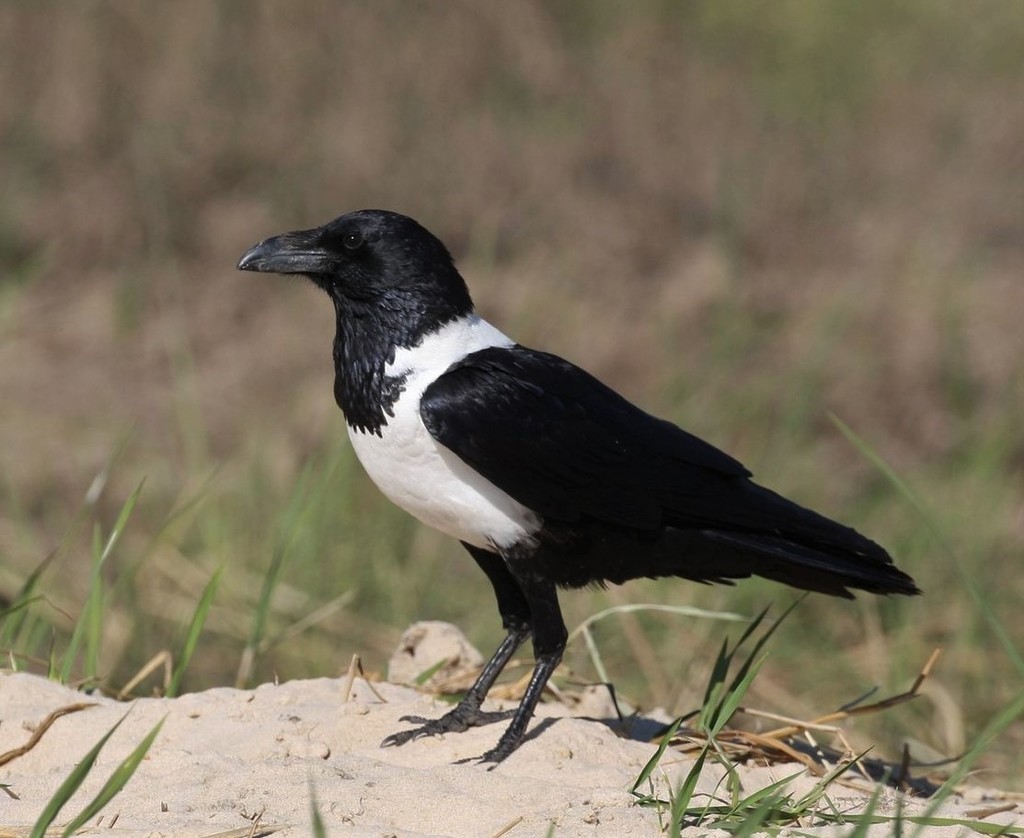
Pied Crow
Photo © Dave Brown
Photo © Dave Brown — CC0 1.0 — Source: iNaturalist photo #104475058Identification
The pied crow is a striking and unmistakable bird, measuring 46–52 cm in length—about the size of a European carrion crow or slightly larger. Its most distinctive feature is its bold plumage pattern: a glossy black head, neck, tail, wings, and bill contrasts sharply with a large white patch extending from the shoulders down to the lower breast and belly. The bird has dark brown eyes and relatively long legs. Immature birds show white plumage mixed with black feathering. In areas where its range overlaps with the white-necked raven in southern Africa, the pied crow can be distinguished by its smaller size, white chest and belly, and more delicate black bill, compared to the larger raven with its black underparts and heavier, white-tipped bill.
Range & Habitat
The pied crow is Africa's most widespread member of the Corvus genus, found across sub-Saharan Africa including Nigeria, Ghana, Senegal, Sudan, Somalia, Eritrea, Zambia, Botswana, Mozambique, Zimbabwe, and South Africa. The species also occurs on Madagascar, the Comoros Islands, and several smaller islands including Zanzibar, Pemba, and Aldabra. Notably, it does not inhabit equatorial rainforest regions. The pied crow strongly favors open country with nearby villages and towns, and is rarely encountered far from human habitation, though it is less dependent on urban environments than Asia's house crow. In Eritrea, it may occasionally be found in more remote areas away from human settlements.
Behaviour & Diet
Pied crows are generally seen in pairs or small groups, though large congregations gather at abundant food sources. Their behavior resembles that of the hooded and carrion crows. In some regions, they have been observed mobbing passing ospreys and snake eagles, yet they avoid black kites. The species forages entirely from the ground and trees, consuming a highly opportunistic diet: insects and invertebrates, small reptiles and mammals, young birds and eggs, grain, peanuts, fruit, and carrion. They frequently scavenge around slaughterhouses and human settlements. Notably, pied crows have been recorded hunting and eating roosting fruit bats. Their digestive system is adapted for rapid processing of large food quantities, with specialized intestinal structures that enhance nutrient absorption while maintaining their ability to fly swiftly.
Best Time & Places to See It
The pied crow is readily encountered throughout its range in open habitats near human settlements—villages, towns, cultivated areas, and agricultural lands offer the best opportunities for observation. Look for them year-round, though breeding occurs from September to November depending on latitude. They are most active during daylight hours and can often be spotted foraging on the ground or perching conspicuously in isolated trees. Visit slaughterhouses, markets, and other food-rich areas where they congregate in sometimes enormous numbers, particularly in West and East African countries within their range.
Photography Tips
The pied crow's bold black-and-white plumage makes it highly photogenic and relatively easy to photograph compared to many bird species. Its distinctive coloring provides excellent contrast and will render well in most lighting conditions. Photograph birds foraging on the ground during early morning or late afternoon light for best results. Their habit of perching openly in trees and their comfort around human habitation make them accessible subjects. Capture their characteristic harsh calls—described as "ar-ar-ar-ar" or "karh-karh-karh"—on audio if recording video. When multiple birds congregate, look for behavioral interactions such as feeding competition or mobbing displays, which provide dynamic compositional opportunities.
Bwindi Impenetrable National Park
Lake Mburo National Park
Mabamba Swamp
Murchison Falls National Park
Queen Elizabeth National Park
Aberdare National Park
Abijata-Shalla Lakes National Park
Addo Elephant National Park
Agulhas National Park
Nothing matches these filters.
No community photos yet. Log in to add the first one.
No community observations of this species yet.