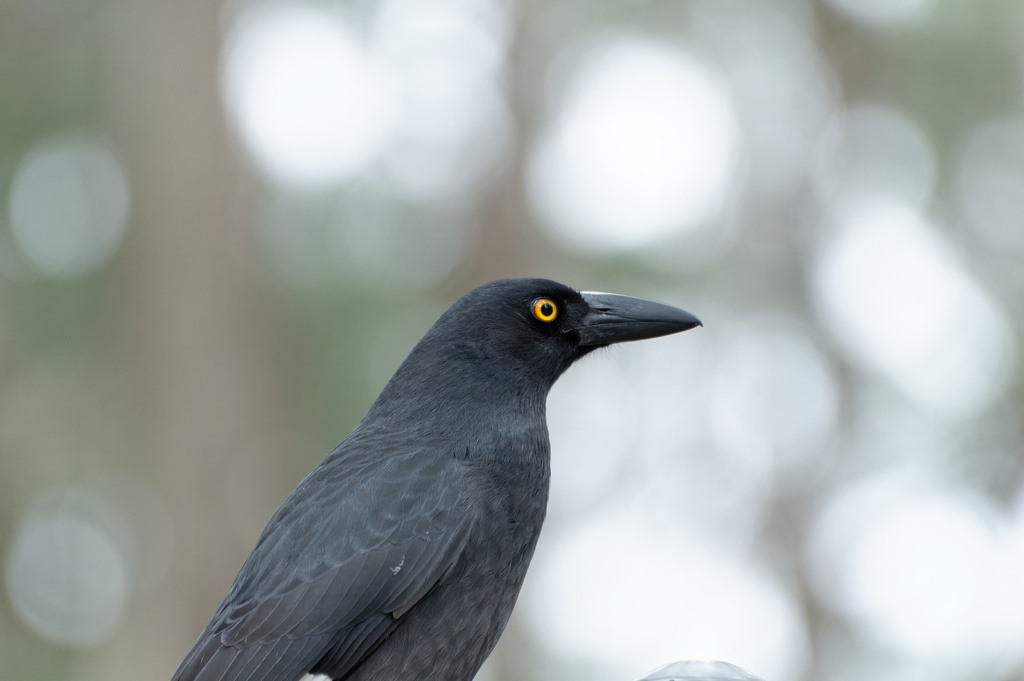
Pied Currawong
Photo © Donald Davesne
Photo © Donald Davesne — CC BY 4.0 — Source: iNaturalist photo #389504205Identification
The pied currawong is a robust, crow-like bird averaging around 48 cm (19 in) in length. Its plumage is predominantly black or sooty grey-black, distinctively marked with white undertail and wing patches that give the species its "pied" name. Yellow irises and a heavy bill complete its striking appearance. Males and females are similar in appearance, making identification straightforward in the field.
Range & Habitat
This species is native to eastern Australia and Lord Howe Island, with six recognized subspecies showing subtle variations in size and plumage across their ranges. Within its distribution, the pied currawong is generally sedentary, though populations at higher altitudes undertake seasonal movements to lower areas during colder months.
The species inhabits every kind of forested area, with a preference for mature forests during breeding season. Unlike its relative the Australian magpie, the pied currawong is highly arboreal, with roosting, nesting, and most foraging occurring in trees. It has adapted remarkably well to urbanisation and can be encountered in parks and gardens as readily as in rural woodland.
Behaviour & Diet
The pied currawong is renowned for its melodious calls, and its name is believed to be derived from indigenous languages, with the onomatopoeic term "currawong" possibly originating from words meaning similar sounds across several Aboriginal language groups.
This omnivorous species feeds on a wide variety of berries and seeds, invertebrates, bird eggs, juvenile birds, and young marsupials. As an adaptable predator that thrives in both natural and urban environments, it demonstrates the behavioral flexibility that has enabled its successful persistence across its range.
Best Time & Places to See It
The pied currawong's sedentary nature means it can be found year-round throughout its eastern Australian range and on Lord Howe Island. However, observing seasonal movements of highland populations to lower elevations during winter may increase encounter rates in certain locations during cooler months. Forested areas, particularly mature forests, and increasingly urbanised parks and gardens offer reliable viewing opportunities.
Photography Tips
The species' strong black and white contrast and distinctive yellow eye make for striking photographs. Since pied currawongs are arboreal foragers, position yourself to photograph them among foliage and branches where they spend most of their time. Their tree-based lifestyle means looking upward will often be necessary, so scout locations with open canopy structure that allows better light penetration and clearer sightlines to perched birds.
Alpine National Park
Bald Rock National Park
Barrington Tops National Park
Ben Boyd National Park
Blue Mountains National Park
Bouddi National Park
Bribie Island National Park
Budawang National Park
Budj Bim National Park
Nothing matches these filters.
No community photos yet. Log in to add the first one.
No community observations of this species yet.