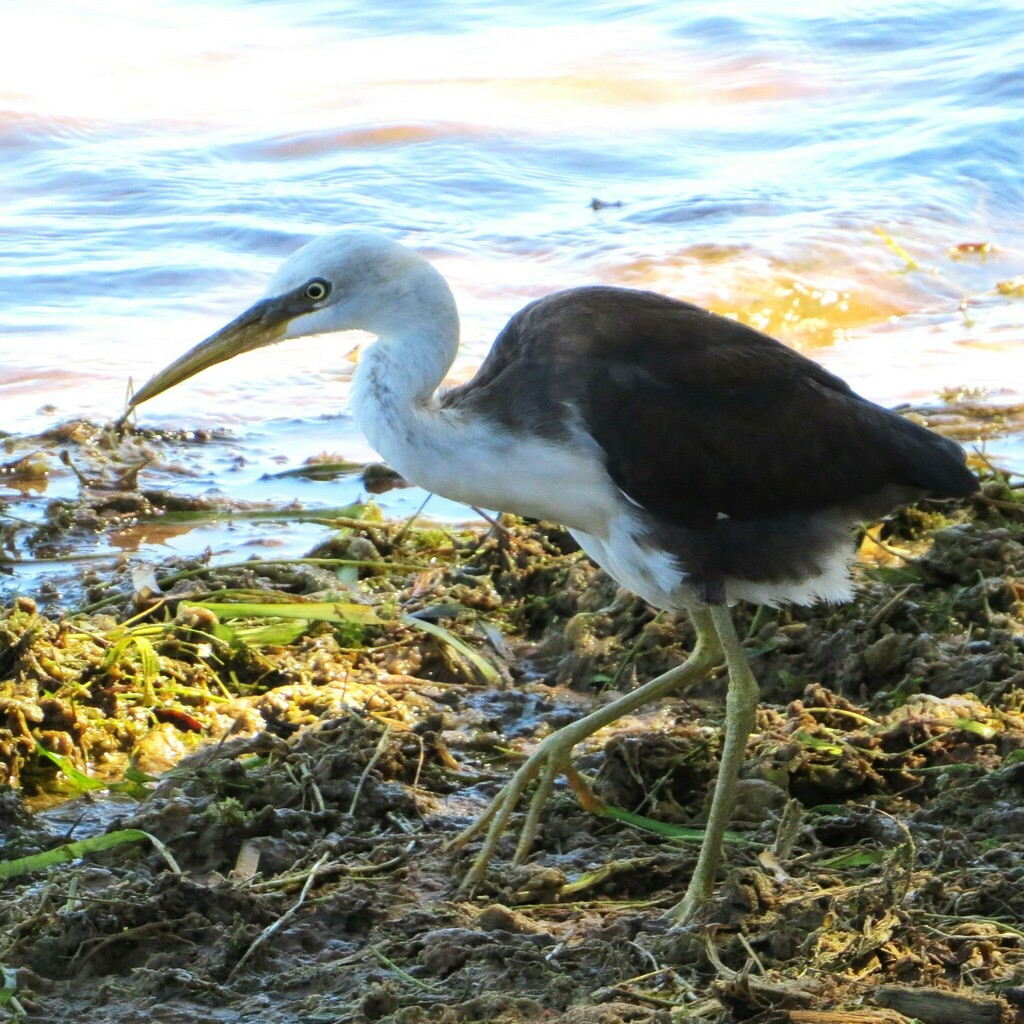
Pied Heron
Photo © pimelea
Photo © pimelea — CC BY 4.0 — Source: iNaturalist #230439680The pied heron (Egretta picata), also known as the pied egret is a bird found in coastal and subcoastal areas of monsoonal northern Australia as well as some parts of Wallacea and New Guinea. == Taxonomy == The species was originally described by ornithologist John Gould in 1845. Recent taxonomists put this species in the genus Egretta. There are no recognised subspecies. == Description == It is a small heron, 43–55 cm (17–22 in) long, with dark slaty wings, body, and crested head, with a white throat and neck. The appearance is similar to the white-necked heron. Males (247–280 g (8.7–9.9 oz)) are heavier than females (225–242 g (7.9–8.5 oz)), but the two are similar in appearance. Immature birds lack the crest as well as the dark colouring on the head and may look like small versions of the white-necked heron. The juveniles were once classified as a separate species. == Distribution and habitat == Its habitat mainly comprises a range of wetlands and wet grasslands. == Behaviour == === Call === The call of the pied heron is a loud 'awk' or 'ohrk' in flight. Soft cooing is given around the nest. Little else is known about vocalisations. ===…
Kakadu National Park
Kakadu, Australia
+273 birds+46 mammals
Kakadu National Park is Australia’s largest national park and one of the world’s most remarkable protected areas, covering nearly 20,000 square kilometres in the tropical north…
VIEW NATIONAL PARKDaintree National Park
Dedin, Australia
+362 birds+37 mammals
Daintree National Park is one of the world’s oldest and most biologically diverse tropical rainforests, protecting an extraordinary landscape where ancient forests meet the Great Barrier…
VIEW NATIONAL PARKEndeavour River National Park
Philadelphia, Australia
+203 birds+1 mammals
Where the Endeavour River winds through northeastern Queensland's tropical lowlands, a compact mosaic of rainforest, open woodland, and riverine corridor creates one of Australia's most ecologically…
VIEW NATIONAL PARKRinyirru National Park
Lakefield, Australia
+258 birds+7 mammals
Where the savanna grasslands of far north Queensland meet seasonal wetlands and eucalypt woodlands, Rinyirru National Park sprawls across more than 12,500 square kilometres of rugged,…
VIEW NATIONAL PARKLitchfield National Park
Australia
+175 birds+15 mammals
Where weathered sandstone plateaus rise above the savanna woodlands of Australia's Top End, Litchfield National Park unfolds as a landscape of dramatic contrasts shaped by a…
VIEW NATIONAL PARKNo community photos yet. Log in to add the first one.
No community observations of this species yet.