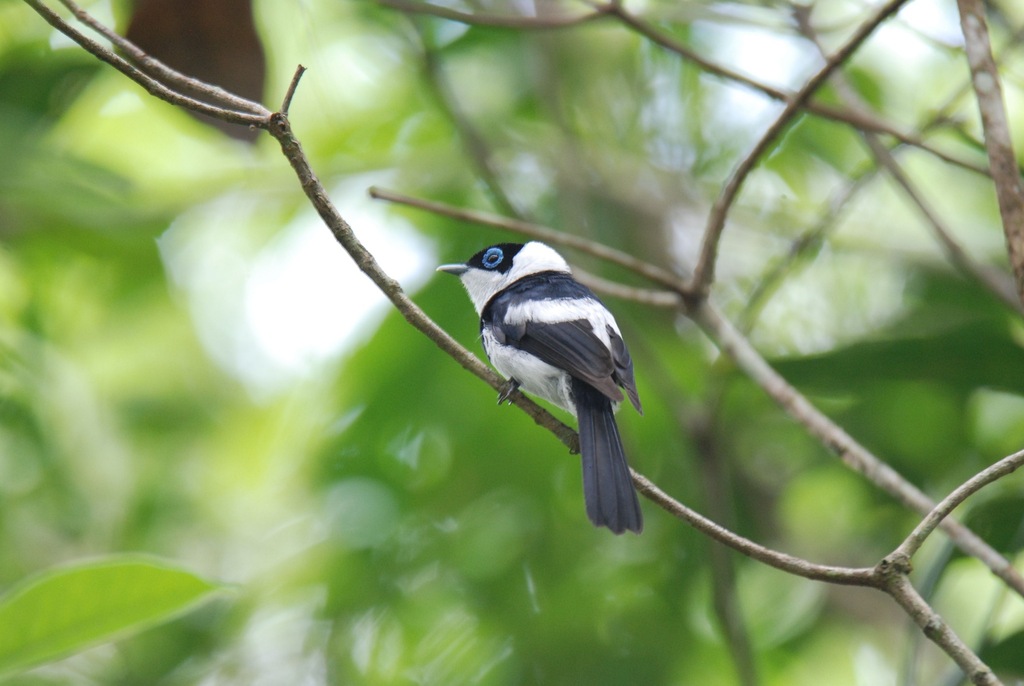
Pied Monarch
Photo © Alan Bell
Photo © Alan Bell — CC BY 4.0 — Source: iNaturalist photo #338615539Identification
The pied monarch is a small flycatcher, measuring 15–16 centimetres in length and weighing around 12.5–15 grams. Males are distinctively marked with black upperparts, head, and tail, contrasting sharply with white scapulars that form a white crescent across the back when folded. The male's erectable white collar extends through the neck to a white throat, while a black breast-band separates the white belly and underside. Females are duller, with less distinct white on the throat and an incomplete collar. Both sexes have a striking blue eye-ring, though less pronounced in females, a blue-grey bill, and black legs. The species shares the genus characteristic of long hind-toes and claws adapted for climbing, resembling those of treecreepers. Immature birds resemble females but lack blue eye-rings and have horn-coloured bills.
Range & Habitat
This species is endemic to coastal north-eastern Queensland, Australia, ranging from Cooktown to Ingham and occurring from sea level to 900 metres elevation. The pied monarch inhabits tropical forest edges, secondary growth, palm-vine scrub, gallery forest, and riverine habitats. Mostly non-migratory, some populations disperse to Eucalyptus woodland in the Atherton Tableland during winter. Though described as uncommon and occurring at low densities, much of its range falls within protected national parks and World Heritage Sites, making its habitat secure. The species is listed as Least Concern by the IUCN.
Behaviour & Diet
The pied monarch is insectivorous, feeding primarily on beetles and moths and butterflies. It typically forages as singles, pairs, or small groups of three to five birds, regularly joining mixed-species feeding flocks with other monarch flycatchers, fantails, whistlers, and shrikethrushes. Within forest habitats, the species usually feeds at mid-level, rarely venturing close to the ground. A signature foraging technique involves climbing tree trunks and larger branches in treecreeper fashion, probing bark and lichens for prey, though they also catch insects in flight.
Best Time & Places to See It
The pied monarch can be encountered year-round in its coastal Queensland range, with the breeding season running October to January when birds are more active and visible. Look for this species in tropical forest edges and secondary growth areas between Cooktown and Ingham, particularly in protected national parks and World Heritage Sites. Early morning foraging activity offers the best viewing opportunities, particularly when mixed-species feeding flocks are active. During winter months, some birds may be found in Eucalyptus woodlands of the Atherton Tableland.
Photography Tips
The pied monarch's striking black-and-white plumage and blue eye-ring make it highly photogenic, though its mid-level forest habitat and active foraging behaviour require patience and quick reflexes. Position yourself quietly near fruiting trees or flowering plants that attract insects and mixed feeding flocks. Early morning light is ideal for capturing the male's glossy black plumage and white markings. Use a fast shutter speed to freeze the bird's rapid movements as it climbs and probes bark. The erectable white collar is most visible during feeding activity, providing distinctive field marks for identification shots.
Herberton Range National Park
Australia
+115 birds+10 mammals
Rainforest-clad ridges and rocky outcrops define this 324-square-kilometre reserve in far north Queensland, where the mountainous terrain of the Herberton Range rises through layered eucalypt woodland…
VIEW NATIONAL PARKDaintree National Park
Dedin, Australia
+362 birds+37 mammals
Daintree National Park is one of the world’s oldest and most biologically diverse tropical rainforests, protecting an extraordinary landscape where ancient forests meet the Great Barrier…
VIEW NATIONAL PARKGirringun National Park
Australia
+231 birds+10 mammals
Where granite gorges cleave through subtropical woodland in North Queensland, Girringun National Park unfolds across rugged terrain shaped by millions of years of weathering and erosion.…
VIEW NATIONAL PARKWooroonooran National Park
Australia
+240 birds+28 mammals
Where the Great Dividing Range rises sharply inland from Queensland's tropical coast, Wooroonooran National Park encompasses a landscape of steep, forested gorges and cascading waterways carved…
VIEW NATIONAL PARKNo community photos yet. Log in to add the first one.
No community observations of this species yet.