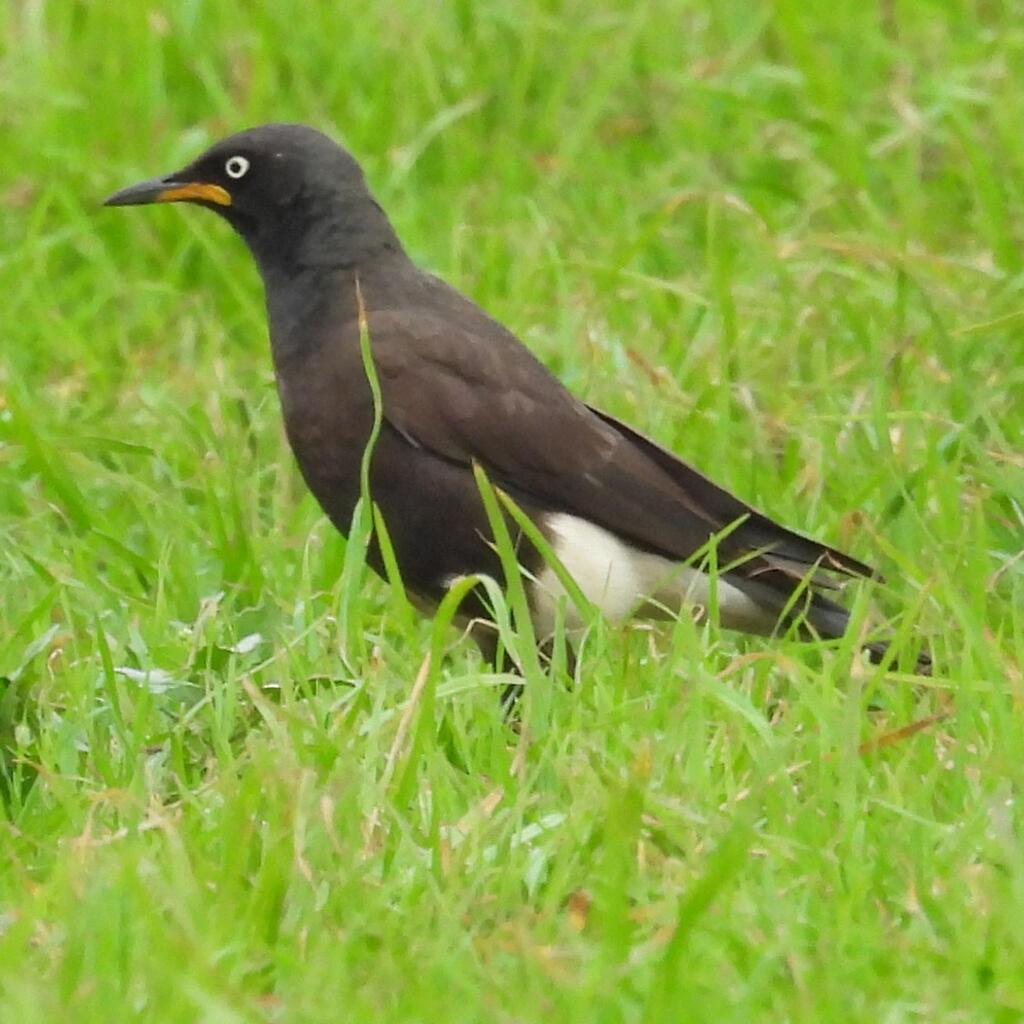
Pied Starling
Photo © Henry de Lange
Photo © Henry de Lange — CC BY 4.0 — Source: iNaturalist #301166388Identification
The pied starling is a medium-sized starling measuring 27–28 cm in length, instantly recognizable by its striking plumage pattern. Adults display mainly dull black plumage with a distinctive glossy sheen, contrasting sharply with a white lower belly and undertail coverts. The bird's pale, staring white iris and yellow lower mandible complete a memorable facial appearance. The sexes are alike in appearance, though juveniles differ noticeably: they lack the glossy plumage of adults, possess a brown iris, and sport a dull yellow lower mandible.
The pied starling's vocalizations are equally distinctive. Its most recognizable call is a sharp, strident "skeer kerrra kerrra," which often betrays the bird's presence even before visual sighting. The species also produces a softer warbling song that contrasts with its harsher contact calls.
Range & Habitat
This species is endemic to southern Africa, occurring in South Africa, Lesotho, and Eswatini. While common across most of its range, it is largely absent from the arid northwest and the eastern lowlands of South Africa. The pied starling favors open habitats including grassland, karoo scrub, thornbush, and agricultural land, where it frequently associates with farm animals.
Behaviour & Diet
The pied starling is highly gregarious outside the breeding season, forming large flocks that sometimes exceed 1,000 birds. Like all starlings, it is an omnivore, but insects dominate its diet, particularly ants and termites. The bird supplements this with seeds, berries, and figs from gardens, as well as human food discards. A notable feeding behavior is its close association with livestock, where it forages on insects disturbed by grazing animals and perches on cattle and sheep to remove ectoparasites—a mutually beneficial relationship.
During breeding season, the pied starling nests in tunnels within river banks, though it readily adapts to holes in buildings, straw bales, natural tree cavities, and even wrecked ships. Females typically lay four eggs, though clutches range from two to six, and incubate for 14–16 days. Chicks fledge in 22–28 days and are fed by both parents assisted by helpers—usually subadult or unmated birds. This cooperative breeding is reinforced by mutual allofeeding, a behavior linked to the bright gape coloration retained unusually into adulthood. The species commonly raises two broods per season but may suffer parasitism from great spotted cuckoos and greater honeyguides.
Best Time & Places to See It
The pied starling is common throughout much of southern Africa within its range, making it a reliable species for observers visiting South Africa, Lesotho, and Eswatini. Open habitats and agricultural areas offer the best viewing opportunities. During non-breeding months, large flocks gathering at roosts provide spectacular viewing opportunities, particularly where roosts are shared with lesser kestrels or wattled starlings. Areas with livestock will reliably show these birds engaged in their characteristic foraging behavior.
Photography Tips
The stark contrast between the bird's glossy black upperparts and white underparts provides excellent photographic potential, particularly in strong light that emphasizes the plumage's texture. The distinctive white iris creates a striking focal point; capture the bird's direct, penetrating gaze for compelling portraits. Photograph birds perched on livestock to illustrate their characteristic commensalistic behavior, or capture flocking birds in flight to convey their gregarious nature. Early morning light will best reveal the subtle gloss on the black plumage and illuminate the yellow mandible and pale iris that characterize this unmistakable starling.
Garden Route National Park
George, South Africa
+353 birds+54 mammals
Sweeping across the Western Cape's coastal and mountainous terrain, this sprawling national park encompasses over five thousand square kilometers of extraordinarily diverse landscape—from coastal limestone cliffs…
VIEW NATIONAL PARKPilanesberg National Park
Moses Kotane Local Municipality, South Africa
+364 birds+49 mammals
Granite peaks and volcanic ridges rise unexpectedly from the savanna floor across this 734-square-kilometre expanse in the North West province, creating a landscape of profound ecological…
VIEW NATIONAL PARKMokala National Park
Siyancuma Local Municipality, South Africa
+246 birds+35 mammals
Across the semi-arid savanna of the Northern Cape, where red earth meets sparse acacia woodland and open grassland punctuated by rocky outcrops, lies a landscape shaped…
VIEW NATIONAL PARKCederberg Wilderness Area
Cederberg Local Municipality, South Africa
+136 birds+12 mammals
Where ancient sandstone ridges rise dramatically from the semi-arid lowlands of Western Cape, the Cederberg Wilderness Area spreads across nearly 1,700 square kilometres of some of…
VIEW NATIONAL PARKKruger National Park
Ba-Phalaborwa Local Municipality, South Africa
+540 birds+91 mammals
Across the low-lying savanna of northeastern South Africa unfolds one of Africa's largest and most ecologically intact protected areas, where acacia woodlands merge into mopane scrub…
VIEW NATIONAL PARKAgulhas National Park
Cape Agulhas Local Municipality, South Africa
+224 birds+13 mammals
Where the Atlantic and Indian Oceans meet at Africa's southernmost tip, Agulhas National Park stretches across 892 square kilometres of windswept coastal landscape and rugged limestone…
VIEW NATIONAL PARKTankwa-Karoo National Park
Hantam Local Municipality, South Africa
+201 birds+20 mammals
Across the semi-arid heartland of the Northern Cape, where winter rains carve ephemeral watercourses through endless ochre plains, Tankwa-Karoo National Park sprawls across more than 3,100…
VIEW NATIONAL PARKMountain Zebra National Park
Inxuba Yethemba Local Municipality, South Africa
+265 birds+35 mammals
Across the windswept plateaus and deeply incised valleys of the Eastern Cape's interior, Mountain Zebra National Park unfolds as a landscape of geological drama and ecological…
VIEW NATIONAL PARKBontebok National Park
Swellendam Local Municipality, South Africa
+204 birds+11 mammals
Where the Cape Fold Mountains give way to coastal lowlands, a landscape of rolling sandstone hills and fynbos heathland creates one of South Africa's most compact…
VIEW NATIONAL PARKAugrabies Falls National Park
Kai !Garib Local Municipality, South Africa
+176 birds+20 mammals
Where the Orange River cuts a dramatic scar through the Northern Cape's arid interior, Augrabies Falls National Park sprawls across nearly 1,200 square kilometers of raw,…
VIEW NATIONAL PARKAddo Elephant National Park
Sundays River Valley Local Municipality, South Africa
+388 birds+55 mammals
Where the Eastern Cape's semi-arid scrublands meet transitional woodland, Addo sprawls across 13,478 square kilometres of one of southern Africa's most biodiverse landscapes. The terrain rises…
VIEW NATIONAL PARKIthala Game Reserve
uPhongolo Local Municipality, South Africa
+328 birds+26 mammals
Rolling thornbush savanna and acacia woodland dominate the landscape of this 494-square-kilometre national park in KwaZulu-Natal's uPhongolo Local Municipality, where granite outcrops punctuate grassland plateaus and…
VIEW NATIONAL PARKCamdeboo National Park
Camdeboo Local Municipality, South Africa
+272 birds+24 mammals
Granite ridges and weathered sandstone cliffs rise across a semi-arid landscape where the Karoo transitions into the eastern escarpment of South Africa, creating Camdeboo National Park's…
VIEW NATIONAL PARKNo community photos yet. Log in to add the first one.
No community observations of this species yet.