Identification
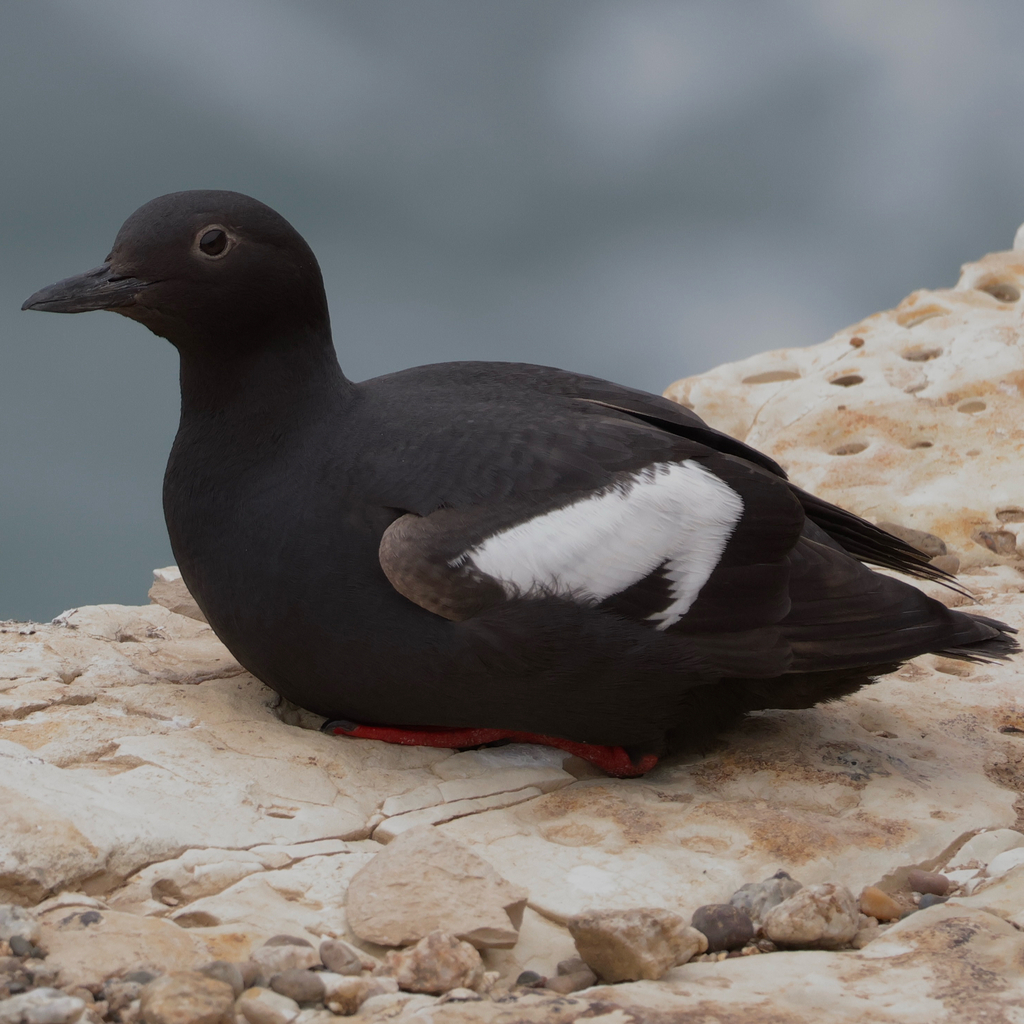
The pigeon guillemot is a medium-sized auk, measuring 30 to 37 cm in length and weighing 450 to 550 grams. In breeding plumage, adults are distinctive: dark brown with a black iridescent sheen, featuring a striking white wing patch interrupted by a brown-black wedge. During winter, they transition to mottled grey and black upperparts with white underparts. Both sexes are similar in appearance, though Californian females have larger bills than males. The species has a long black bill, red legs and feet with black claws, and a characteristic red interior to the mouth. A thin white eye-ring encircles the brown iris. Juveniles resemble winter adults but show brown-tipped underpart feathers and a smaller wing patch, with greyish-brown legs. The pigeon guillemot closely resembles the black guillemot but is distinguished by its darker wing wedge, which the black guillemot lacks.
Range & Habitat
This North Pacific seabird ranges from Siberia through Alaska to California, with five recognized subspecies distributed across this vast expanse. The pigeon guillemot breeds and sometimes roosts on rocky shores, cliffs, and islands positioned close to shallow water. During winter months, birds exhibit subtle migratory patterns: those in the northernmost part of their range move slightly south in response to advancing ice, while southern populations shift slightly north. The species generally favours more sheltered areas during the colder months.
Behaviour & Diet
Pigeon guillemots are pursuit divers, feeding on small fish and marine invertebrates caught mostly near the sea floor. They are monogamous breeders that nest in small colonies close to the shore, defending small territories around nesting cavities. Each pair typically lays one or two eggs, with both parents sharing incubation and chick-feeding duties. Once fledged, young birds become completely independent. The species undergoes substantial moulting cycles: birds moult into non-breeding plumage between August and October (becoming flightless for approximately four weeks) and into breeding plumage between January and March.
Best Time & Places to See It
Breeding season provides excellent opportunities to observe pigeon guillemots in their coastal habitats throughout the North Pacific. Rocky shores, cliffs, and islands from Siberia and Alaska southward to California offer the best viewing prospects. Winter birders should focus on sheltered coastal areas, particularly in the southern portion of the range where birds concentrate. The species' preference for shallow waters near rocky terrain makes it relatively accessible to patient observers along suitable coastlines.
Photography Tips
The pigeon guillemot's striking breeding plumage with its distinctive white wing patch and dark body provides excellent photographic subjects against rocky coastal backgrounds. The vibrant red legs, feet, and mouth interior offer colorful details worth capturing in close-ups. Photographers should note the dramatic seasonal plumage changes: the dark breeding plumage (visible January through October) contrasts sharply with the mottled winter appearance. Early morning light along rocky shores and islands will best illuminate the iridescent black sheen of breeding birds. Patience is rewarded when photographing nesting colonies, where both adults and fledglings display characteristic behaviors near their cliff and cavity nest sites.
Gulf Islands National Park Reserve
Southern Gulf Islands Electoral Area, Canada
+268 birds+26 mammals
Scattered across the Salish Sea in British Columbia's southwestern corner, this national park reserve stitches together a fragmented archipelago of forested islands and rocky outcrops where…
VIEW NATIONAL PARKKenai Fjords National Park
Kenai Peninsula Borough, United States
+164 birds+19 mammals
Granite peaks and tidewater glaciers dominate Alaska's Kenai Peninsula, where nearly 7,900 square kilometers of pristine coastal wilderness descend from the Harding Icefield toward the Gulf…
VIEW NATIONAL PARKKatmai National Park
Lake and Peninsula Borough, United States
+160 birds+19 mammals
Across southwestern Alaska's Lake and Peninsula Borough, nearly 27,000 square kilometers of subarctic wilderness sprawl between volcanic peaks and coastal wetlands, anchored by the confluence of…
VIEW NATIONAL PARKGlacier Bay National Park
Unorganized Borough, United States
+221 birds+15 mammals
Tidewater glaciers calving into fjords of impossible blue, where temperate rainforest rises steeply from the water's edge and alpine peaks pierce the clouds—this is the ecological…
VIEW NATIONAL PARKRedwood National Park
Humboldt County, United States
+343 birds+43 mammals
Where the Pacific fog rolls deep into northern California's coastal valleys, some of the tallest trees on Earth rise from a landscape shaped by tectonic forces…
VIEW NATIONAL PARKOlympic National Park
Jefferson County, United States
+263 birds+35 mammals
Where temperate rainforest meets alpine wilderness, Olympic National Park sprawls across nearly 11,000 square kilometers of the Pacific Northwest's most pristine landscape. The park's three distinct…
VIEW NATIONAL PARKWrangell-Saint Elias National Park
Unorganized Borough, United States
+155 birds+13 mammals
Where granite peaks thrust above 5,400 metres and vast fields of glacial ice dominate the landscape, Wrangell-Saint Elias encompasses one of North America's most extreme wilderness…
VIEW NATIONAL PARKGwaii Haanas National Park Reserve and Haida Heritage Site
Area E (Moresby Island), Canada
+98 birds+8 mammals
Where temperate rainforest meets the Pacific's edge, the islands of southern Haida Gwaii rise as one of North America's most pristine coastal wilderness areas. Spanning approximately…
VIEW NATIONAL PARKSt. Paul Island
Saint Paul, United States
+255 birds+8 mammals
Windswept tundra rolls across this remote Pribilof island, where volcanic basalt cliffs plunge into the Bering Sea and fog rolls in thick enough to erase the…
VIEW PROTECTED LANDSCAPEChannel Islands National Park
Santa Barbara County, United States
+330 birds+15 mammals
A chain of eight volcanic islands rises from the cold Pacific waters off the California coast, their rugged sea cliffs and windswept terrain shaped by millions…
VIEW NATIONAL PARKLake Clark National Park
United States
+158 birds+11 mammals
Where subarctic tundra meets volcanic terrain and pristine waterways, Lake Clark National Park unfolds across southwestern Alaska as a landscape carved by ice age glaciers and…
VIEW NATIONAL PARKKodiak National Wildlife Refuge
United States
+221 birds+22 mammals
Where temperate rainforest meets subarctic coast, Kodiak National Wildlife Refuge sprawls across Alaska's largest island, a sanctuary defined by steep valleys carved by tidewater glaciers and…
VIEW WILDLIFE SANCTUARYAlaska Maritime National Wildlife Refuge
Alaska, United States
+391 birds+58 mammals
Where the North Pacific collides with Alaska's rugged coastline, a sprawling archipelago of islands, rocky outcrops, and coastal headlands forms one of North America's most remote…
VIEW WILDLIFE SANCTUARYIzembek National Wildlife Refuge
Cold Bay, United States
+138 birds+9 mammals
Where the Aleutian archipelago reaches westward into the Bering Sea, subarctic tundra and shallow coastal waters converge to create one of Alaska's most ecologically vital wildlife…
VIEW WILDLIFE SANCTUARYBecharof National Wildlife Refuge
United States
+146 birds+2 mammals
Across southwestern Alaska's windswept lowlands, where the Bristol Bay watershed spills into vast tidal flats and sedge marshes, lies one of North America's most pristine subarctic…
VIEW WILDLIFE SANCTUARYDon Edwards San Francisco Bay National Wildlife Refuge
Fremont, United States
+286 birds+20 mammals
Where the San Francisco Bay's shallow margins dissolve into tidal salt marshes and mudflats, this wildlife sanctuary preserves one of California's most ecologically vital estuarine systems.…
VIEW WILDLIFE SANCTUARYFarallon National Wildlife Refuge
San Francisco, United States
+384 birds+16 mammals
Windswept granite peaks rising abruptly from the Pacific, the Farallon Islands form a wildlife sanctuary of extraordinary seabird abundance and ecological significance just twenty-seven miles west…
VIEW WILDLIFE SANCTUARYNo community photos yet. Log in to add the first one.
No community observations of this species yet.