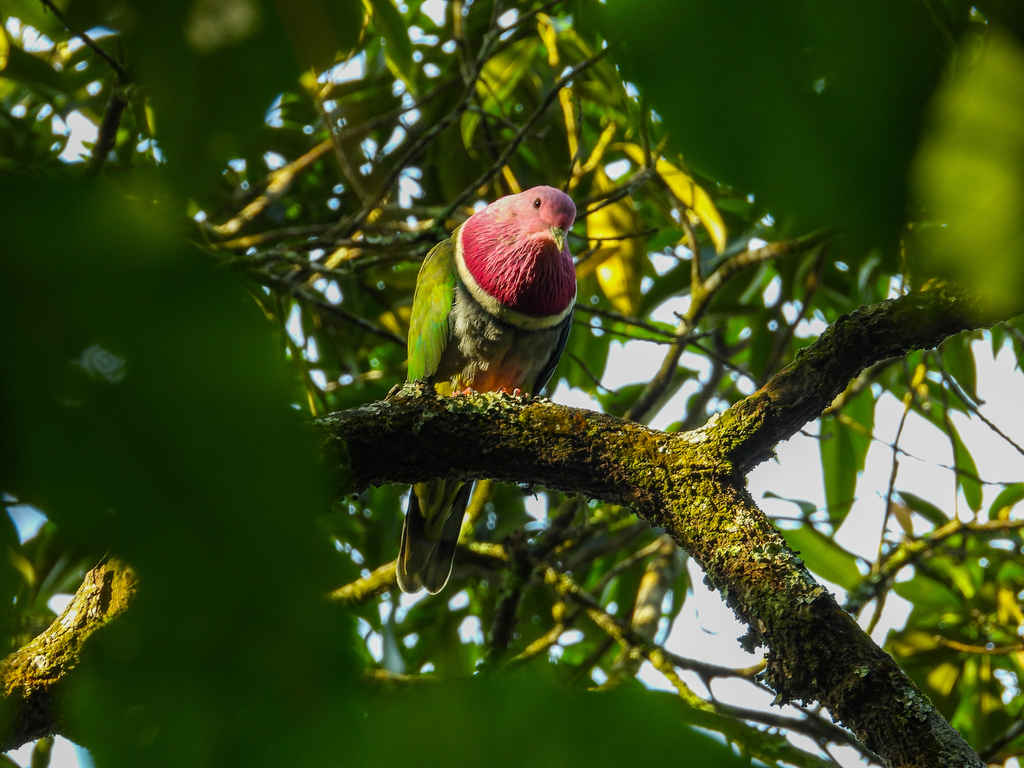
Pink-headed Fruit Dove
Photo © ꦥꦤ꧀ꦗꦶꦒꦸꦱ꧀ꦠꦶꦄꦏ꧀ꦧꦂ
Photo © ꦥꦤ꧀ꦗꦶꦒꦸꦱ꧀ꦠꦶꦄꦏ꧀ꦧꦂ — CC BY 4.0 — Source: iNaturalist #181152464Identification
The pink-headed fruit dove is a small, colourful dove with striking sexual dimorphism. The male displays a distinctive purple-pink head, neck and throat, bordered below by a white band outlined in greenish-black. The upperparts are green and underparts grey, with bright yellow undertail coverts. The iris is orange, the bill greenish, and feet pink. The female is noticeably duller, with a weaker breast band, while juveniles are even more subdued versions of females. The species produces a soft, melodious 'hoo' call that is often the first indication of its presence.
Range & Habitat
The pink-headed fruit dove is an endemic resident breeder of Indonesia, occurring exclusively in the mountain forests of Sumatra, Java and Bali. The species is highly restricted, found only at altitudes between 1,000–2,200 m, with most populations occurring on forested mountains at least 2,000 m high. Its range is fragmented across fewer than 12,000 km² of forest habitat, distributed across three sites on Sumatra, sixteen on Java, and one on Bali. Most forest patches occupied are smaller than 200 km², and these sites are steadily shrinking.
Behaviour & Diet
The pink-headed fruit dove is an exceptionally shy and inconspicuous species, typically observed singly or in pairs as it forages high in the forest canopy. However, flocks of up to 17 birds may congregate at particularly productive fruit trees. The dove feeds on figs, small fruits and berries in the upper canopy, where it remains well-camouflaged amongst green foliage. Breeding involves a distinctive division of labour: males construct the characteristic flimsy, pigeon-like nest in trees, while females perch in nearby tall trees rather than participating in nest construction. Females lay one or two white eggs, which are incubated for 20 days; chicks fledge after a further 15–16 days.
Best Time & Places to See It
Locating this elusive dove requires patience and a focus on montane forest habitats above 1,000 m in Sumatra, Java and Bali. The species is present year-round as a resident bird. Your best chances come during the fruiting season at favoured fruit trees, when birds are most likely to congregate. Early morning is typically the most productive time for observation. Working with experienced local guides familiar with individual territories and fruiting cycles significantly increases sighting probability, though the species' cryptic behaviour means encounters remain unpredictable.
Photography Tips
The pink-headed fruit dove's preference for high canopy foraging and cryptic behaviour present considerable challenges for photographers. Position yourself near fruiting fig or fruit-bearing trees within suitable montane forest, and use patient stalking or waiting strategies. The male's vibrant purple-pink head and white breast band provide striking subject matter when well-lit, but backlighting through canopy foliage often creates silhouettes. A telephoto lens (400–600 mm) is essential given the bird's height in the canopy and wariness. Early morning light is preferable, and recording the soft 'hoo' call may aid in locating birds. Expect long waits and be prepared for mostly obscured or distant views typical of canopy doves.
Gunung Ciremai National Park
Gunung Merbabu National Park
Kerinci Seblat National Park
Mount Merapi National Park
West Bali National Park
Nothing matches these filters.
No community photos yet. Log in to add the first one.
No community observations of this species yet.