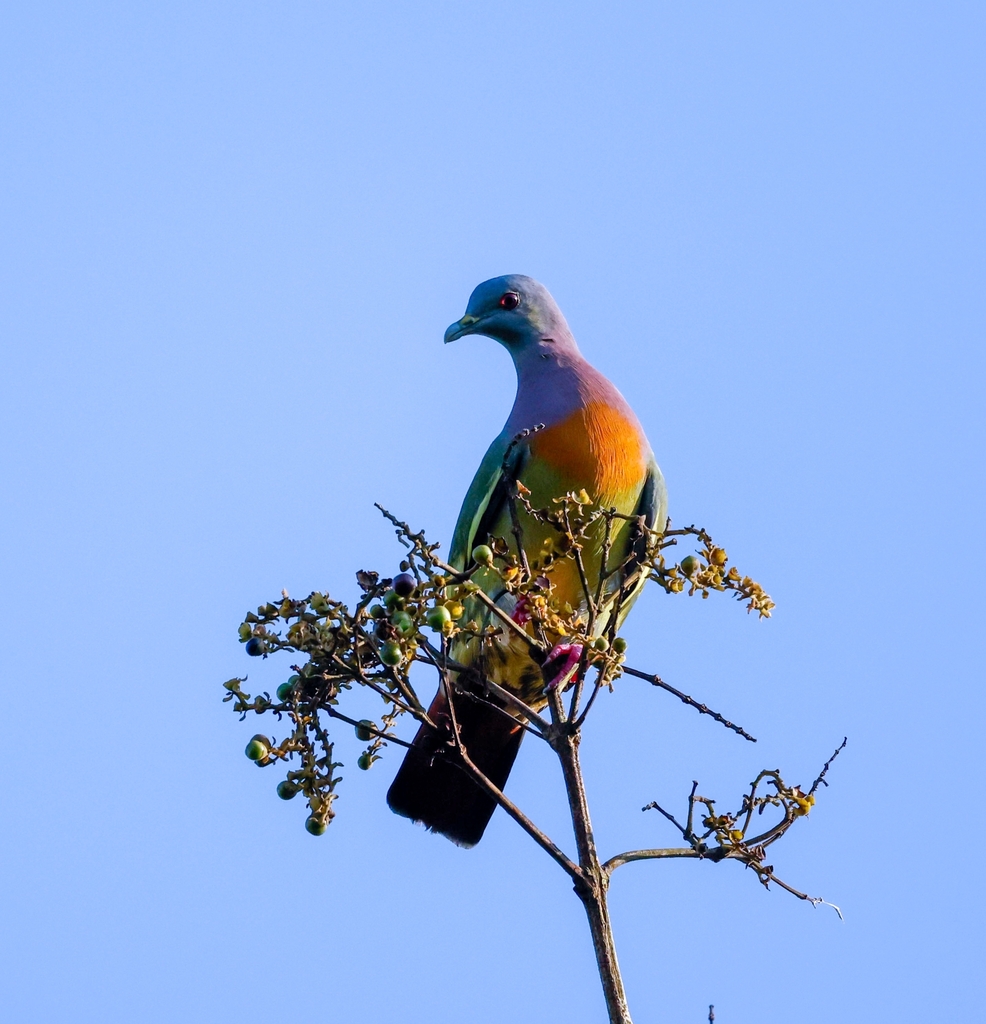
Pink-necked Green Pigeon
Photo © pittafisher
Photo © pittafisher — CC BY 4.0 — Source: iNaturalist #254503453Identification
The pink-necked green pigeon is a medium-sized pigeon measuring 25 to 30 cm in length and weighing around 105–160 g. The species exhibits striking sexual dimorphism. Males are particularly distinctive, featuring a grey head, pinkish neck and upper breast, and an orange lower breast. Their backs are olive green with green wings marked by black primaries and a distinctive yellow bar across the wings in flight. The belly is yellowish with grey flanks, and the tail is grey with a black terminal band and chestnut upper coverts. Females are smaller overall, with a yellowish belly, throat and face, and greenish crown and back of the neck. Both sexes have pink or reddish legs and white to pale blue-grey bills. Juveniles resemble females but are greyer above.
Unlike many pigeons in the genus Treron, this species is not particularly vocal, though males produce distinctive tri-syllabic whistling calls ending in a coo. Rasping krrak krrak calls have also been recorded. Birds typically call only in communal roosts and when discovering food sources.
Range & Habitat
The pink-necked green pigeon is a common species throughout Southeast Asia, ranging from southern Myanmar, Thailand, Cambodia, and Vietnam southward through the Malay Peninsula and across the Greater Sundas, Bali, Lombok, Sumbawa, and the Moluccas, extending as far east as the Philippines. The species occupies remarkably varied habitats, from primary and secondary forests to forest edges, coastal mangroves, gardens, plantations, and farmland. It shows a clear preference for open environments and typically occurs at forest edges rather than in dense forest interiors. While most common in lowlands and coastal areas, it ranges up to 300 m in the Philippines, 750 m in Borneo, and 1,200 m in Sulawesi. Local movements occur, likely linked to fruit availability, though the species is generally non-migratory.
The species demonstrates remarkable colonisation ability, being among the first frugivores to establish itself on the Krakatoa islands following the catastrophic 1883 eruption, and subsequently colonising newly emerged Anak Krakatau within 36 years of a major eruption in 1952. It has also recently expanded its range to include Flores.
Behaviour & Diet
The pink-necked green pigeon is primarily a frugivore, with its diet dominated by figs, though it also consumes fruits from Glochidion, Breynia, Vitex, Macaranga, Muntingia, Melastoma, Oncosperma, and Bridelia. Shoots, buds, and seeds are taken only occasionally. Pairs work together to raise their young, laying two eggs in a flimsy twig nest constructed in a tree, shrub, or hedge. Both parents share incubation duties and chick-rearing responsibilities. The species is considered an important disperser of fruit seeds throughout its range.
The pink-necked green pigeon has proven remarkably adaptable to human-modified environments and can thrive in crowded cities provided fruiting trees are present. This flexibility has enabled the species to maintain healthy populations across its range despite extensive habitat conversion.
Best Time & Places to See It
As a non-migratory or locally mobile species, the pink-necked green pigeon can be encountered year-round throughout its Southeast Asian range. However, sightings and activity levels are likely highest during periods of fruit abundance. The species favours open habitats and edges, making it more readily observed than many forest pigeons. Look in gardens, agricultural areas, coastal regions, and forest margins rather than dense interior forest. Communal roosts, particularly in fruiting fig trees, offer excellent viewing opportunities, especially in the early morning and evening hours when birds gather to feed and call.
Photography Tips
The striking sexual dimorphism of this species makes it rewarding to photograph both males and females for comparative images. Males' iridescent pink and orange plumage is particularly photogenic in good light. The yellow bar across the wings visible in flight is a distinctive feature worth capturing. Early morning and late afternoon light will best render the males' subtle but beautiful coloration. Patience near fruiting trees, particularly figs, will reward photographers with natural behavioural shots. Watch for communal roosts at dawn and dusk when birds are vocal and active, offering dynamic composition opportunities.
Mu Ko Ang Thong National Park
Thailand
+47 birds+1 mammals
Forty-two limestone islands rise from the Gulf of Thailand, their weathered karst peaks piercing emerald waters in a landscape of stunning geological drama. Mu Ko Ang…
VIEW NATIONAL PARKHat Noppharat Thara-Mu Ko Phi Phi National Park
Ao Nang, Thailand
+253 birds+9 mammals
Where limestone karsts rise dramatically from turquoise waters, Hat Noppharat Thara-Mu Ko Phi Phi National Park unfolds across a mosaic of beach, mangrove forest, and island…
VIEW NATIONAL PARKMu Ko Similan National Park
Lam Kaen, Thailand
+82 birds+1 mammals
Granite islands rise from the Andaman Sea in a scattered archipelago where limestone cliffs meet turquoise shallows, their steep faces weathered into caves and overhangs that…
VIEW NATIONAL PARKKhao Laem Ya-Mu Ko Samet National Park
Mueang Rayong District, Thailand
+159 birds+3 mammals
Where limestone hills meet the Gulf of Thailand, Khao Laem Ya–Mu Ko Samet National Park stitches together a mosaic of terrestrial and marine worlds that few…
VIEW NATIONAL PARKBako National Park
Kuching, Malaysia
+210 birds+17 mammals
Weathered sandstone cliffs rise dramatically from the South China Sea, their ochre faces sculpted by millennia of wind and tide into a landscape of extraordinary geological…
VIEW NATIONAL PARKKuching Wetlands National Park
Kuching, Malaysia
+103 birds+4 mammals
Where brackish waters meet mangrove stilts and freshwater swamps blend into coastal mudflats, one of Southeast Asia's most dynamic wetland ecosystems unfolds across Sarawak's northwestern coast.…
VIEW NATIONAL PARKTaman Negara National Park
Kampong Samas, Malaysia
+393 birds+48 mammals
Where ancient rainforest meets limestone peaks, one of Southeast Asia's oldest protected wilderness preserves sprawls across 4,343 square kilometers of primordial landscape. Dipterocarp giants tower overhead,…
VIEW NATIONAL PARKPenang National Park
Balik Pulau, Malaysia
+107 birds+2 mammals
Granite peaks rise abruptly from the Andaman Sea where tropical rainforest clings to steep slopes in one of Malaysia's oldest protected landscapes. Mangrove forests fringe the…
VIEW NATIONAL PARKTaman Negara Bukit Lambir National Park
Miri, Malaysia
+153 birds+7 mammals
Rainforest cascades down sandstone ridges where crystal streams carve through ancient geology, creating a landscape of profound biological richness in Sarawak's interior. This 68-square-kilometre sanctuary protects…
VIEW NATIONAL PARKGunung Mulu National Park
Long Seridan, Malaysia
+280 birds+39 mammals
Where granite monoliths pierce the rainforest canopy of Sarawak, an ancient limestone karst landscape reveals one of Southeast Asia's most biodiverse strongholds. Soaring peaks cloaked in…
VIEW NATIONAL PARKTaman Nasional Baluran
Situbondo, Indonesia
+189 birds+9 mammals
Across the northeastern tip of East Java, where monsoon winds sweep down from the Bali Strait, a landscape of contrasts unfolds within 374 square kilometres of…
VIEW NATIONAL PARKWest Bali National Park
Gerokgak, Indonesia
+240 birds+8 mammals
Across West Bali's northwestern reaches, where the Indian Ocean meets volcanic slopes and limestone cliffs plunge toward turquoise shallows, sprawls a protected realm of roughly 325…
VIEW NATIONAL PARKBogani Nani Wartabone National Park
Bolaang Mongondow, Indonesia
+154 birds+4 mammals
Across North Sulawesi's rugged interior, where tectonic uplift has carved steep ridges and deep valleys through ancient volcanic terrain, Bogani Nani Wartabone National Park sprawls across…
VIEW NATIONAL PARKGunung Ciremai National Park
Majalengka, Indonesia
+116 birds+1 mammals
Volcanic slopes rise sharply from West Java's interior, where Gunung Ciremai's 3,078-metre summit dominates a landscape carved by geological upheaval and shaped by equatorial monsoon rainfall.…
VIEW NATIONAL PARKMount Merapi National Park
Hargobinangun, Indonesia
+150 birds+3 mammals
Where the volcanic slopes of central Java rise into mist and montane forest, Mount Merapi National Park guards one of Indonesia's most dynamic landscapes. Spanning roughly…
VIEW NATIONAL PARKKerinci Seblat National Park
Kerinci, Indonesia
+228 birds+16 mammals
Across nearly 67,000 square kilometres of Sumatra's spine, a mountainous realm of equatorial rainforest rises from steaming lowlands to volcanic peaks shrouded in cloud. Kerinci Seblat…
VIEW NATIONAL PARKWay Kambas National Park
Lampung Timur, Indonesia
+237 birds+20 mammals
Across the low swamplands of eastern Lampung, where freshwater wetlands merge into tidal mangrove forests along the Sunda Strait, sprawls one of Sumatra's most vital sanctuaries.…
VIEW NATIONAL PARKNo community photos yet. Log in to add the first one.
No community observations of this species yet.