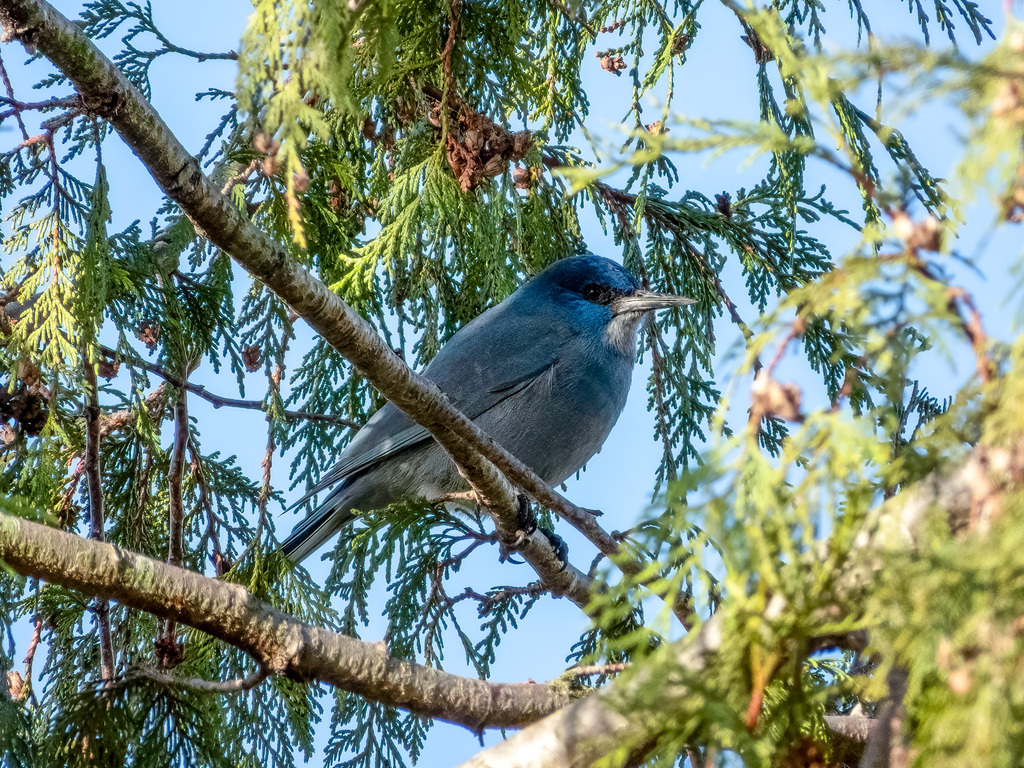
Pinyon Jay
Photo © Jason Alexander
Photo © Jason Alexander — CC BY 4.0 — Source: iNaturalist photo #343557259Identification
The pinyon jay is a bluish-grey bird with deeper colouring on the head and a distinctive whitish throat. It has a black bill, legs, and feet. In size and proportions, it sits roughly between the blue jay and the Eurasian jay, though it shares a similar body structure with Clark's nutcracker—a similarity explained by convergent evolution, as both species occupy comparable ecological roles. Historically, this species was sometimes called the "blue crow."
Range & Habitat
Native to western North America, the pinyon jay ranges from central Oregon south to northern Baja California, and eastward to western Oklahoma. These birds are permanent residents of pinyon-juniper woodlands and low-elevation ponderosa pine forests throughout the southwestern United States, with their range centred on areas where pinyon pines and junipers dominate the landscape. In the northwestern portion of their range, they rely heavily on singleleaf pinyon, while in the southeast they depend on Colorado pinyon. When pinyon seed crops fail, they may wander widely across the Great Basin, northward into Washington and Montana, and south into Mexico and Texas.
Behaviour & Diet
Pinyon jays share a remarkable mutual relationship with pinyon trees: the trees provide food, nesting sites, roosting areas, and breeding stimulus, while the jays influence seed dispersal and the genetic structure of pinyon populations. Their diet centres on pinyon seeds, which become available in variable cycles—Colorado pinyon produces substantial nut crops every 4 to 7 years, while singleleaf pinyon has intervals of 2 to 7 years between cone production. These seed crops are episodic and geographically synchronous, likely an adaptation to counteract seed predation. The availability of seeds directly influences the birds' breeding success and survival.
Best Time & Places to See It
Pinyon jays are best found in pinyon-juniper woodlands and ponderosa pine forests across the southwestern United States, particularly in Colorado, northern Arizona, Utah, and Nevada—regions where vast acreages of these woodland types occur. Since they are permanent residents throughout their range, they can be seen year-round, though their presence and behaviour are strongly tied to pinyon seed availability. During years of poor seed crops, irregular wandering movements may place them in unexpected locations across the western states.
Photography Tips
The subtle beauty of the pinyon jay—its bluish-grey plumage with darker head markings and pale throat—rewards careful observation and patient photography. These birds are often found in family groups moving through pinyon and juniper trees, making them engaging subjects in their natural habitat. Photographing them within their characteristic landscape of woodland foothills will provide valuable context for wildlife imagery, particularly during the seasons when they are actively foraging in the canopy.
Arches National Park
Badlands National Park
Bear River Migratory Bird Refuge
Black Canyon of the Gunnison National Park
Bosque del Apache National Wildlife Refuge
Bryce Canyon National Park
Canyonlands National Park
Capitol Reef National Park
Carlsbad Caverns National Park
Nothing matches these filters.
No community photos yet. Log in to add the first one.
No community observations of this species yet.