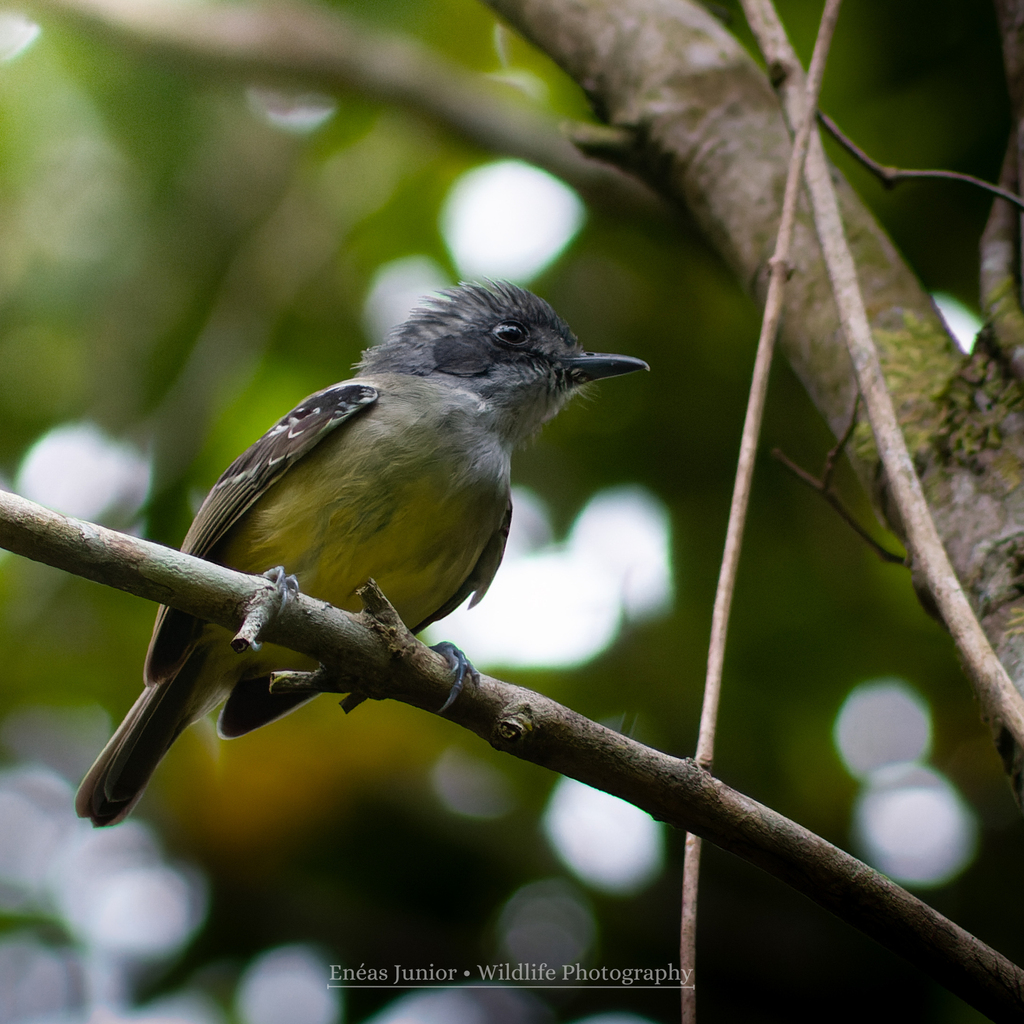
Plain Antvireo
Photo © Enéas V. Gouvêa Junior
Photo © Enéas V. Gouvêa Junior — CC BY-SA 4.0 — Source: iNaturalist #190103474Identification
The Plain Antvireo is a small, compact passerine measuring 10–13 cm in length and weighing 12–16 g. It is a chunky bird characterized by a large head and short tail. Males of the nominate subspecies display a dark gray forehead and crown with blackish ear coverts, grayish-olive upperparts, and a distinctive hidden white patch between the scapulars. The wings are dark grayish-olive with white tips on the greater coverts and blackish median coverts; the tail is dark with narrow white tips. The throat and upper breast are white with light gray spotting, while the lower breast and flanks are pale gray with a yellow belly center. Females are noticeably different, featuring a cinnamon-tawny crown, more olive (less gray) upperparts without the interscapular patch, and more extensive yellow on the underparts than males. With 18 recognized subspecies across its range, plumage varies considerably, from grayer northern populations to warmer, more olive-toned southern birds.
Range & Habitat
The Plain Antvireo has a wide but disjunct distribution across Mexico, Central America, Trinidad and Tobago, and much of mainland South America, notably absent from Chile, French Guiana, Suriname, and Uruguay. Its range extends from southeastern Mexico (Campeche, Tabasco, and Chiapas) southward through Central America on both Caribbean and Pacific slopes, then fragments across multiple Andean regions and lowland areas of South America. The species occupies humid forest and woodland habitats throughout its range, with different subspecies adapted to various elevations and slope exposures—from lowland Caribbean rainforests to cloud forests and Andean foothills.
Behaviour & Diet
Like other antbirds in the subfamily Thamnophilinae, the Plain Antvireo is an insectivorous forager that typically hunts in the understory and mid-story levels of forest. It is generally found in small groups or pairs, actively gleaning insects from foliage and branches with characteristic quick, deliberate movements. The species is relatively inconspicuous despite its wide distribution, favoring dense vegetation where it can be easily overlooked.
Best Time & Places to See It
The Plain Antvireo can be found year-round throughout its range, making it accessible to travelers during any season. In Central America, it is readily encountered in protected forests of Costa Rica and Panama, particularly in Caribbean slope reserves. In South America, humid forests across the Andes and lowland Amazonian regions host various subspecies. Early morning hours typically offer the best viewing opportunities, when the bird is most active and vocal. Visitors should focus on mid-story vegetation in humid forest habitats, particularly in areas with dense understory vegetation.
Photography Tips
Photographing Plain Antvireos presents a moderate challenge due to their small size and preference for dense vegetation. A telephoto lens of at least 400 mm is recommended to capture adequate detail. Early morning light provides the best conditions, and patience is essential—scanning slowly through likely habitat with binoculars first will help locate birds before attempting photography. Males' contrasting plumage and white patches between the scapulars (visible when the bird moves) offer good focal points. Focus on areas where mixed-species flocks congregate, as Plain Antvireos often join these groups, increasing encounter rates and photo opportunities.
Araucárias National Park
Arenal Volcano National Park
Bahuaja Sonene National Park
Baru Volcano National Park
Brasília National Park
Braulio Carrillo National Park
Carara National Park
Carlos Botelho State Park
Cerros de Amotape National Park
Nothing matches these filters.
No community photos yet. Log in to add the first one.
No community observations of this species yet.