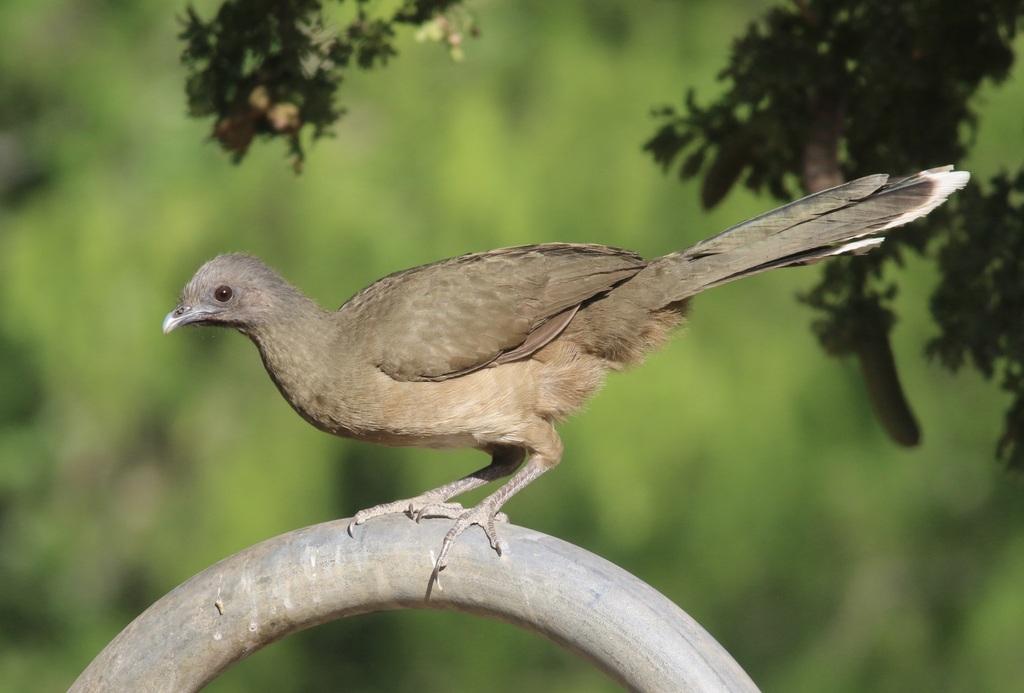
Plain Chachalaca
Photo © Cricket Raspet
Photo © Cricket Raspet — CC BY 4.0 — Source: iNaturalist photo #625738259Identification
The plain chachalaca is a medium-sized galliform measuring 48–58 cm in length, roughly the size of a common pheasant. Both sexes are similar in appearance, though males average larger. The bird has a long neck, small head, and distinctive bare throat patch that becomes deep red during the breeding season in both sexes. Adults display a greyish head and neck contrasting with a dull olive-brown body and wings. The underbelly ranges from pale to ochraceous, while the blackish tail features a green gloss and buffy-white tip. The brown iris, black bill, and dull grey orbital skin and feet complete the picture.
Range & Habitat
The plain chachalaca breeds across tropical and subtropical environments from the Rio Grande Valley in southernmost Texas through the eastern coast of Mexico, the Yucatán Peninsula, Belize, northern Guatemala, northern Honduras, and into north central Nicaragua. A separate population exists on the Nicoya Peninsula of northern Costa Rica. The species has also been introduced to parts of coastal Georgia. Elevation range extends from sea-level to 1,850 m.
This adaptable bird occupies primary and secondary forests, forest edges, riverine habitats, and thorny bush-scrub, as well as human-modified landscapes including orchards, suburban parks, gardens, and croplands. Unlike other cracids, it uniquely thrives in scrubland that develops after tropical rainforest clearing, making it more versatile than its relatives in disturbed habitats.
Behaviour & Diet
Plain chachalacas are mostly diurnal, showing peak activity during cool mornings and evenings while remaining largely inactive during midday heat. They are typically found in groups of up to 15 birds, displaying furtive and wary behaviour. When threatened, they prefer escaping by running swiftly on the ground or leaping and gliding through brushy tangles rather than flying. Pairs or family groups roost communally in trees on branches, often touching and facing the same direction.
The birds feed both in trees and on the ground, consuming fruit (including figs, palms, and sapotaceae family plants), seeds, leaves, and flowers. Primary dietary items include berries from coyotillo, Mexican ash, pigeon-berry, and cedar elm. Animal matter is taken incidentally and consists of small snails, caterpillars, and insects. Plain chachalacas occasionally become crop pests, particularly in tomato and cucumber plantings.
Best Time & Places to See It
The best opportunities for observing plain chachalacas come during early morning and evening hours when they are most vocal and active. Listen for their loud, raucous calls—described as RAW-pa-haw or cha-cha-LAW-ka—often delivered in rhythmical choruses by multiple birds. Early morning and evening are prime times for spotting them, particularly during the early wet season when breeding activity increases. Search for them in mixed forest and scrub habitats, especially where vegetation provides good cover.
Photography Tips
Photographers should position themselves near dense vegetation where chachalacas congregate, as the birds prefer to stay well up in trees and within brushy tangles. Early morning and late afternoon light will be most advantageous. Since these birds are furtive and wary, patience and careful movement are essential. Audio recording equipment can be valuable for documenting their distinctive vocal choruses. The bird's relatively dull plumage may require careful exposure metering to capture detail, though the distinctive bare red throat patch during breeding season provides an excellent focal point when visible.
Santa Rosa National Park
Santa Elena, Costa Rica
+359 birds+30 mammals
Where Pacific-facing slopes descend from volcanic uplands toward the Guanacaste lowlands, Santa Rosa National Park unfolds across a mosaic of tropical dry forest, gallery woodland, and…
VIEW NATIONAL PARKGuanacaste National Park
Santa Elena, Costa Rica
+461 birds+17 mammals
Where the Pacific slopes of northwestern Costa Rica rise toward the Continental Divide, dry tropical forest gives way to cloud-laden peaks and misty ridges—a landscape that…
VIEW NATIONAL PARKDzibilchantún National Park
Barcelona, Mexico
+144 birds+2 mammals
Across the limestone plains of Yucatán, where cenotes pierce the bedrock and tropical forest clings to shallow soils, lies Dzibilchantún—a modest yet ecologically vital national park…
VIEW NATIONAL PARKLagunas de Montebello National Park
Laguna de Montebello, Mexico
+360 birds+2 mammals
Where turquoise lagoons pierce the limestone plateau of southeastern Chiapas, the Lagunas de Montebello National Park unfolds across roughly 174 square kilometers of spectral water and…
VIEW NATIONAL PARKSian Ka’an
Chunyaxché, Mexico
+350 birds+16 mammals
Where the Yucatán Peninsula dissolves into wetland and mangrove, a vast mosaic of forest, lagoon, and coastal margin creates one of Mexico's most biodiverse strongholds. Across…
VIEW BIOSPHERE RESERVESierra de Tamaulipas
El Porvenir, Mexico
+98 birds+19 mammals
Where limestone peaks thrust skyward through dense subtropical forest, Mexico's northeastern frontier reveals one of the continent's most biodiverse mountain ranges. Canyons carved by perennial rivers…
VIEW NATURE RESERVEMontes Azules
Candelaria, Mexico
+395 birds+47 mammals
Where jungle-clad limestone plateaus plunge into canyon systems carved by the Usumacinta River, Mexico's most pristine rainforest reserve unfolds across the Lacandón region of Chiapas. Montes…
VIEW BIOSPHERE RESERVELaguna del Tigre National Park
Petén, Guatemala
+399 birds+29 mammals
Where the Petén lowlands dissolve into wetland and forest, Laguna del Tigre National Park protects one of Guatemala's most ecologically vital landscapes. This sprawling reserve encompasses…
VIEW NATIONAL PARKSierra del Lacandón National Park
Petén, Guatemala
+348 birds+7 mammals
Where the Petén rainforest rises into limestone ridges and deep ravines, Sierra del Lacandón National Park protects one of Central America's most intact tropical wilderness zones.…
VIEW NATIONAL PARKLaguna Atascosa National Wildlife Refuge
Cameron County, United States
+365 birds+19 mammals
Where coastal prairie meets shallow lagoon along the southernmost tip of Texas, Laguna Atascosa National Wildlife Sanctuary sprawls across a landscape sculpted by salt spray and…
VIEW WILDLIFE SANCTUARYSanta Ana National Wildlife Refuge
Hidalgo County, United States
+349 birds+12 mammals
Where the Rio Grande delta meets the semi-arid scrublands of South Texas, Santa Ana National Wildlife Sanctuary preserves a rare mosaic of wetland and thornforest habitat…
VIEW WILDLIFE SANCTUARYLower Rio Grande Valley National Wildlife Refuge
Starbase, United States
+311 birds+11 mammals
Where the Rio Grande delta spreads across the coastal plain of South Texas, a sanctuary of subtropical wetlands and riparian corridors creates a landscape that pulses…
VIEW WILDLIFE SANCTUARYPalo Verde National Park
Bagaces, Costa Rica
+318 birds+24 mammals
Dry forest spreads across Palo Verde's low-lying terrain in northwestern Guanacaste, where seasonal rivers and lagoons etch through deciduous woodland that sheds its canopy each winter.…
VIEW NATIONAL PARKRincón de la Vieja National Park
Liberia, Costa Rica
+451 birds+30 mammals
Where volcanic slopes rise abruptly from the Guanacaste lowlands, Rincón de la Vieja National Park sprawls across a landscape shaped by geothermal drama and seasonal extremes.…
VIEW NATIONAL PARKVolcán Tenorio National Park
Guatuso, Costa Rica
+480 birds+12 mammals
Where volcanic slopes rise through Costa Rica's northwestern borderlands, Volcán Tenorio National Park sprawls across terrain shaped by ancient lava flows and mineral-rich springs. The park's…
VIEW NATIONAL PARKMarino Las Baulas National Park
Santa Cruz, Costa Rica
+246 birds+9 mammals
Where the Pacific meets a mosaic of dry forest and mangrove estuary, this coastal national park protects one of Central America's most dynamic wildlife theatres. The…
VIEW NATIONAL PARKCurú National Wildlife Refuge
Paquera, Costa Rica
+249 birds+8 mammals
Where the Pacific coast of Puntarenas dissolves into dry deciduous forest and mangrove fringe, Curú Wildlife Sanctuary holds one of Costa Rica's most ecologically vital yet…
VIEW WILDLIFE SANCTUARYNo community photos yet. Log in to add the first one.
No community observations of this species yet.