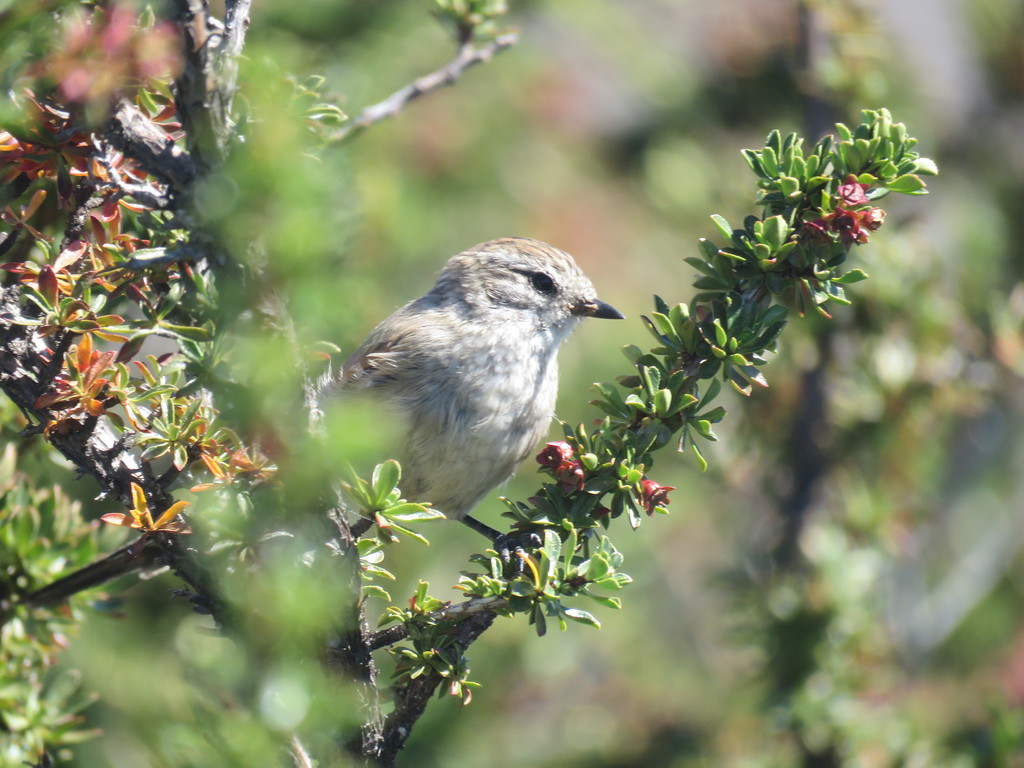
Plain-mantled Tit-Spinetail
Photo © Diego Carús
Photo © Diego Carús — CC0 1.0 — Source: iNaturalist photo #31738133Identification
The plain-mantled tit-spinetail is a small, slender passerine measuring 15 to 17 cm in length and weighing just 7.5 to 11 grams. It belongs to the ovenbird family and is characterized by its long tail, short bill, and lack of sexual dimorphism. Adults of the nominate subspecies display a distinctive white supercilium contrasting with an otherwise dark brownish face with whitish streaks. The crown is dark brown with golden-tawny streaks, while the back and rump are dull brownish. The wings feature rufous-edged coverts and dark rufous-based flight feathers, and the tail is notably graduated with a forked appearance due to reduced inner webs on the central feathers. The throat is whitish with dark edges that increase toward the upper breast, and the remaining underparts are dull grayish brown. Juveniles are distinguishable by indistinct crown and throat markings and rounded tail feathers.
The four recognized subspecies show notable plumage variation. Subspecies grisescens is overall paler with a grayer back and buffier rump. The berlepschi subspecies is larger and bulkier, with a striking cinnamon crown and entirely buffy underparts. The pallida subspecies, found in southern regions, possesses the longest tail of all subspecies and pale gray upperparts with a pale buffy rump.
Range & Habitat
The plain-mantled tit-spinetail is found across South America in Argentina, Bolivia, Chile, and Peru, with distribution varying by subspecies. The nominate subspecies occurs in central Chile between the Coquimbo and Aysén regions. The grisescens subspecies is the northernmost, found coastally from Peru's Department of Arequipa south through northern Chile. The berlepschi subspecies inhabits the Andes of southern Peru, northern Chile, western Bolivia, and northwestern Argentina. The pallida subspecies ranges from northern Argentina and southern Chile south to Tierra del Fuego.
Habitat preferences also vary geographically. The nominate and grisescens subspecies favor arid scrublands, open forests, and human-modified areas such as agricultural fields and oases, ranging from near sea level to 2,500 meters in Chile. The berlepschi subspecies specializes in puna grasslands and scrublands of the Altiplano at elevations of 2,000 to 4,300 meters. The pallida subspecies inhabits scrublands, woodlands, salt flats, and arid thorny woods at lower elevations from sea level to 700 meters.
Behaviour & Diet
The plain-mantled tit-spinetail feeds on arthropods, foraging by gleaning prey from foliage, flower clusters, twigs, and branches. It typically forages in pairs or small family groups, though in the non-breeding season it may gather in flocks of up to 40 individuals. The species regularly joins mixed-species feeding flocks and forages from the forest understory to the canopy, though in some areas it remains at lower levels or even on the ground. Notably, it sometimes hangs upside down to access prey, demonstrating considerable agility.
Movement patterns vary by subspecies. The nominate subspecies is partially migratory, with some populations moving downslope after breeding. The grisescens subspecies moves between widely separated oases in desert areas. The berlepschi subspecies is thought to be a year-round resident, while the pallida subspecies exhibits complex migrations that are not yet fully understood.
Best Time & Places to See It
The plain-mantled tit-spinetail breeds during the austral spring and summer, making these seasons optimal for observation and photography. To encounter this species, target the appropriate habitat for each subspecies: arid scrublands and open forests for the nominate and grisescens forms, high-altitude puna grasslands for berlepschi, and scrubland-woodland transitions for pallida. The species' habit of joining mixed-species feeding flocks can increase sighting opportunities, as observing one feeding flock may yield multiple species.
The bird's preference for foraging from understory to canopy levels means scanning foliage carefully at various heights. Its tendency to forage on the ground in some areas and frequent visits to flower clusters should guide your search strategy. Visiting protected areas and nature reserves within the species' range during breeding season will maximize your chances of encountering this inconspicuous but widespread South American resident.
Photography Tips
Photography of the plain-mantled tit-spinetail presents challenges typical of small, active forest birds. The bird's diminutive size and preference for foraging in foliage and at various canopy heights demand patience and careful positioning. Position yourself where morning or late afternoon light can illuminate the bird from behind or side angles to highlight the distinctive white supercilium and golden-tawny crown streaks.
The species' foraging behavior offers excellent opportunities: watch for gleaning movements on foliage and branches, and anticipate the upside-down feeding posture that provides distinctive compositional opportunities. Photographing birds in mixed-species flocks may require wider focal lengths to capture behavioral context. Given the variation between subspecies, document plumage details carefully if your location falls within the range of multiple subspecies. Early morning when birds are most active in scrublands and open areas will yield the best light and behavior.
Salar del Huasco National Park
Pica, Chile
+75 birds+2 mammals
High above the Atacama's shimmering flats, where the Andes grip the sky, lies a landscape of stark geological drama and surprising biological richness. Salar del Huasco…
VIEW NATIONAL PARKChiloé National Park
Dalcahue, Chile
+122 birds+6 mammals
Temperate rainforest cloaks the Chiloé archipelago's northwestern reaches, where granite ridges thrust through dense, moisture-laden canopy and freshwater streams carve ravines toward the Pacific. Across approximately…
VIEW NATIONAL PARKPan de Azúcar National Park
Chañaral, Chile
+74 birds+4 mammals
Where the Atacama Desert plunges toward the Pacific, Pan de Azúcar National Park sprawls across 727 square kilometres of one of Earth's most extreme transitions—a landscape…
VIEW NATIONAL PARKTorres del Paine National Park
Torres del Paine, Chile
+143 birds+10 mammals
Where granite spires pierce the Patagonian sky, Torres del Paine commands one of South America's most dramatic landscapes. Across 4,106 square kilometres of southern Chile, jagged…
VIEW NATIONAL PARKLaja National Park Lagoon
Antuco, Chile
+123 birds+1 mammals
Where the Andes descend into the Biobío Region's temperate forests, a vast lagoon fills the caldera of the extinct Antuco volcano, cradled by steep native woodland…
VIEW NATIONAL PARKPuyehue National Park
Puyehue, Chile
+110 birds+4 mammals
Across the volcanic spine of the Los Lagos Region, where the Andes descend toward temperate rainforest, Puyehue National Park encompasses nearly 2,600 square kilometers of one…
VIEW NATIONAL PARKLauca National Park
Putre, Chile
+139 birds+17 mammals
Where the Andes rise toward the altiplano in Chile's far north, Lauca National Park sprawls across more than 3,000 square kilometres of some of South America's…
VIEW NATIONAL PARKVicente Pérez Rosales National Park
Puerto Varas, Chile
+109 birds+8 mammals
Where the Andes descend toward the temperate rainforests of Chile's Lake District, nearly 4,641 square kilometers of pristine wilderness unfolds across Vicente Pérez Rosales National Park.…
VIEW NATIONAL PARKCerro Castillo National Park
Coyhaique, Chile
+89 birds+3 mammals
Granite peaks and windswept steppe converge across this vast Patagonian landscape, where the Andes' eastern flank drops into terrain sculpted by ice age glaciers and relentless…
VIEW NATIONAL PARKReserva Nacional las Vicuñas
Putre, Chile
+87 birds+6 mammals
High desert plateaus interlace with volcanic ridges across this 4,204-square-kilometre expanse at the border between Chile and Bolivia, where altitudes exceed 3,500 metres and the climate…
VIEW NATIONAL PARKSalar de Surire Natural Monument
Putre, Chile
+61 birds
High across the Altiplano of northern Chile, where the Andes push toward 4,300 metres and the air thins to a crystalline clarity, lies a vast shallow…
VIEW NATURAL MONUMENTParque Provincial Península de Magallanes
Argentina
+125 birds+4 mammals
Granite peaks and windswept steppe converge across this 415-square-kilometre peninsula jutting into the cold Atlantic waters of southern Patagonia, where the Magallanes landscape embodies the raw,…
VIEW NATIONAL PARKParque Municipal Llao Llao
San Carlos de Bariloche, Argentina
+73 birds+1 mammals
Where the Andes meet the Patagonian lakes, granite peaks rise above temperate rainforest in a landscape of startling contrasts. Parque Municipal Llao Llao, sprawling across 23…
VIEW NATIONAL PARKMonte León National Park
Argentina
+100 birds+4 mammals
Where the Patagonian steppe meets the Atlantic, Monte León National Park protects a landscape of windswept coastal cliffs, rocky outcrops, and semi-arid grassland spanning over 1,200…
VIEW NATIONAL PARKPerito Moreno National Park
Argentina
+78 birds
Where the Patagonian steppe descends into a landscape carved by ancient ice, Perito Moreno National Park sprawls across nearly 1,590 square kilometres of some of South…
VIEW NATIONAL PARKLos Cardones National Park
Argentina
+193 birds+6 mammals
Where the Andes descend into northwestern Argentina, Los Cardones National Park sprawls across nearly 1,200 square kilometres of one of South America's most distinctive high-altitude desert…
VIEW NATIONAL PARKNahuel Huapi National Park
Argentina
+124 birds+11 mammals
Where the Andes descend toward Patagonia, vast glacial lakes cut through a landscape of southern beech forest and granite peaks, creating one of South America's most…
VIEW NATIONAL PARKLanín National Park
Argentina
+128 birds+7 mammals
Where the volcanic spine of the Andes plunges into Patagonian steppe, Lanín National Park sprawls across nearly 4,700 square kilometers of one of Argentina's most visually…
VIEW NATIONAL PARKSierra de las Quijadas National Park
Argentina
+168 birds+5 mammals
Sandstone cliffs and deeply incised canyons define this 1,137-square-kilometre expanse in San Luis Province, where the dry Chacoan landscape of central Argentina reveals an unexpected ecological…
VIEW NATIONAL PARKLago Puelo National Park
Argentina
+109 birds+1 mammals
Where temperate forests descend to crystalline waters in the foothills of the Andes, Lago Puelo National Park sprawls across nearly 300 square kilometers of pristine wilderness…
VIEW NATIONAL PARKNo community photos yet. Log in to add the first one.
No community observations of this species yet.