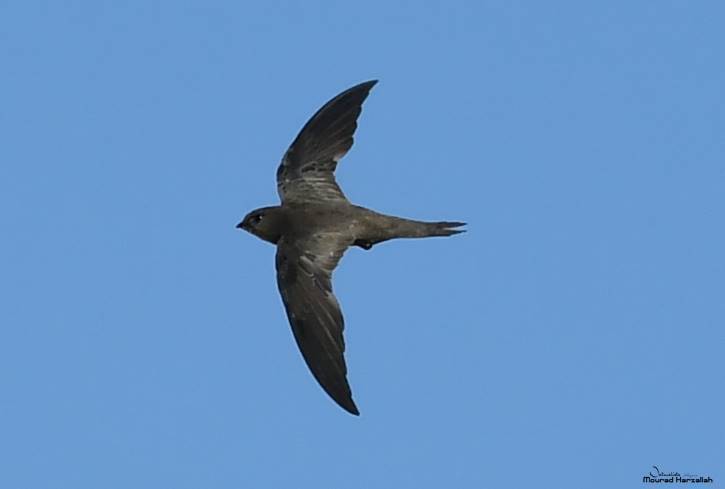
Plain Swift
Photo © Mourad Harzallah
Photo © Mourad Harzallah — CC BY 4.0 — Source: iNaturalist photo #586003990Identification
The plain swift is a compact, 14–15 cm aerial specialist with the characteristic silhouette of its family: long, swept-back wings resembling a crescent or boomerang, a short forked tail, and tiny legs adapted only for clinging to vertical surfaces. Its plumage is entirely dark except for an indistinct pale throat patch. Although superficially similar to barn swallows and house martins due to convergent evolution, it is not closely related to those passerine birds.
Separating the plain swift from its relatives requires careful observation. It is slimmer and more rakish than the pallid swift, and noticeably darker than that species, lacking the pallid swift's obvious white throat. Distinguishing it from the common swift is far more challenging. The plain swift is slimmer and appears longer-winged than the common, and features scaly underparts that are difficult to discern except in excellent light. Juvenile common swifts can be ruled out by their conspicuous white throat. The plain swift's loud, dry screaming call is similar to that of the common swift, though possibly higher-pitched.
Range & Habitat
The plain swift breeds in colonies on cliffs, bridges, and buildings in the Canary Islands and Madeira. Small breeding populations have also been confirmed in mainland Portugal, with colonies discovered in Lisbon and Porto. Additional birds are believed to breed in small numbers along the Moroccan coast between Agadir and Essaouira, where they nest on coastal cliffs, and possibly in Mauritania where sightings are frequent.
This species is partially migratory. While it was once thought to winter along the African coast, recent studies have revealed that many birds undertake remarkable journeys of some 2,600 kilometres to equatorial forest regions in Liberia and Guinea. This discovery fundamentally altered our understanding of the species' annual movements.
Behaviour & Diet
The plain swift is a consummate aerial insectivore, spending most of its life in flight and catching insects in its beak. It drinks while on the wing, never settling voluntarily on the ground. Its very short legs are used only for clinging to vertical surfaces such as cliff faces and building walls—a perfect adaptation for a bird that is almost entirely airborne.
Plain swifts breed in colonies, constructing distinctive saucer-shaped nests from flowerheads that they glue together using saliva. Each breeding pair lays two eggs, raising their young in these simple but effective structures built on suitable vertical surfaces.
Best Time & Places to See It
The Canary Islands and Madeira are the most reliable locations for observing plain swifts, particularly during the breeding season when colonial birds are actively nesting on cliffs, bridges, and buildings. Lisbon and Porto in mainland Portugal offer additional opportunities, as do the coastal cliffs of Morocco between Agadir and Essaouira. The best viewing opportunities occur when birds are present at their breeding sites; however, seasonal timing varies depending on local migration patterns and individual colony phenology.
Photography Tips
Photographing plain swifts presents the classic challenge of capturing fast-moving aerial birds. Fast shutter speeds (1/2000s or faster) are essential to freeze wing motion during flight. Focus on areas where birds are known to breed or congregate, such as cliff faces and building colonies, where they may circle repeatedly. Early morning or late afternoon light often provides the best conditions for photographing birds in flight against the sky.
Close observation is necessary to obtain diagnostic images showing the subtle field marks that distinguish plain swifts from common and pallid swifts: the slimmer profile, longer-winged appearance, and scaly underparts. Patient positioning near known breeding colonies maximizes your chances of obtaining clear, identifiable photographs.
Teide Natural Monument
La Orotava, Spain
+41 birds+4 mammals
High on the volcanic slopes of Tenerife, where the landscape transforms from lush laurel forests into lunar terrain, the Teide Natural Monument preserves one of Spain's…
VIEW NATURE RESERVEPilancones Natural Park
Las Tederas, Spain
+30 birds
Where volcanic ridges and ravines carve through the northwestern interior of Gran Canaria, Pilancones Nature Park preserves one of the archipelago's most dramatic upland ecosystems. The…
VIEW NATURAL PARKTeide National Park
La Orotava, Spain
+83 birds+7 mammals
At nearly 3,900 metres, Spain's highest peak rises from the Canary Islands as a singular volcanic monument, its slopes sweeping through five distinct climate zones in…
VIEW NATIONAL PARKCaldera de Taburiente National Park
El Paso, Spain
+40 birds+1 mammals
Where volcanic ramparts rise nearly two kilometres above the Atlantic, Caldera de Taburiente reveals one of the Canary Islands' most dramatic geological narratives. This national park…
VIEW NATIONAL PARKGarajonay National Park
Hermigua, Spain
+68 birds+1 mammals
Laurel forests cloak the volcanic ridges of this Canarian national park, their evergreen canopy so dense that mist clings to the moss-draped branches even on cloudless…
VIEW NATIONAL PARKNo community photos yet. Log in to add the first one.
No community observations of this species yet.