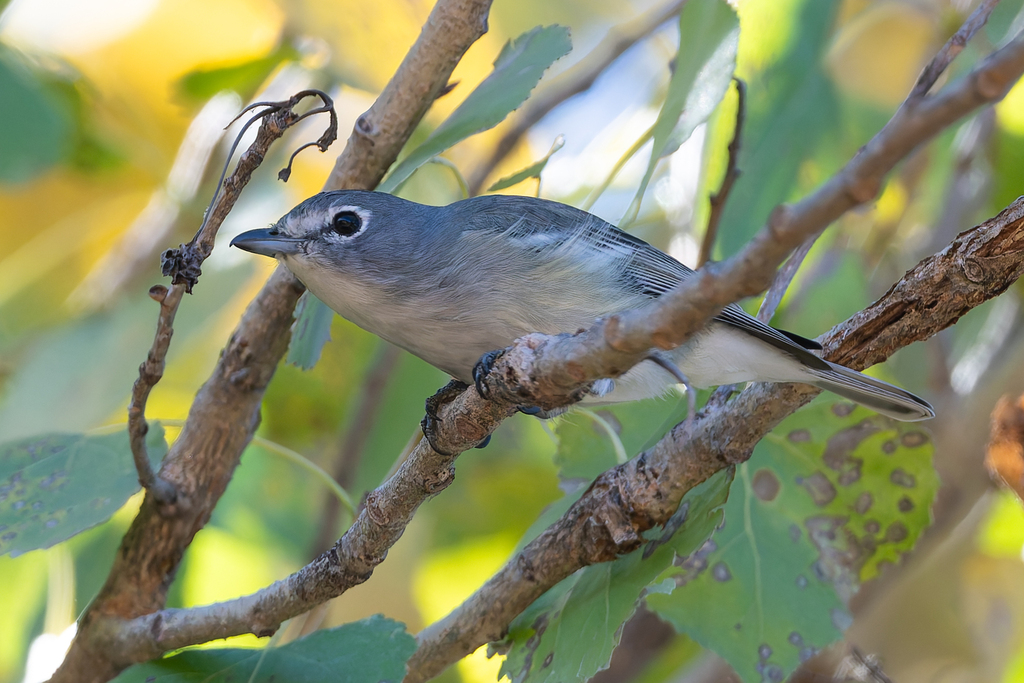
Plumbeous Vireo
Photo © Adam Jackson
Photo © Adam Jackson — CC0 1.0 — Source: iNaturalist photo #444289002Identification
The plumbeous vireo is a small songbird measuring 4.9 to 5.4 inches long, weighing just 0.42 to 0.71 ounces. It is most readily identified by its distinctive facial pattern: a wide white eye-ring, a prominent white stripe above the lores, and a dusky stripe running through the eye-ring itself. The crown and nape are neutral gray, with gray ear coverts. The upperparts are gray with an olive-green tinge on the rump, while the underparts are mostly white with grayish-olive smudging on the breast sides and sometimes very pale yellow on the flanks. Two whitish wing bars are visible on the blackish-gray wing coverts. All individuals have a brown iris, black bill with grayish base, and bluish-gray legs and feet.
The plumbeous vireo is closely related to Cassin's vireo and the blue-headed vireo, with which it was historically grouped as a single "solitary vireo" species until the late 1990s. Subspecies vary slightly: V. p. gravis is larger and darker-crowned with more olive-edged secondaries; V. p. montanus shows a blue-gray crown, greenish back, and greenish-yellow flanks.
Range & Habitat
The plumbeous vireo has a disjunct distribution spanning from southeastern Montana and southwestern South Dakota south through the western U.S. and into Mexico, Central America, and Honduras. The nominate subspecies breeds across the western U.S. from Idaho and Wyoming through Nevada, California, Arizona, Colorado, and New Mexico into northern Mexico. Other subspecies occupy separate ranges in east-central Mexico, Belize, and from Oaxaca through Guatemala and Honduras.
In its breeding range, the species favors coniferous and mixed pine-oak forests, particularly those dominated by ponderosa pine and piñon-juniper complexes, at elevations between 3,800 and 8,200 feet in the U.S. and up to 9,800 feet in Mexico. It also inhabits riparian woodlands and, in Central America, pine-oak forests and pine savannas. During migration and winter, it uses a wider variety of habitats including gallery forests, mangroves, evergreen forests, and thorn forests.
Behaviour & Diet
The plumbeous vireo is a highly active forager, gleaning arthropods from leaves and branches at all levels of the habitat, and also capturing insects mid-air while hovering. During breeding season it feeds almost exclusively on arthropods, but in winter it supplements its diet with fruits and regularly joins mixed-species feeding flocks. The nominate subspecies is fully migratory, breeding in the U.S. and northern Mexico before migrating through western Arizona to overwinter in west-central and southwestern Mexico and the northern Central American fringe. The other three subspecies are year-round residents.
Breeding occurs between early May and early August in the central U.S. Both sexes build the nest, a delicate open cup suspended in a branch fork and constructed from grass, bark strips, plant fibers, and animal hair bound together with spider web, often decorated with lichens and moss on the exterior. Clutches typically contain four eggs, incubated by both parents for approximately 14 days. Nestlings fledge in 13 to 14 days. Both cowbird species—brown-headed and bronzed—parasitize a significant number of nests.
Best Time & Places to See It
For observers in the United States, the plumbeous vireo is best found during its breeding season from May through early August in the pine-oak and piñon-juniper forests of the Interior West. Key regions include southeastern Montana, Idaho, Wyoming, Nevada, Arizona, New Mexico, and western Colorado. Birders in Mexico should seek it in pine-oak woodlands of the northern highlands, particularly in Arizona and Guerrero. The species is most active and vocal in the early morning hours.
Winter observations are best made in west-central and southwestern Mexico, where the nominate subspecies congregates from November through March. In Central America, year-round residents can be found in pine-oak forests and pine savannas of Belize, Guatemala, and Honduras, typically above 2,000 feet elevation.
Photography Tips
The plumbeous vireo's small size and habit of gleaning among foliage present a challenge for photographers. Position yourself early in the morning when the bird is most active and vocal. Look for individuals in open forest edges and riparian corridors where light penetration is better. The bird's distinctive facial markings are its most photogenic feature; capture the bold white eye-ring and loral stripe when the bird's head is turned toward the camera. A shutter speed of at least 1/1000th second is recommended given the bird's constant movement.
In migration and on the wintering grounds, look for plumbeous vireos within mixed-species flocks, where they may linger longer as they feed with other species. Patience and scanning with binoculars will often locate birds before they disappear into dense foliage. The bird's relatively quiet demeanor in winter makes audio playback helpful, though it should be used sparingly to avoid stress to the bird.
Big Bend National Park
Brewster County, United States
+345 birds+34 mammals
Where the Chisos Mountains rise abruptly from the Sonoran Desert floor, Big Bend National Park spans over 7,300 square kilometers of one of North America's most…
VIEW NATIONAL PARKCanyonlands National Park
Wayne County, United States
+186 birds+15 mammals
Where the Colorado River has carved an intricate labyrinth through the high desert plateau of southeastern Utah, Canyonlands National Park sprawls across nearly 3,030 square kilometres…
VIEW NATIONAL PARKSaguaro National Park
Rincon Valley, United States
+354 birds+40 mammals
Where the Sonoran Desert meets sky-island mountains, two geographically separated districts of Saguaro National Park sprawl across nearly two thousand square kilometers of Arizona's most iconic…
VIEW NATIONAL PARKJoshua Tree National Park
Riverside County, United States
+221 birds+23 mammals
Across 5,610 square kilometers of Riverside County's high desert, a landscape of geological drama unfolds where granite monoliths pierce through bajadas of creosote scrub and Joshua…
VIEW NATIONAL PARKGreat Basin National Park
White Pine County, United States
+170 birds+19 mammals
Where the Great Basin's high desert plateaus rise above 10,000 feet, ancient bristlecone pines endure on moonscape ridges of limestone and quartzite, creating one of North…
VIEW NATIONAL PARKCarlsbad Caverns National Park
Eddy County, United States
+309 birds+18 mammals
Beneath the Chihuahuan Desert floor of southern New Mexico lies one of North America's most spectacular subterranean landscapes. Carlsbad Caverns National Park encompasses over 518 square…
VIEW NATIONAL PARKArches National Park
Grand County, United States
+185 birds+20 mammals
Where rust-red sandstone fins rise abruptly from high desert scrubland, Arches National Park spans 548 square kilometers of one of North America's most sculptural landscapes. The…
VIEW NATIONAL PARKZion National Park
Washington County, United States
+244 birds+30 mammals
Towering sandstone cliffs in shades of crimson, rust, and cream rise abruptly from the Virgin River's winding canyon floor, their sculpted faces bearing witness to millions…
VIEW NATIONAL PARKMesa Verde National Park
Montezuma County, United States
+166 birds+10 mammals
Across the high desert plateau of southwestern Colorado, where sandstone mesas rise abruptly from piñon-juniper scrubland, Mesa Verde National Park preserves one of North America's most…
VIEW NATIONAL PARKGreat Sand Dunes National Park
Saguache County, United States
+193 birds+14 mammals
Where the Colorado high plains collide with one of North America's most extraordinary geological anomalies, nearly 600 square kilometres of windswept sand rise abruptly from the…
VIEW NATIONAL PARKCapitol Reef National Park
Garfield County, United States
+196 birds+22 mammals
Wrinkled ridges of crimson and gold sandstone rise from the floor of south-central Utah, their weathered faces carved by the Fremont River into one of the…
VIEW NATIONAL PARKGrand Teton National Park
Teton County, United States
+247 birds+38 mammals
Where the Teton Range tears skyward in a dramatic escarpment above the Snake River valley, nearly 2,550 square kilometers of montane wilderness unfolds across Teton County,…
VIEW NATIONAL PARKYellowstone National Park
Park County, United States
+253 birds+43 mammals
Across nearly 11,400 square kilometres of the Rocky Mountain plateau, geothermal fury and pristine wilderness converge in one of Earth's most dynamic landscapes. Hot springs, geysers…
VIEW NATIONAL PARKBlack Canyon of the Gunnison National Park
Montrose County, United States
+169 birds+13 mammals
Where the Gunnison River has carved one of North America's steepest and most dramatic canyons, ancient metamorphic rock walls plunge nearly 2,000 feet in places, creating…
VIEW NATIONAL PARKRocky Mountain National Park
Larimer County, United States
+259 birds+33 mammals
Where granite peaks rise above 12,000 feet and alpine tundra gives way to subalpine forest, Rocky Mountain National Park spans the Continental Divide across nearly 1,600…
VIEW NATIONAL PARKRedwood National Park
Humboldt County, United States
+343 birds+43 mammals
Where the Pacific fog rolls deep into northern California's coastal valleys, some of the tallest trees on Earth rise from a landscape shaped by tectonic forces…
VIEW NATIONAL PARKSequoia National Park
Tulare County, United States
+187 birds+27 mammals
Granite peaks rising above 3,600 meters dominate the southern Sierra Nevada, where Sequoia National Park sprawls across one of North America's most vertically compressed wilderness zones.…
VIEW NATIONAL PARKKings Canyon National Park
Fresno County, United States
+186 birds+20 mammals
Where granite peaks fracture the Sierra Nevada skyline and the Kings River has carved one of North America's most dramatic canyons, a landscape of extreme relief…
VIEW NATIONAL PARKDeath Valley National Park
Inyo County, United States
+339 birds+25 mammals
Across nearly 3.5 million acres of southeastern California's Inyo County, vast salt flats meet sculpted badlands and alluvial fans in a landscape so extreme it defines…
VIEW NATIONAL PARKLagunas de Montebello National Park
Laguna de Montebello, Mexico
+360 birds+2 mammals
Where turquoise lagoons pierce the limestone plateau of southeastern Chiapas, the Lagunas de Montebello National Park unfolds across roughly 174 square kilometers of spectral water and…
VIEW NATIONAL PARKEl Vizcaíno
Laguna San Ignacio, Mexico
+317 birds+29 mammals
Where the Baja California peninsula thins into a tapestry of salt lagoons and coastal desert, one of Mexico's most biodiverse reserves sprawls across half a million…
VIEW BIOSPHERE RESERVEParque Nacional Cerro de la Estrella
Mexico
+126 birds+4 mammals
Where volcanic peaks rise sharply above Mexico City's sprawling metropolis, Parque Nacional Cerro de la Estrella offers a rare glimpse of high-altitude terrain within one of…
VIEW NATIONAL PARKParque Nacional Benito Juárez
San Andrés Huayápam, Mexico
+128 birds+4 mammals
High in the Sierra Madre del Sur of Oaxaca, where cloud forest mingles with pine woodland and the terrain climbs steeply through ravines carved by mountain…
VIEW NATIONAL PARKParque Nacional Grutas de Cacahuamilpa
Pilcaya, Mexico
+97 birds+12 mammals
Where limestone ridges rise abruptly from the tropical deciduous forests of central Guerrero, the Grutas de Cacahuamilpa National Park shelters one of Mexico's most extensive cave…
VIEW NATIONAL PARKTutuaca
Tosanachi, Mexico
+147 birds+13 mammals
Where copper canyons plunge deeper than the Grand Canyon itself, Mexico's remote Sierra Madre Occidental unfolds in dramatic vertical relief. Tutuaca anchors this wilderness realm, a…
VIEW PROTECTED LANDSCAPEBryce Canyon National Park
Tropic, United States
+202 birds+20 mammals
Hoodoos rise like a forest of stone pillars from an amphitheater carved into Utah's high plateau, where the Paunsaugunt elevates the landscape to over 9,000 feet…
VIEW NATIONAL PARKChannel Islands National Park
Santa Barbara County, United States
+330 birds+15 mammals
A chain of eight volcanic islands rises from the cold Pacific waters off the California coast, their rugged sea cliffs and windswept terrain shaped by millions…
VIEW NATIONAL PARKGrand Canyon National Park
United States
+277 birds+35 mammals
A mile-deep chasm of rust-red rock and purple shadow cuts through the high desert plateau of northern Arizona, revealing nearly two billion years of geological history…
VIEW NATIONAL PARKGuadalupe Mountains National Park
Culberson County, United States
+262 birds+14 mammals
Where fossil-laden limestone ridges thrust skyward above the Chihuahuan Desert floor, Guadalupe Mountains National Park reveals a landscape sculpted by ancient seas and relentless aridity. These…
VIEW NATIONAL PARKPetrified Forest National Park
Apache County, United States
+206 birds+23 mammals
Across the high desert plateau of northeastern Arizona, where the climate swings between scorching summer days and frost-laden winters, badlands of raw earth and timber-turned-to-stone dominate…
VIEW NATIONAL PARKWind Cave National Park
Custer County, United States
+175 birds+13 mammals
Beneath the rolling prairie of the Black Hills, a network of passages carved through limestone creates one of North America's most extensive cave systems. Wind Cave…
VIEW NATIONAL PARKBosque del Apache National Wildlife Refuge
Socorro County, United States
+345 birds+17 mammals
Where the Rio Grande emerges from its desert canyon in central New Mexico, a narrow ribbon of riparian woodland defies the arid landscape that surrounds it.…
VIEW WILDLIFE SANCTUARYCabeza Prieta National Wildlife Refuge
United States
+155 birds+6 mammals
Across southwestern Arizona's harshest terrain, where the Colorado River marks the border with Mexico, lies a sanctuary shaped entirely by heat and aridity. Cabeza Prieta National…
VIEW WILDLIFE SANCTUARYKofa National Wildlife Refuge
Yuma County, United States
+142 birds+10 mammals
Desert mountains rise in sculptured ridges across northwestern Arizona, where the Colorado River's distant influence fades into some of the most austere terrain in the American…
VIEW WILDLIFE SANCTUARYHavasu National Wildlife Refuge
Lake Havasu City, United States
+291 birds+8 mammals
Where the Colorado River widens into a vast reservoir in the Sonoran Desert, Havasu National Wildlife Sanctuary protects one of the most critical wetland ecosystems in…
VIEW WILDLIFE SANCTUARYMalheur National Wildlife Refuge
Harney County, United States
+309 birds+24 mammals
Across the high desert plateau of southeastern Oregon, where sagebrush scrubland stretches toward distant ridgelines under an enormous sky, lies a sanctuary shaped by water in…
VIEW WILDLIFE SANCTUARYFarallon National Wildlife Refuge
San Francisco, United States
+384 birds+16 mammals
Windswept granite peaks rising abruptly from the Pacific, the Farallon Islands form a wildlife sanctuary of extraordinary seabird abundance and ecological significance just twenty-seven miles west…
VIEW WILDLIFE SANCTUARYBear River Migratory Bird Refuge
Box Elder County, United States
+254 birds+9 mammals
Where the Bear River winds through the semi-arid basin country of northwestern Utah, a sprawling wildlife sanctuary transforms the high desert into a haven for migratory…
VIEW WILDLIFE SANCTUARYSeedskadee National Wildlife Refuge
Sweetwater County, United States
+209 birds+8 mammals
Where the Green River carves through the high-desert basin of southwestern Wyoming, Seedskadee National Wildlife Sanctuary preserves one of the West's most vital riparian corridors. The…
VIEW WILDLIFE SANCTUARYNational Elk Refuge
Jackson, United States
+230 birds+27 mammals
Where the sagebrush flats of northwestern Wyoming rise toward the Gros Ventre Mountains, winter transforms the landscape into a realm of survival and spectacle. The National…
VIEW WILDLIFE SANCTUARYBitter Lake National Wildlife Refuge
Chaves County, United States
+284 birds+10 mammals
Across the high desert floor of southeastern New Mexico, where elevation and aridity shape every living thing, shallow alkaline lakes and marshes form an unexpected oasis…
VIEW WILDLIFE SANCTUARYNo community photos yet. Log in to add the first one.
No community observations of this species yet.