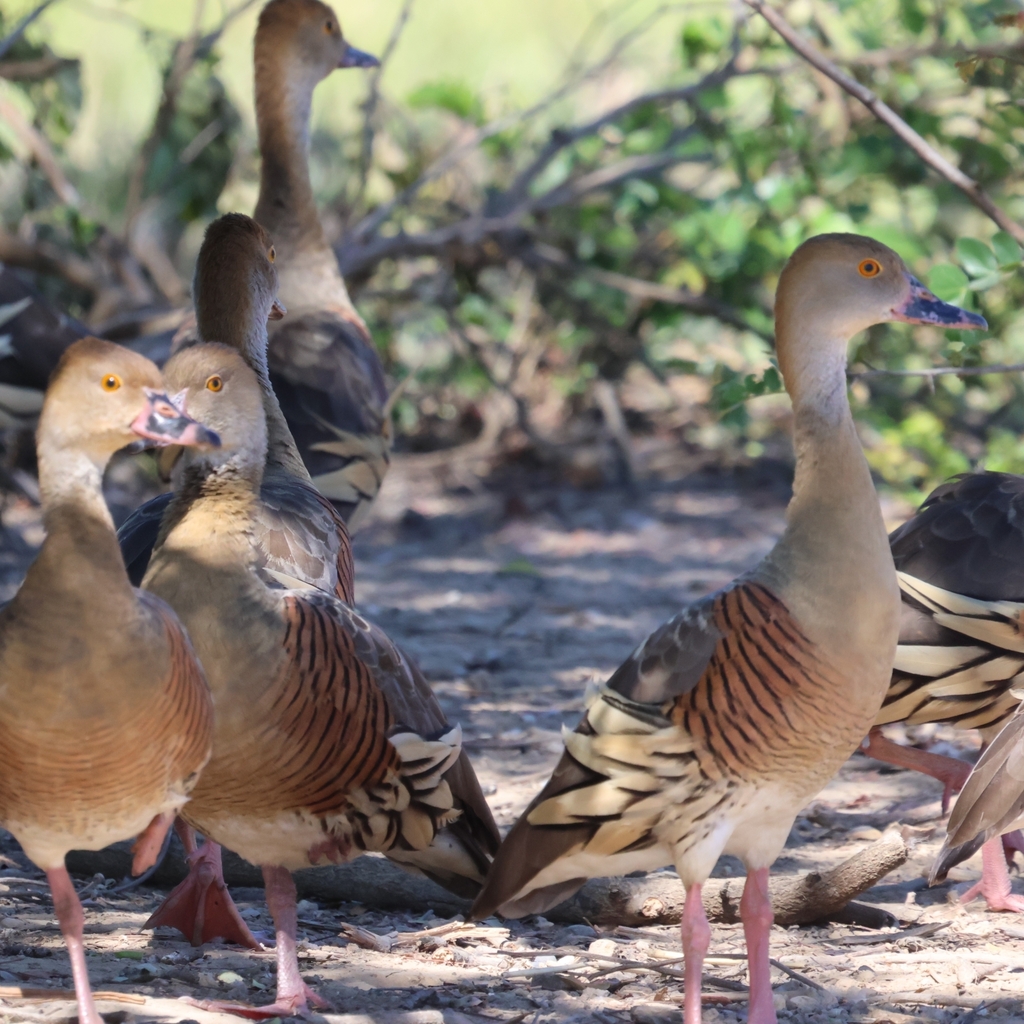
Plumed Whistling Duck
Photo © Luke Lythgoe
Photo © Luke Lythgoe — CC BY 4.0 — Source: iNaturalist #311563203Identification
The plumed whistling duck is a distinctive long-necked duck measuring 42–60 cm in length and weighing around one kilogram. Its most striking feature is the pair of long, black-margined plumes that arise from its flanks, giving the species its name. The plumage is predominantly brown on the upperparts with paler underparts and a contrasting white rump. The chest displays chestnut colouration with thin black barring. Both sexes are similar in appearance. The bill and legs are pinkish red, while the iris is yellow. In flight, the bird shows a characteristic lowered neck posture and short, dark, rounded wings.
The species is easily distinguished by its distinctive whistling call, which is the origin of its common name. This vocalization is a reliable identifier in the field, particularly useful when observing birds at a distance or in poor light conditions.
Range & Habitat
The plumed whistling duck is resident and breeds throughout a broad arc covering the northern half and most of the eastern third of Australia, with its range extending from the Kimberley across the Top End and Cape York Peninsula, southward to northern New South Wales and southern Queensland. Inland populations may reach north-western Victoria in the vicinity of the Murray River. Non-breeding and seasonally uncertain populations also occur in New Zealand, the Solomon Islands, Indonesia, and Papua New Guinea.
This species prefers tall grassland and savanna habitats, typically in areas near bodies of water. Unlike many ducks that rely on aquatic environments, the plumed whistling duck is highly adapted to terrestrial grassland ecosystems, though proximity to water remains important for its survival and breeding activities.
Behaviour & Diet
The plumed whistling duck has a notably different feeding strategy from most other duck species. Rather than diving in water bodies, it feeds by cropping grass on land, making it an unusual member of the Anatidae family. This adaptation to grassland feeding reflects its specialization for terrestrial savanna and grassland habitats.
The species breeds during the wet season, generally from January to March, though breeding can extend into April or occasionally May. A single brood is raised per season. Nests are constructed as mattresses of grass or similar material, placed in tall grass or amid vegetation for cover. Clutch sizes typically range from 10 to 12 eggs, though 14 or more have been recorded. The oval eggs measure 48 by 36 millimetres, initially shiny and creamy-coloured but may become stained. The incubation period lasts approximately 30 days.
Best Time & Places to See It
The wet season (January to May) is the optimal time to observe plumed whistling ducks, coinciding with breeding activity and peak vocalization. Northern Australia offers the best viewing opportunities, particularly in Queensland, the Northern Territory, and Western Australia's Kimberley region. Grassland and savanna habitats near waterways are the most productive areas for sighting this species.
Birders visiting eastern Australia should also watch for this species in suitable habitats in northern New South Wales and southern Queensland. Early morning and late afternoon are typically the most active times for observation, when the birds' characteristic whistling calls are most audible.
Photography Tips
The plumed whistling duck's distinctive plumes and long neck make it a visually striking subject for photographers. Position yourself in open grassland habitats where the birds feed on land, as this offers better photographic opportunities than waterfowl that remain predominantly on water. The contrast between the brown upperparts, chestnut chest, and white rump provides good colour variation in images.
The bird's characteristic lowered neck posture in flight is a defining feature worth capturing. Early morning light during the wet season can enhance the bird's plumage colours. Patient observation in grassland and savanna near water bodies will yield the best opportunities for both behavioral and portrait photography of this elegant species.
Kroombit Tops National Park
Valentine Plains, Australia
+152 birds+6 mammals
Where eucalypt woodlands rise into sandstone plateaus, Kroombit Tops unfolds across nearly 906 square kilometres of northeastern Queensland's most biodiverse terrain. The park's defining feature is…
VIEW NATIONAL PARKNerang National Park
Gold Coast, Australia
+126 birds+13 mammals
Steep subtropical rainforest clads the hinterland ridges of southeast Queensland's Gold Coast, where Nerang National Park sprawls across 34 square kilometres of protected bushland between the…
VIEW NATIONAL PARKHerberton Range National Park
Australia
+115 birds+10 mammals
Rainforest-clad ridges and rocky outcrops define this 324-square-kilometre reserve in far north Queensland, where the mountainous terrain of the Herberton Range rises through layered eucalypt woodland…
VIEW NATIONAL PARKKakadu National Park
Kakadu, Australia
+273 birds+46 mammals
Kakadu National Park is Australia’s largest national park and one of the world’s most remarkable protected areas, covering nearly 20,000 square kilometres in the tropical north…
VIEW NATIONAL PARKDaintree National Park
Dedin, Australia
+362 birds+37 mammals
Daintree National Park is one of the world’s oldest and most biologically diverse tropical rainforests, protecting an extraordinary landscape where ancient forests meet the Great Barrier…
VIEW NATIONAL PARKGreater Bendigo National Park
Whipstick, Australia
+202 birds+8 mammals
Across the red volcanic plains of inland Victoria, Greater Bendigo National Park sprawls across more than 1,000 square kilometres of eucalyptus woodland, open grassland, and scattered…
VIEW NATIONAL PARKChiltern-Mt Pilot National Park
Australia
+229 birds+12 mammals
Granite ridges and eucalyptus woodlands define this 869-square-kilometre park straddling the border between Victoria and New South Wales, where rugged terrain rises sharply from gentler foothill…
VIEW NATIONAL PARKSpringbrook National Park
Australia
+195 birds+25 mammals
Subtropical rainforest meets open eucalypt woodland across a mountainous terrain where the McPherson Range rises sharply from the Queensland coast, creating a patchwork of microclimates and…
VIEW NATIONAL PARKLamington National Park
Australia
+227 birds+24 mammals
Where subtropical rainforest rises steeply from the Queensland coast, Lamington National Park spreads across 541 square kilometres of one of Australia's most biodiverse mountain landscapes. The…
VIEW NATIONAL PARKRoyal National Park
Sydney, Australia
+296 birds+46 mammals
Where sandstone ridges plunge toward the Tasman Sea, Royal National Park unfolds across 343 square kilometres of southeastern Australian coastal wilderness. The park's defining character emerges…
VIEW NATIONAL PARKLockyer National Park
Australia
+130 birds+5 mammals
Steep ridges and weathered escarpments rise from the Brisbane Valley in southeastern Queensland, where Lockyer National Park sprawls across 267 square kilometres of eucalypt woodland and…
VIEW NATIONAL PARKRinyirru National Park
Lakefield, Australia
+258 birds+7 mammals
Where the savanna grasslands of far north Queensland meet seasonal wetlands and eucalypt woodlands, Rinyirru National Park sprawls across more than 12,500 square kilometres of rugged,…
VIEW NATIONAL PARKMorton National Park
Australia
+253 birds+57 mammals
Across nearly 4,800 square kilometers of New South Wales's Southern Tablelands, rugged sandstone plateaus rise above sheltered valleys where cool-climate eucalypt woodland meets grassy heath and…
VIEW NATIONAL PARKGlass House Mountains National Park
Australia
+151 birds+8 mammals
Conical peaks of volcanic origin rise dramatically from the coastal lowlands of southeastern Queensland, their weathered slopes cloaked in eucalyptus woodland and open sclerophyll forest that…
VIEW NATIONAL PARKBribie Island National Park
Brisbane, Australia
+284 birds+20 mammals
Across tidal flats and shallow waterways north of Brisbane, Bribie Island National Park spreads across nearly four hundred square kilometres of subtropical coastal wilderness—a patchwork of…
VIEW NATIONAL PARKLitchfield National Park
Australia
+175 birds+15 mammals
Where weathered sandstone plateaus rise above the savanna woodlands of Australia's Top End, Litchfield National Park unfolds as a landscape of dramatic contrasts shaped by a…
VIEW NATIONAL PARKNitmiluk National Park
Australia
+186 birds+27 mammals
Dramatic sandstone gorges carved by the Katherine River slice through the tropical savanna of Australia's Top End, creating a landscape where escarpments tower above crystalline pools…
VIEW NATIONAL PARKGreat Sandy National Park
Australia
+306 birds+40 mammals
Where coastal dunes rise inland from the Queensland coastline, Great Sandy National Park encompasses a landscape of remarkable ecological diversity shaped by subtropical humid conditions year-round.…
VIEW NATIONAL PARKGirringun National Park
Australia
+231 birds+10 mammals
Where granite gorges cleave through subtropical woodland in North Queensland, Girringun National Park unfolds across rugged terrain shaped by millions of years of weathering and erosion.…
VIEW NATIONAL PARKWooroonooran National Park
Australia
+240 birds+28 mammals
Where the Great Dividing Range rises sharply inland from Queensland's tropical coast, Wooroonooran National Park encompasses a landscape of steep, forested gorges and cascading waterways carved…
VIEW NATIONAL PARKNoosa National Park
Marcus Beach, Australia
+216 birds+8 mammals
Subtropical eucalypt woodland and open forest meet coastal heathland along the Noosa Peninsula, where the temperate waters of the Tasman current moderate the Queensland climate into…
VIEW NATIONAL PARKBlue Mountains National Park
Australia
+220 birds+43 mammals
Dramatic sandstone cliffs rise in tiers across this mountainous plateau west of Sydney, their rust-coloured faces weathered into amphitheatres and gorges where eucalyptus forest clings to…
VIEW NATIONAL PARKNo community photos yet. Log in to add the first one.
No community observations of this species yet.