Identification
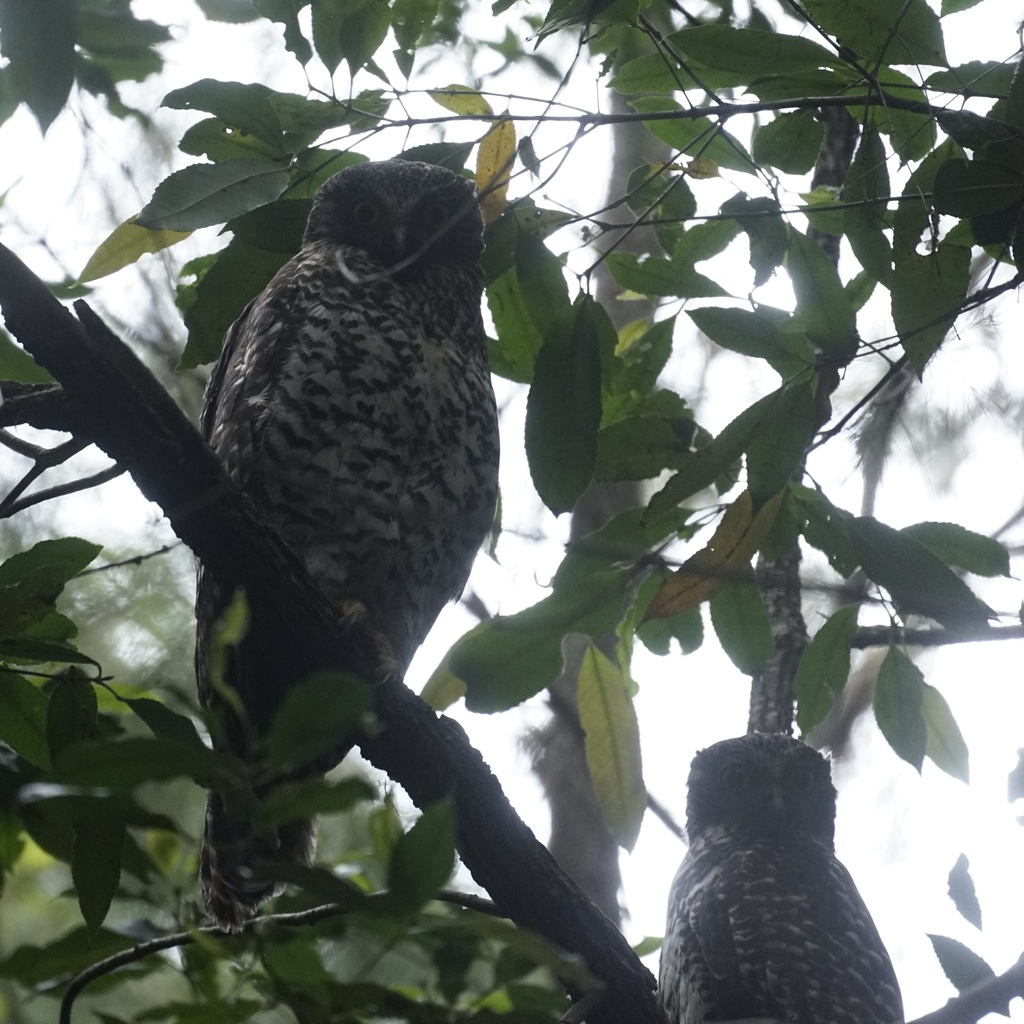
Australia's largest owl, the powerful owl has a distinctive silhouette unlike most of its relatives. Its long tail and relatively small head give it a surprisingly hawk-like appearance, enhanced by a protruding bill and prominent brow ridges. Measuring 45 to 65 cm in length with a wingspan of 112 to 135 cm, it is a substantial raptor with striking plumage: dark grey-brown upper parts mottled and barred with whitish, contrasting with white underparts boldly marked with grey-brown V-shaped barring. The tail displays six narrow white bars. Large yellow eyes and powerful, heavy claws complete the portrait of a formidable predator. Unusually among owls, males are slightly larger than females on average.
Range & Habitat
Found exclusively in south-eastern and eastern Australia, the powerful owl's range extends from Eungella and the Dawson River in Queensland south to Victoria's central highlands and west to Mount Burr in South Australia. The species rarely ventures more than 200 km inland from the coast. It inhabits tall, humid forests, wooded mountain gullies, forested ravines, sclerophyll forests, and wetter, heavily timbered subcoastal ranges. While typically associated with primary forests containing tall native trees, the species demonstrates some flexibility outside the breeding season, occasionally ranging into plantations, parks, and gardens.
Behaviour & Diet
As the top nocturnal predator in its range, the powerful owl is an apex predator that lives permanently in breeding pairs once adult. These owls frequently roost during daylight on branches in tall, open trees, often still holding prey from the previous night, using several perches that may be occupied intermittently for years. They fly in a slow, deliberate manner on their large wings and maintain large home ranges with long intervals between breeding cycles.
The powerful owl is a dedicated hunter of arboreal mammals, particularly small to medium-sized marsupials, which comprise approximately three-quarters of its diet. Interestingly, male powerful owls are larger and stronger than females, giving males the dominant position in the mating pair—a reversal of the typical owl pattern—which extends to controlling food distribution. The male's impressive breeding call is a low, mournful-sounding double-hoot, while females have a similar but higher-pitched call, with duets frequently heard at breeding onset.
Best Time & Places to See It
Breeding season, when duets are frequently heard, offers excellent opportunities to locate these owls. Search tall, open trees in primary forests and sclerophyll woodland within the species' range, particularly in Queensland, New South Wales, Victoria, and South Australia. Streams between ridges covered with Eucalyptus forest often represent prime habitat. Early morning or dusk offers the best chance of observation, though roosting birds may be spotted during daylight hours.
Photography Tips
The powerful owl's distinctive long-tailed, small-headed silhouette and hawk-like profile offer striking photographic subjects. Its large yellow eyes and bold underpart barring are particularly photogenic. Search for roosting birds in tall open trees during daylight, when they frequently remain stationary. The bird's large wingspan and powerful build are best captured with room to show the full wing span. Low light conditions during dawn and dusk may challenge exposure, but patient waiting at known roost sites may reward with closer, well-lit shots of this magnificent raptor.
Kroombit Tops National Park
Valentine Plains, Australia
+152 birds+6 mammals
Where eucalypt woodlands rise into sandstone plateaus, Kroombit Tops unfolds across nearly 906 square kilometres of northeastern Queensland's most biodiverse terrain. The park's defining feature is…
VIEW NATIONAL PARKCania Gorge National Park
Australia
+131 birds+7 mammals
Where sandstone ridges rise above the Queensland inland plains, Cania Gorge National Park carves a compelling landscape across 51 square kilometres of dry eucalypt woodland and…
VIEW NATIONAL PARKMount Coolum National Park
Sunshine Coast, Australia
+124 birds+3 mammals
Rising abruptly from the hinterland plateau of Queensland's Sunshine Coast, Mount Coolum commands attention as a distinctive volcanic remnant clothed in open eucalypt woodland and heathland…
VIEW NATIONAL PARKNerang National Park
Gold Coast, Australia
+126 birds+13 mammals
Steep subtropical rainforest clads the hinterland ridges of southeast Queensland's Gold Coast, where Nerang National Park sprawls across 34 square kilometres of protected bushland between the…
VIEW NATIONAL PARKGreater Bendigo National Park
Whipstick, Australia
+202 birds+8 mammals
Across the red volcanic plains of inland Victoria, Greater Bendigo National Park sprawls across more than 1,000 square kilometres of eucalyptus woodland, open grassland, and scattered…
VIEW NATIONAL PARKChiltern-Mt Pilot National Park
Australia
+229 birds+12 mammals
Granite ridges and eucalyptus woodlands define this 869-square-kilometre park straddling the border between Victoria and New South Wales, where rugged terrain rises sharply from gentler foothill…
VIEW NATIONAL PARKKinglake National Park
Australia
+164 birds+11 mammals
Where the volcanic plains of central Victoria rise into forested ridges, Kinglake National Park encompasses roughly 844 square kilometres of diverse habitat that represents one of…
VIEW NATIONAL PARKLower Glenelg National Park
Australia
+161 birds+12 mammals
Where the Glenelg River carves through southeastern Victoria's limestone country, Lower Glenelg National Park unfolds across nearly 800 square kilometres of river gorge, eucalypt woodland, and…
VIEW NATIONAL PARKBudj Bim National Park
Australia
+137 birds+7 mammals
Across southwestern Victoria's volcanic plains, Budj Bim National Park preserves a landscape shaped by ancient lava flows and Indigenous land stewardship spanning millennia. The park's 184…
VIEW NATIONAL PARKSpringbrook National Park
Australia
+195 birds+25 mammals
Subtropical rainforest meets open eucalypt woodland across a mountainous terrain where the McPherson Range rises sharply from the Queensland coast, creating a patchwork of microclimates and…
VIEW NATIONAL PARKLamington National Park
Australia
+227 birds+24 mammals
Where subtropical rainforest rises steeply from the Queensland coast, Lamington National Park spreads across 541 square kilometres of one of Australia's most biodiverse mountain landscapes. The…
VIEW NATIONAL PARKSydney Harbour National Park
Sydney, Australia
+203 birds+26 mammals
Where Sydney Harbour's sheltered waters meet the sandstone headlands of New South Wales, a mosaic of coastal heathland, eucalyptus woodland and rocky shores creates one of…
VIEW NATIONAL PARKRoyal National Park
Sydney, Australia
+296 birds+46 mammals
Where sandstone ridges plunge toward the Tasman Sea, Royal National Park unfolds across 343 square kilometres of southeastern Australian coastal wilderness. The park's defining character emerges…
VIEW NATIONAL PARKLockyer National Park
Australia
+130 birds+5 mammals
Steep ridges and weathered escarpments rise from the Brisbane Valley in southeastern Queensland, where Lockyer National Park sprawls across 267 square kilometres of eucalypt woodland and…
VIEW NATIONAL PARKGirraween National Park
Australia
+193 birds+21 mammals
Granite boulders rise like the bones of the earth across these 278 square kilometres of southeastern Queensland, where the Great Dividing Range descends towards the coastal…
VIEW NATIONAL PARKMorton National Park
Australia
+253 birds+57 mammals
Across nearly 4,800 square kilometers of New South Wales's Southern Tablelands, rugged sandstone plateaus rise above sheltered valleys where cool-climate eucalypt woodland meets grassy heath and…
VIEW NATIONAL PARKHeathcote National Park
Sydney, Australia
+119 birds+16 mammals
Sandstone ridges and eucalypt woodlands rise from the Cumberland Plain southwest of Sydney, where Heathcote National Park unfolds across 82 square kilometres of bushland shaped by…
VIEW NATIONAL PARKLake Eildon National Park
Australia
+119 birds+8 mammals
Across the rippled waters and wooded shorelines of central Victoria's sprawling reservoir system, Lake Eildon National Park encompasses nearly 870 square kilometres of transformed landscape where…
VIEW NATIONAL PARKGlass House Mountains National Park
Australia
+151 birds+8 mammals
Conical peaks of volcanic origin rise dramatically from the coastal lowlands of southeastern Queensland, their weathered slopes cloaked in eucalyptus woodland and open sclerophyll forest that…
VIEW NATIONAL PARKBribie Island National Park
Brisbane, Australia
+284 birds+20 mammals
Across tidal flats and shallow waterways north of Brisbane, Bribie Island National Park spreads across nearly four hundred square kilometres of subtropical coastal wilderness—a patchwork of…
VIEW NATIONAL PARKWilsons Promontory National Park
Australia
+210 birds+21 mammals
Where granite headlands plunge toward Bass Strait, Wilson's Promontory National Park sprawls across nearly 1,300 square kilometers of southeastern Victoria's most rugged coastal wilderness. The park's…
VIEW NATIONAL PARKGreat Sandy National Park
Australia
+306 birds+40 mammals
Where coastal dunes rise inland from the Queensland coastline, Great Sandy National Park encompasses a landscape of remarkable ecological diversity shaped by subtropical humid conditions year-round.…
VIEW NATIONAL PARKBlue Mountains National Park
Australia
+220 birds+43 mammals
Dramatic sandstone cliffs rise in tiers across this mountainous plateau west of Sydney, their rust-coloured faces weathered into amphitheatres and gorges where eucalyptus forest clings to…
VIEW NATIONAL PARKKosciuszko National Park
Australia
+211 birds+52 mammals
Where the Great Dividing Range reaches its highest peaks in southeastern Australia, Kosciuszko National Park encompasses a landscape of windswept plateaus, rocky ridges, and deep river…
VIEW NATIONAL PARKBouddi National Park
Gosford, Australia
+147 birds+17 mammals
Sandstone ridges rise sharply from the Tasman Sea along the central New South Wales coast, their weathered faces etched by millennia of salt spray and storm…
VIEW NATIONAL PARKKu-ring-gai Chase National Park
Sydney, Australia
+216 birds+39 mammals
Where Hawkesbury sandstone cliffs plunge toward sheltered bays and creeks, Ku-ring-gai Chase National Park unfolds across rugged terrain just north of Sydney, a mosaic of eucalyptus…
VIEW NATIONAL PARKBarrington Tops National Park
Australia
+175 birds+47 mammals
Where the New England Plateau rises above the Hunter Valley, temperate rainforest cloaks the highest reaches of Barrington Tops, its dense canopy fed by year-round precipitation…
VIEW NATIONAL PARKOxley Wild Rivers National Park
Australia
+202 birds+45 mammals
Where the New England Tablelands descend toward the coast, river gorges carve through temperate forests in a landscape of dramatic geological contrast. Oxley Wild Rivers National…
VIEW NATIONAL PARKNew England National Park
Australia
+169 birds+35 mammals
Temperate eucalypt woodlands and cool rainforest pockets define this upland reserve where granite peaks rise above the New England Plateau in northeastern New South Wales. Here,…
VIEW NATIONAL PARKBen Boyd National Park
Eden, Australia
+255 birds+47 mammals
Where the temperate forests of the far south coast meet towering sea cliffs, Ben Boyd National Park unveils one of New South Wales' most dramatic coastal…
VIEW NATIONAL PARKGrampians National Park
Australia
+214 birds+18 mammals
Where sandstone ridges rise above the Western District of Victoria, Grampians National Park unfolds across rolling terrain sculpted by ancient geology and sustained by a temperate…
VIEW NATIONAL PARKGreat Otway National Park
Australia
+255 birds+42 mammals
Temperate rainforest and wet eucalyptus woodland cloak the ridges and gullies of Victoria's Great Otway National Park, where persistent moisture and mild year-round temperatures sustain a…
VIEW NATIONAL PARKNo community photos yet. Log in to add the first one.
No community observations of this species yet.