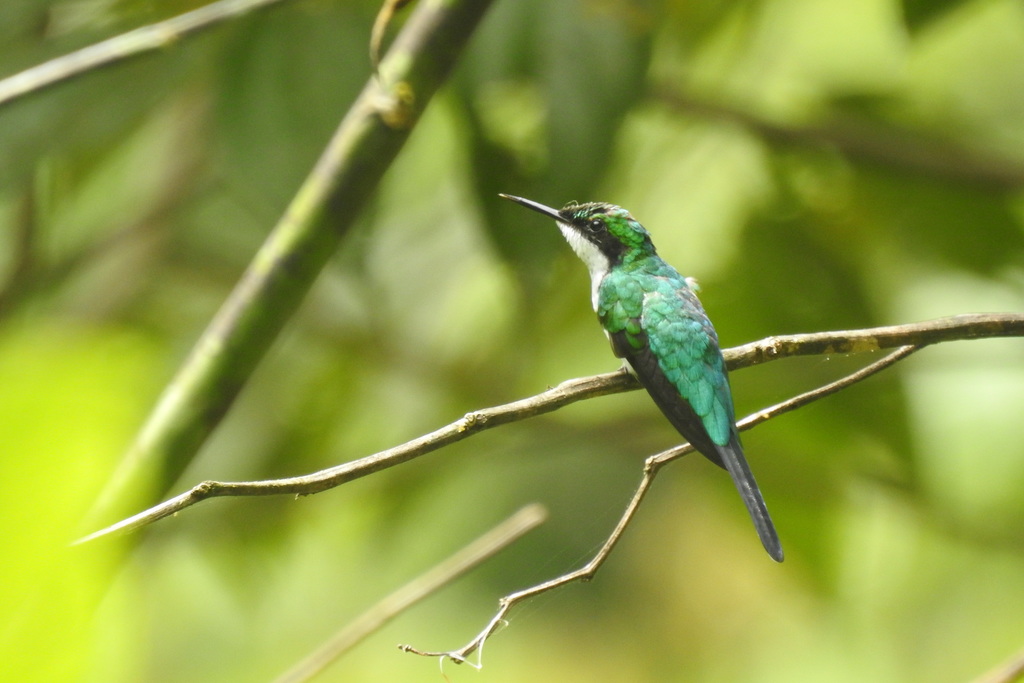
Purple-crowned Fairy
Photo © Ben Meredyk
Photo © Ben Meredyk — CC BY 4.0 — Source: iNaturalist photo #181005345Identification
The purple-crowned fairy is a small hummingbird, measuring 9 to 13 cm in length and weighing approximately 5.5 g. It is instantly recognizable by its brilliant emerald green upperparts contrasting with pure white underparts. The long, pointed tail displays striking blue-black central feathers edged with white. A distinctive black eye patch runs across the face, and the bill is short, straight, and black.
Males sport a metallic violet forecrown with a matching violet spot behind the eye patch and bright emerald green below it, creating a striking facial pattern. Females are more subdued, with a green crown and less extensive black on the face, lacking both the violet spot and the green marking below. Immature birds show cinnamon fringes on their upperparts and sparse dusky spotting on the throat and breast.
Range & Habitat
This species ranges from southeastern Mexico through Central America into northern South America, inhabiting eastern Chiapas and southern Tabasco in Mexico, the Caribbean slopes of Belize, Guatemala, and Nicaragua, both slopes of Costa Rica, much of Panama, and the Pacific slopes of Colombia, Ecuador, and far northern Peru. In Colombia, it also occurs east into the lower Magdalena River valley. Elevations vary by region, from sea level to 500 m in Mexico and northern Central America, reaching 1,675 m in Costa Rica, 1,000 m in Colombia, and 800 m in Ecuador.
The purple-crowned fairy inhabits the canopy and edges of humid lowland forests, shady plantations, and mature secondary forest. It remains resident throughout its range year-round.
Behaviour & Diet
This species is primarily a nectar feeder, foraging mostly in the mid-story and canopy, though it descends to lower levels at forest edges. It feeds by inserting its bill into flowers and also practices nectar robbing, piercing the base of flowers to access nectar directly. Beyond flowering plants, the purple-crowned fairy supplements its diet with small arthropods, particularly spiders, which it gleans from foliage while hovering. Unlike many hummingbirds, it does not catch insects in flight.
Though not particularly territorial, the purple-crowned fairy is notably aggressive and will vigorously resist attacks from other territorial hummingbird species. Breeding typically occurs between October and March in Costa Rica, with females constructing small conical cup nests of plant down—lacking the attached lichens found on many other hummingbird nests. Nests are positioned near thin branch tips, usually 6 to 20 m above ground and often over water. Females lay two eggs, with incubation lasting 16 to 17 days and fledging occurring 20 to 24 days after hatching. The species is not highly vocal, producing only a high, thin, slightly metallic call that may be run into rapid series.
Best Time & Places to See It
October through March is the optimal season for observing the purple-crowned fairy, coinciding with its breeding season in Costa Rica. Look for this species in humid lowland forests, forest edges, and mature secondary growth throughout its range. In Costa Rica, both Caribbean and Pacific slopes offer good opportunities, as do the lowland forests of Panama, Colombia, and Ecuador. Forest edges and shaded plantations are particularly productive, as birds descend to lower foraging levels in these more open habitats.
Photography Tips
Photographing the purple-crowned fairy rewards patience and attention to lighting. Position yourself to capture the male's distinctive metallic violet forecrown and the striking black eye patch with its violet spot—side-on portraits showcase these features beautifully. The contrast between the emerald green upperparts and pure white underparts provides excellent compositional opportunities. Early morning light works best for rendering the iridescent crown feathers. Since birds forage at mid-canopy to canopy level, positioning yourself at or slightly above eye level with the flowering plants they visit will yield better angles than shooting from below. Watch for their hovering feeding behavior and gleaning actions on foliage to anticipate photo moments.
Arenal Volcano National Park
Barbilla National Park
Barra del Colorado National Wildlife Refuge
Baru Volcano National Park
Braulio Carrillo National Park
Cahuita National Park
Caño Negro National Wildlife Refuge
Carara National Park
Cerros de Amotape National Park
Nothing matches these filters.
No community photos yet. Log in to add the first one.
No community observations of this species yet.