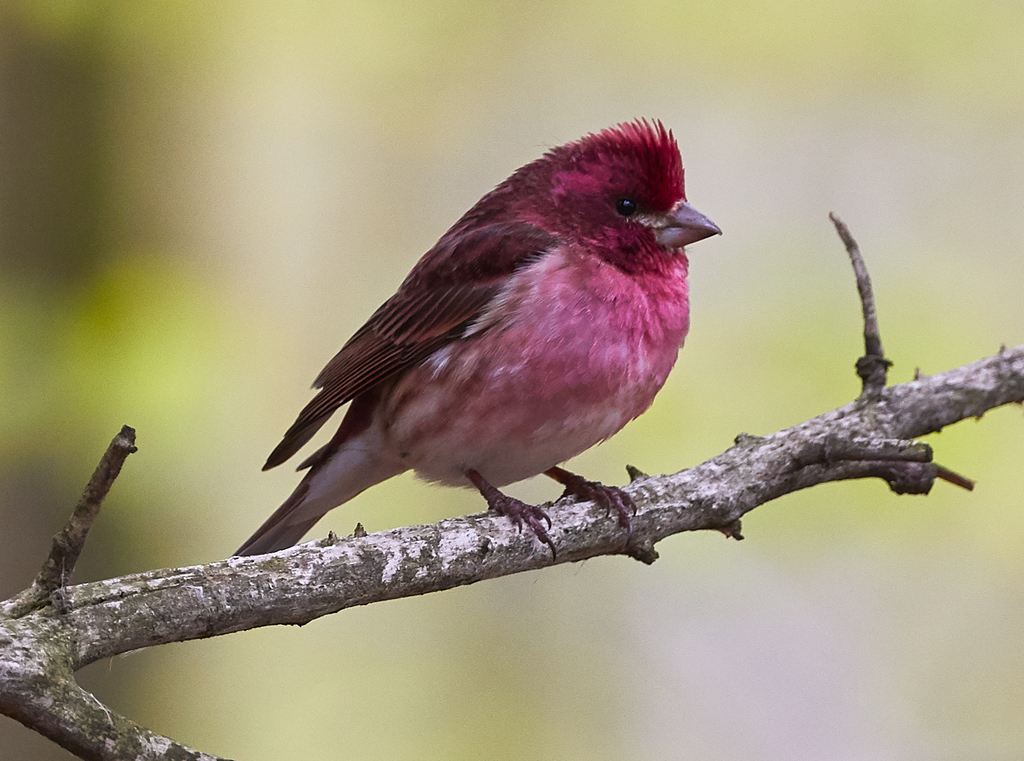
Purple Finch
Photo © David Bird
Photo © David Bird — CC0 1.0 — Source: iNaturalist photo #73218113Identification
The purple finch is a small songbird measuring 12–16 cm in length and weighing approximately 23 grams. Despite its name, this finch's plumage is actually raspberry red rather than purple. Adult males display striking red coloring on the head, breast, back, and rump, with streaking on the back. Adult females are more subdued, with light brown upperparts, white underparts heavily streaked with dark brown, and a distinctive white eyebrow stripe. Both sexes have short forked brown tails and brown wings. The western subspecies (californicus) is notably darker and more greenish, with a longer tail, shorter wings, and longer bill than its eastern counterpart.
Range & Habitat
The purple finch breeds across the northern United States, southern Canada, and along the west coast of North America, occupying coniferous and mixed forests in breeding season. These birds favor lowland coniferous and mixed forest habitats and various wooded areas along the Pacific coast, though they avoid heavily populated urban centers. Some populations from northern Canada migrate south to the United States during winter, while others remain as permanent residents. The species has faced competition from the introduced house finch in eastern breeding grounds, with the latter often outcompeting purple finches during summer months.
Behaviour & Diet
Purple finches are highly vocal birds, with males producing several types of musical vocalizations. Their signature continuous dense warbling is characteristic of finches, while rapid strings of alternating high and low notes are used for territorial announcement, flocking, and mate attraction. The continuous song has a distinctive up-and-down cadence, and nesting females even produce their own songs. These birds forage in trees, bushes, and ground vegetation, primarily consuming seeds and berries, supplemented with insects, tree buds, caterpillars, and beetles.
Best Time & Places to See It
Northern breeding populations are most reliably found in their coniferous and mixed forest habitats during breeding season. Winter months may bring southern visitors to feeding areas, making late fall and winter good times to observe migratory birds. Rural and forest-edge habitats offer better chances than urban areas. Listen for their characteristic warbling song to locate males during breeding season. The western subspecies can be distinguished by its darker, more greenish plumage when compared alongside eastern birds.
Photography Tips
The vibrant raspberry-red plumage of males makes them excellent photography subjects in good light. Position yourself in open forest edges or clearings where birds forage in shrubs and low vegetation. Early morning hours often provide the best light and highest activity levels. Females blend better with their surroundings, so patience and careful scanning are essential. Capture singing males perched openly to showcase their distinctive coloring and posture. The white eyebrow stripe on females provides a useful identification feature to isolate in close-up shots.
Alaska Maritime National Wildlife Refuge
Alligator River National Wildlife Refuge
Banff National Park
Bic National Park
Blackwater National Wildlife Refuge
Bombay Hook National Wildlife Refuge
Cabeza Prieta National Wildlife Refuge
Cape Breton Highlands National Park
Cape May Point State Park
Nothing matches these filters.
No community photos yet. Log in to add the first one.
No community observations of this species yet.