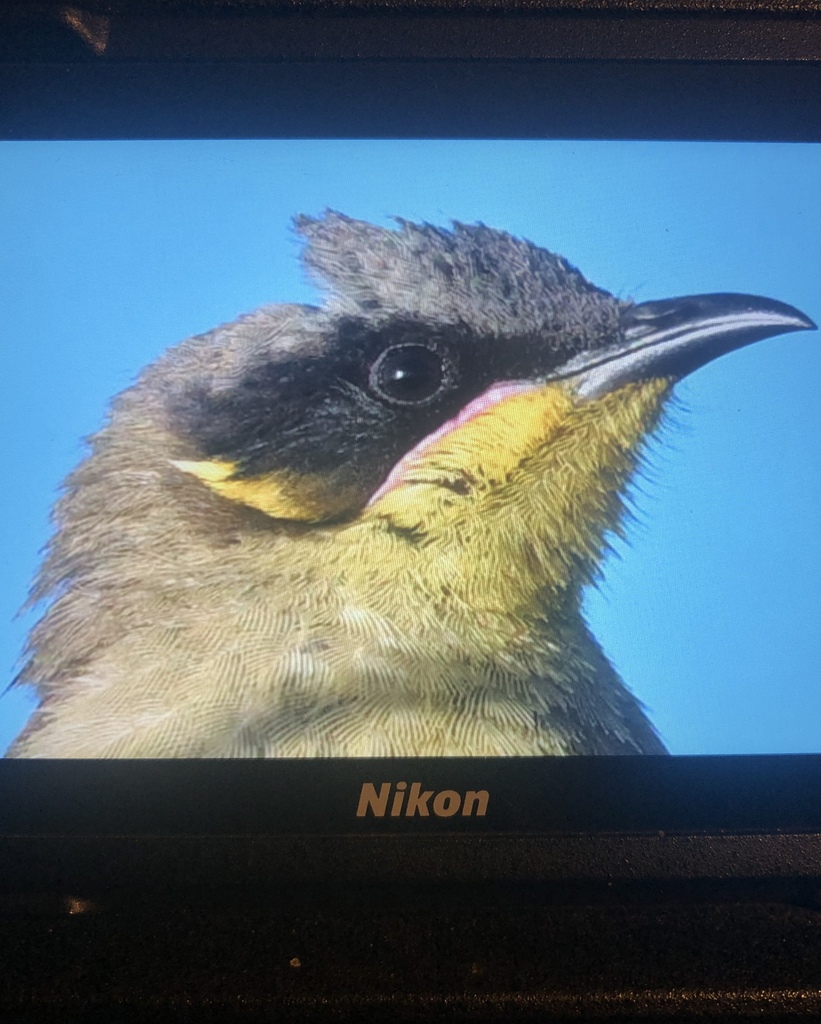
Purple-gaped Honeyeater
Photo © Alan Bell
Photo © Alan Bell — CC BY 4.0 — Source: iNaturalist #251291156The purple-gaped honeyeater (Lichenostomus cratitius) is a species of bird in the family Meliphagidae. It is endemic to semi-arid southern Australia, where it inhabits mallee, tall heath and associated low eucalypt woodland. == Description == The purple-gaped honeyeater is a medium-sized (16-19 centimetres) honeyeater which is generally grey-olive above and buffish yellow below. They have a patterned head, with a black eyestripe against a grey background and purple gape above a yellow streak on the throat and pointed yellow ear coverts. Juveniles are similar, but with duller facial patterns, slightly browner plumage, and a yellow gape and gape line. The Kangaroo Island subspecies is considered to be larger and darker than the mainland subspecies. Similar species include yellow-plumed honeyeater and singing honeyeater. The bird is also named Wattle-Cheeked Honeyeater in Birds of Australia vol 11 by Gregory Mathews === Call === The song is a clear toweet-toweet-toweet, followed by a high-pitched yep-yep-yep, often performed from a tall branch, including before dawn. == Distribution == They occur in disjunct populations across southern Australia, east from southern Western Australia, with the eastern population largely occurring south of the Murray River, and NSW forming the extreme north-east of its range. Despite its naturally…
Greater Bendigo National Park
Whipstick, Australia
+202 birds+8 mammals
Across the red volcanic plains of inland Victoria, Greater Bendigo National Park sprawls across more than 1,000 square kilometres of eucalyptus woodland, open grassland, and scattered…
VIEW NATIONAL PARKLittle Desert National Park
Australia
+200 birds+11 mammals
Across northwestern Victoria's semi-arid interior, sandstone ridges and heathland plateaus rise from red earth in a landscape sculpted by fire and drought rather than water. Little…
VIEW NATIONAL PARKLincoln National Park
Australia
+149 birds+5 mammals
Across the mid-north of South Australia, where the landscape transitions from coastal lowlands toward semi-arid interior plains, sprawls a wilderness of 2,671 square kilometres where red-earth…
VIEW NATIONAL PARKCoffin Bay National Park
Australia
+143 birds+5 mammals
Across South Australia's Eyre Peninsula, where limestone headlands rise above turquoise shallows and eucalypt woodland gives way to coastal heath, lies a 1,319-square-kilometre sanctuary shaped by…
VIEW NATIONAL PARKInnes National Park
Barcelona, Australia
+141 birds+10 mammals
Granite ridges and weathered stone outcrops rise across South Australia's Fleurieu Peninsula, defining a landscape where ancient rock formations meet open eucalypt woodland and heathland scrub.…
VIEW NATIONAL PARKFlinders Chase National Park
Australia
+142 birds+14 mammals
Granite ridges and windswept mallee scrubland define this 1,630-square-kilometre expanse on Kangaroo Island, where ancient rock formations rise abruptly from coastal heathland and woodland mosaics. The…
VIEW NATIONAL PARKFitzgerald River National Park
Fitzgerald River National Park, Australia
+209 birds+11 mammals
Where granite peaks rise above windswept heathlands and pristine river systems carve through untamed wilderness, one of Australia's most biodiverse landscapes unfolds across the southwestern corner…
VIEW NATIONAL PARKMurray-Sunset National Park
Australia
+205 birds+2 mammals
Across the semi-arid borderlands of northwestern Victoria, where the Murray River defines the state's edge, sprawls a landscape of remarkable resilience and subtle beauty. Murray-Sunset National…
VIEW NATIONAL PARKCoorong National Park
Australia
+217 birds+15 mammals
Where the Murray River meets the Southern Ocean, a chain of shallow lagoons stretches across the South Australian coast, separated from the sea by a ribbon…
VIEW NATIONAL PARKStirling Range National Park
Australia
+149 birds+7 mammals
Where ancient quartzite ranges rise abruptly from the southwestern Australian plateau, Stirling Range National Park unfolds as a realm of dramatic escarpments, deep valleys, and surprising…
VIEW NATIONAL PARKNo community photos yet. Log in to add the first one.
No community observations of this species yet.