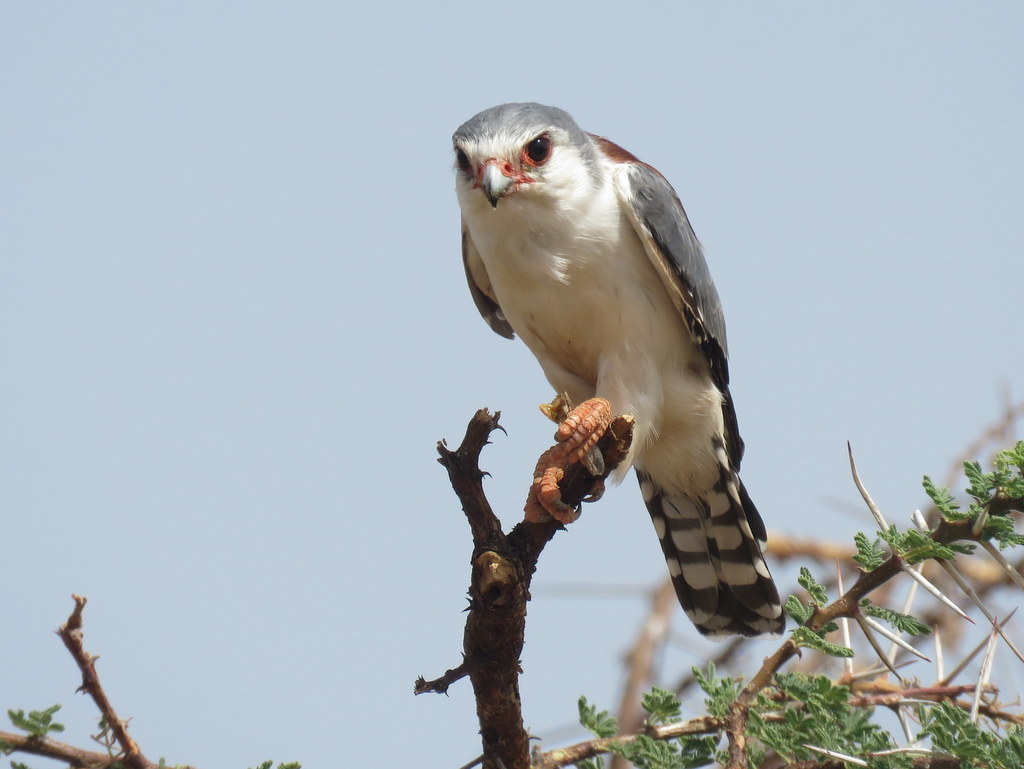
Pygmy Falcon
Photo © Diego Carús
Photo © Diego Carús — CC0 1.0 — Source: iNaturalist photo #27406537Identification
The pygmy falcon is Africa's smallest bird of prey, measuring just 20 cm in length and weighing a mere 54–76 grams. Only Asia's pygmy falconets are smaller. Adults are strikingly marked with white undersides extending to the face, while males display grey backs and females sport chestnut plumage. Juveniles are duller, with brown backs and a rufous wash on the breast. Both sexes show distinctive white "eye spots" on the nape, and their wings and tail feature striking black-and-white patterning—more black above, more white below on the flight feathers, with barred tail feathers. Their low, undulating flight style may cause confusion with some shrike species, though the falcon's proportions and hunting behaviour are distinctly raptor-like.
Pygmy falcons produce a distinctive high-pitched call described as "kikiKIK, repeated" in Kenya, or as rapid "chip-chip" and "kik-kik-kik-kik" sequences in southern Africa, making them acoustically identifiable even when perched inconspicuously among dry bush.
Range & Habitat
The pygmy falcon inhabits dry bushland across eastern and southern Africa, with its range covering approximately 2.7 million square kilometers. Two subspecies divide the distribution: P. s. castanonotus ranges from South Sudan and Somalia south to Uganda and Tanzania, while P. s. semitorquatus occupies the region from Angola to northern South Africa. The total population is estimated between 100,000 and one million birds, and the species is not threatened.
These diminutive raptors show remarkable physiological adaptations to their arid environments, which are subject to climatic variability. They depend heavily on the large, multichambered nests of sociable weavers and white-headed buffalo weavers, not only for nesting but also for communal roosting that provides crucial thermal buffering and reduces energy expenditure.
Behaviour & Diet
Pygmy falcons are specialist hunters of reptiles and insects, though they opportunistically take small birds, rodents, and juvenile mammals. They employ a classic hunting strategy, launching from high perches to swoop down and pounce on prey. Interestingly, some prey species like Kalahari tree skinks have evolved counter-tactics, eavesdropping on alarm calls from sociable weaver birds to detect approaching danger.
These falcons exhibit unusual cooperative breeding, with territories sometimes hosting multiple adults that jointly tend nestlings. Breeding occurs from August through February, peaking in September and December, with clutches typically containing three eggs. Pairs rarely breed more than three times per season. Pygmy falcons mark their nest chambers with conspicuous faecal mats—white when fresh, turning pinkish with age—which may deter snakes, reduce parasites, boost chick immunity, and signal occupancy to other falcons. In winter, they nest deeper within weaver colonies where insulation is superior, demonstrating behavioural flexibility in response to temperature.
Best Time & Places to See It
Pygmy falcons are most active during breeding season from August through February, particularly in September and December. Look for them in dry bushland habitats throughout their range, particularly near the large, characteristic nest structures of sociable weavers and buffalo weavers. The bird's association with these specific weaver species means that locating active weaver colonies significantly increases your chances of encountering pygmy falcons.
Photography Tips
The pygmy falcon's tiny size and preference for perching in dry, often thorny bush presents significant challenges. Use high magnification and be prepared for difficult lighting conditions in arid landscapes. Their low, undulating flight is best captured with fast shutter speeds. Listen for their distinctive high-pitched calls to locate individuals, and approach cautiously—their perches in thin vegetation leave them exposed but wary. Early morning and late afternoon light often provides the best conditions for photographing these small raptors against the African bush.
Serengeti National Park
Tanzania
+558 birds+57 mammals
Across Tanzania's northern plateau, where volcanic soils meet acacia woodland and open grassland, unfolds one of Earth's most dynamic ecosystems. The Serengeti National Park sprawls across…
VIEW NATIONAL PARKArusha National Park
Tanzania
+555 birds+16 mammals
Where the slopes of Mount Mawenzi rise above the Arusha region, a compact yet ecologically rich national park unfolds across montane forest, moorland, and alpine zones.…
VIEW NATIONAL PARKKidepo Valley National Park
Uganda
+478 birds+24 mammals
Where the Narus and Kidepo rivers carve through northeastern Uganda's semi-arid lowlands, a landscape of sparse acacia woodland, grassland, and riverine thickets creates one of East…
VIEW NATIONAL PARKTsavo East National Park
Athi ward, Kenya
+468 birds+50 mammals
Across the semi-arid lowlands of southeastern Kenya, where acacia woodland fragments into scrubland and the landscape rolls toward the Indian Ocean horizon, lies one of Africa's…
VIEW NATIONAL PARKTsavo West National Park
Mwatate, Kenya
+513 birds+49 mammals
Where volcanic ridges and weathered lava flows meet the semi-arid lowlands of south-central Kenya, Tsavo West National Park unfolds across a landscape sculpted by fire and…
VIEW NATIONAL PARKAmboseli National Park
Etonet/Lenkism ward, Kenya
+501 birds+43 mammals
Where the Amboseli basin opens toward the Tanzanian frontier, a shallow alkaline lake mirrors vast skies across one of East Africa's most iconic savanna landscapes. The…
VIEW NATIONAL PARKTarangire National Park
Tanzania
+527 birds+50 mammals
Acacia woodland and grassland sweep across the Manyara Region where the Tarangire River carves through low hills and volcanic soils, creating one of East Africa's most…
VIEW NATIONAL PARKNgorongoro Conservation Area
Tanzania
+626 birds+55 mammals
Volcanic calderas and open grassland dominate this high plateau in northern Tanzania, where the landscape rises above 2,000 metres and ancient geological forces have shaped both…
VIEW WILDLIFE MANAGEMENT AREAMokala National Park
Siyancuma Local Municipality, South Africa
+246 birds+35 mammals
Across the semi-arid savanna of the Northern Cape, where red earth meets sparse acacia woodland and open grassland punctuated by rocky outcrops, lies a landscape shaped…
VIEW NATIONAL PARKAugrabies Falls National Park
Kai !Garib Local Municipality, South Africa
+176 birds+20 mammals
Where the Orange River cuts a dramatic scar through the Northern Cape's arid interior, Augrabies Falls National Park sprawls across nearly 1,200 square kilometers of raw,…
VIEW NATIONAL PARKNamib-Naukluft National Park
Namibia
+217 birds+33 mammals
Across nearly 94,000 square kilometers of southwestern Namibia, a landscape of extremes unfolds where towering sand dunes meet rugged mountain ranges, and ancient riverbeds carve through…
VIEW NATIONAL PARKEtosha National Park
Namibia
+356 birds+58 mammals
Across northern Namibia's stark semi-arid plateau, a vast shallow depression transforms seasonally into one of Africa's most dramatic wildlife theaters. Etosha National Park, encompassing more than…
VIEW NATIONAL PARKNamibRand Nature Reserve
Hammerstein, Namibia
+107 birds+12 mammals
Where rust-coloured dunes surrender to sculpted granite outcrops and vast plains stretch toward an endless horizon, one of southern Africa's most pristine wilderness areas unfolds. The…
VIEW NATURE RESERVEAbijata-Shalla Lakes National Park
Ethiopia
+438 birds+7 mammals
Two crater lakes of contrasting chemistry define this remote corner of Ethiopia's Rift Valley, where soda lakes and freshwater basins create a mosaic of distinct aquatic…
VIEW NATIONAL PARKBale Mountains National Park
Ethiopia
+397 birds+20 mammals
Where the Ethiopian highlands rise above 4,000 metres, the Bale Mountains create a landscape of stunning ecological extremes—from afroalpine grasslands swept by wind and mist to…
VIEW NATIONAL PARKAwash National Park
Didiga, Ethiopia
+473 birds+23 mammals
Where the Ethiopian Rift Valley carves through volcanic plateaus, a ribbon of riverine forest winds through acacia scrubland and grassland, creating a mosaic of habitats that…
VIEW NATURAL PARKYabelo Wildlife Sanctuary
Bedewera, Ethiopia
+359 birds+5 mammals
Where acacia woodlands meet volcanic plateaus in southern Ethiopia, a landscape of austere beauty unfolds across nearly 2,500 square kilometers. Yabelo Wildlife Sanctuary sprawls across semi-arid…
VIEW WILDLIFE SANCTUARYNairobi National Park
Nairobi, Kenya
+515 birds+35 mammals
Just minutes from Kenya's capital, where the Nairobi River winds through acacia woodland and open grassland, lies one of Africa's most paradoxical wildlife sanctuaries. The park's…
VIEW NATIONAL PARKMeru National Park
Igembe Central, Kenya
+408 birds+38 mammals
Granite outcrops and acacia woodland rise across the northern reaches of Meru, where semi-arid savanna transitions into drier scrubland under the fierce equatorial sun. The park's…
VIEW NATIONAL PARKSamburu National Reserve
Samburu, Kenya
+430 birds+42 mammals
Across the arid plains of northern Kenya, where scattered acacia woodland gives way to rocky outcrops and dry riverbeds, Samburu National Park unfolds as one of…
VIEW NATURE RESERVEChyulu Hills National Park
Kibwezi East, Kenya
+232 birds+30 mammals
Volcanic cones rise abruptly from the Kenyan savanna floor, their flanks clothed in dense acacia woodland and grassland that transforms the Chyulu Hills into an ecological…
VIEW NATIONAL PARKNo community photos yet. Log in to add the first one.
No community observations of this species yet.