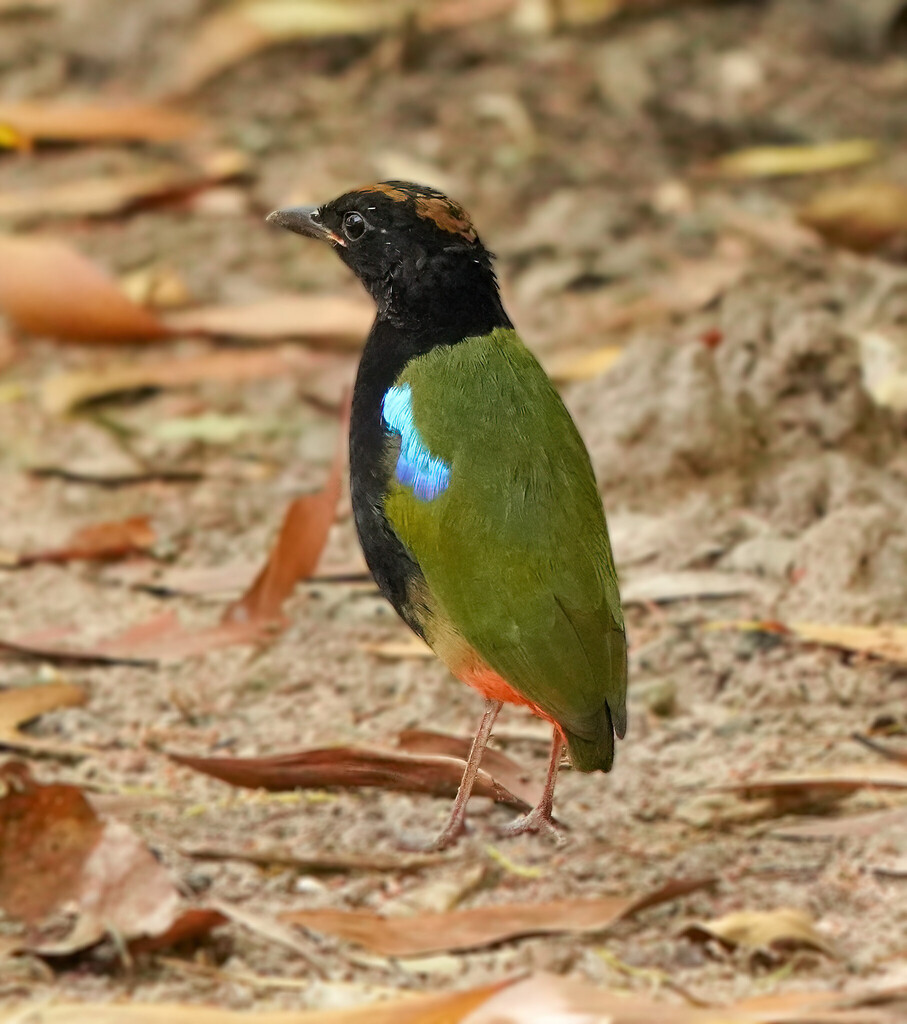
Rainbow Pitta
Photo © Philwarb
Photo © Philwarb — CC BY 4.0 — Source: iNaturalist #286419292Identification
The rainbow pitta is a small passerine measuring 16 to 18 cm in length, with females averaging slightly heavier at 67 g compared to males at 62 g. Its plumage is strikingly colourful and distinctive: a velvet black head, neck, breast, flanks and upper belly contrasts dramatically with a bright scarlet-red lower belly and undertail coverts. The upper parts are olive-green, while the wings are green with a golden sheen and feature a shining blue patch on the lesser wing coverts. The tail is olive-green with a black base. A distinctive chestnut stripe runs along each side of the crown, and around 60% of individuals display bronze-coloured streaks through the middle of their upper body feathers—unique among pittas for their bronze rather than dusky colouration. The bird has a black bill, pink legs and brown eyes, and typically stands upright with legs slightly bent at a 60–70° angle.
Plumage is essentially identical between the sexes, though females may show slightly more buff-yellow on the flanks and a subtly different shade of red on the lower belly. The western Australian subspecies P. i. johnstoneiana is very similar to the nominate race but features a larger chestnut eyebrow and wing-spot, with a slightly smaller overall body size.
Range & Habitat
The rainbow pitta is endemic to northern Australia, occurring exclusively in the Northern Territory and Western Australia from sea level to 380 metres. It is the only pitta species endemic to Australia. In the Northern Territory, it is found in the Top End from Darwin eastward to the Arnhem Escarpment edge, and also on Groote Eylandt and the Wessel Islands. In Western Australia, its range is restricted to the coastal Kimberley from Walcott Inlet to Middle Osborn Island, plus islands of the Bonaparte Archipelago.
The species favours monsoon forests and adjacent vine-scrub and gallery forests, though it also inhabits eucalypt forest, bamboo forests, paperbark forest, Lophostemon forests and the edges of mangrove forests. It typically occupies closed forests but adapts to more open woodland, and has occasionally been recorded in introduced pine plantations where it has even bred. Most pairs remain sedentary year-round, though some local movements to marginal habitats occur during the dry season.
Behaviour & Diet
Like other pittas, the rainbow pitta is secretive and shy, spending approximately 12% of each day calling—particularly in the hour before dawn and before 10 am or after 4 pm. Males call significantly more than females, with calling frequency increasing during the breeding season. The species employs several calls and displays to communicate, including a distinctive bowing display where the legs are held straight and the body held vertically with the breast nearly touching the ground.
Its diet consists mainly of insects, arthropods and small vertebrates obtained through ground foraging. Pairs defend territories and breed during the rainy season when food availability is highest for feeding nestlings. The female lays three to five blotched eggs in a large domed nest, with both parents sharing incubation duties, nest defence and chick feeding. Young birds eventually disperse from their parents' territories in search of their own.
Best Time & Places to See It
The rainbow pitta breeds during the rainy season when it is most active and vocal, making this the optimal time for observation. However, the species remains sedentary throughout much of the year in established territories. The bird is shy and secretive, and becomes particularly silent during the annual moult, making detection challenging during the post-breeding season.
In the Northern Territory, focus on the Top End region from Darwin to the Arnhem Escarpment edge, and visit Groote Eylandt and the Wessel Islands. In Western Australia, search the coastal Kimberley between Walcott Inlet and Middle Osborn Island, and islands of the Bonaparte Archipelago. Monsoon forests and adjacent gallery forests offer the best chances, though the species also frequents eucalypt woodlands and paperbark forests. Though shy, it is locally common and occasionally ventures onto open lawns in towns.
Photography Tips
The rainbow pitta's striking plumage—with its velvet black head, brilliant scarlet belly, olive-green upperparts and iridescent blue wing patches—offers excellent photographic potential when birds are located. The species typically moves by hopping along the ground while foraging, presenting opportunities for low-angle shots that capture its characteristic upright posture.
Early morning sessions, particularly in the hour before dawn and extending to 10 am, offer the best chance of locating calling birds during breeding season. Exercise patience in monsoon forests and gallery forests where the dense vegetation can obscure views. The contrast between the bird's dark upper body and brilliant red underparts requires careful exposure metering to retain detail in both highlights and shadows.
Kakadu National Park
Kakadu, Australia
+273 birds+46 mammals
Kakadu National Park is Australia’s largest national park and one of the world’s most remarkable protected areas, covering nearly 20,000 square kilometres in the tropical north…
VIEW NATIONAL PARKLitchfield National Park
Australia
+175 birds+15 mammals
Where weathered sandstone plateaus rise above the savanna woodlands of Australia's Top End, Litchfield National Park unfolds as a landscape of dramatic contrasts shaped by a…
VIEW NATIONAL PARKNitmiluk National Park
Australia
+186 birds+27 mammals
Dramatic sandstone gorges carved by the Katherine River slice through the tropical savanna of Australia's Top End, creating a landscape where escarpments tower above crystalline pools…
VIEW NATIONAL PARKNo community photos yet. Log in to add the first one.
No community observations of this species yet.