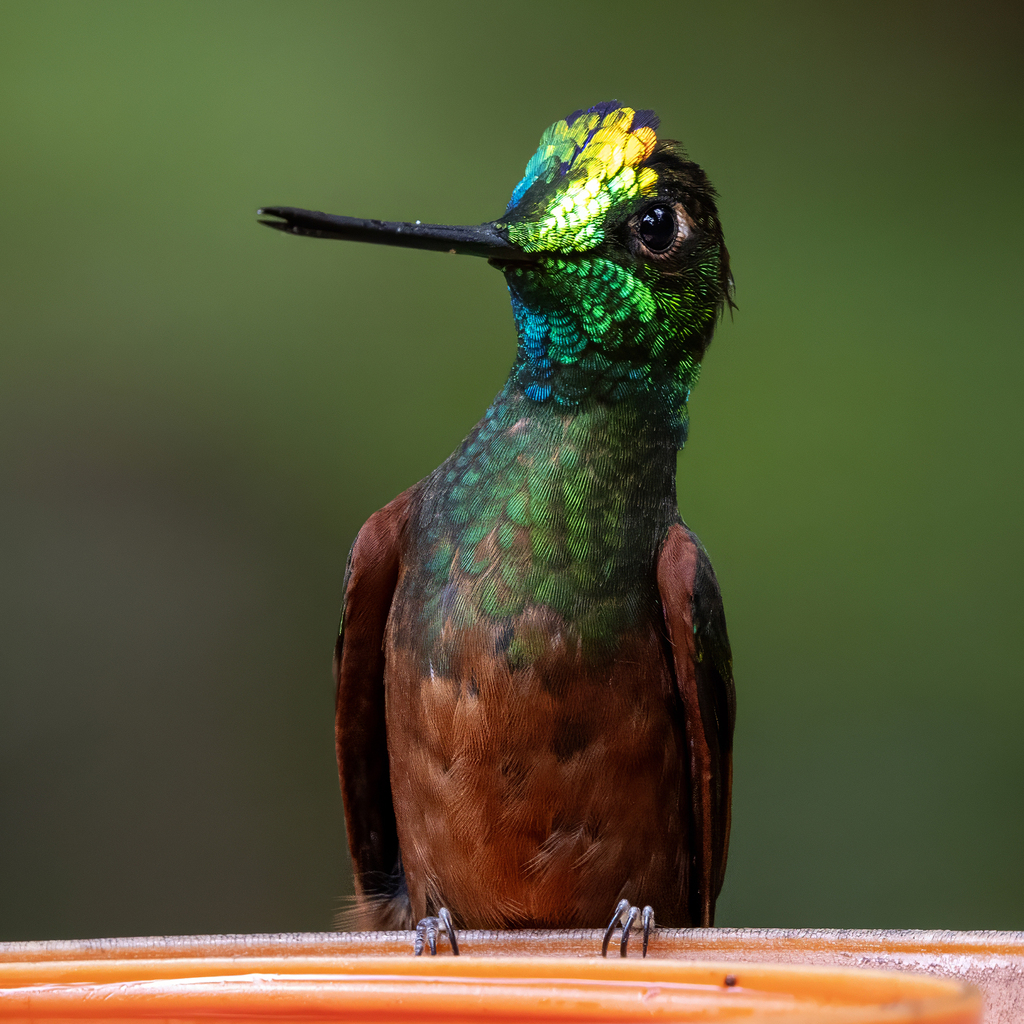
Rainbow Starfrontlet
Photo © Dan Vickers
Photo © Dan Vickers — CC BY 4.0 — Source: iNaturalist #310084857Identification
The rainbow starfrontlet is a small hummingbird measuring 12.5 to 14 cm in length, weighing 6–8.8 g depending on sex. Both males and females sport a long, straight black bill, a distinctive white spot behind the eye, and a forked tail. The species shows remarkable plumage variation across its six subspecies, but males of the nominate subspecies display the classic "rainbow" pattern: a glittering yellow-green forecrown transitioning through golden yellow to brilliant blue on the crown. The throat and chest are emerald green with a small violet spot, while the belly and tail are chestnut. Females are similar but with less metallic sheen. Other subspecies exhibit striking regional variations, from turquoise crowns with golden tips to dark violet crowns, making field identification challenging within their range.
Range & Habitat
The rainbow starfrontlet is endemic to the Andes of Ecuador and Peru, with six subspecies distributed across different regions. In Ecuador, subspecies occur in the southwestern provinces; in Peru, the species ranges from the Department of Piura in the north to southern Amazonas in the east. The species inhabits cloudforest edges, both humid and semi-humid, as well as gardens and riparian scrub. Elevations typically range from 1,700 to 3,300 m, though records exist as high as 4,000 m in northern Peru's Huascarán National Park. The species shows a notable ability to adapt to human-modified landscapes such as gardens and parks, which has helped buffer it against habitat fragmentation.
Behaviour & Diet
The rainbow starfrontlet is presumed to be sedentary. It feeds primarily on nectar using a trap-lining strategy, visiting a circuit of flowering plants in sequence. Favored nectar sources include red-flowered tubular blooms from genera such as Embothrium, Fuchsia, Iochroma, Mutisia, Salvia, and Tilandsia, typically foraging within 2–4 m of the ground. The species supplements its diet by capturing small arthropods in flight. Breeding occurs from November through January, with females constructing delicate cup nests from small twigs, moss, and lichens, lined with soft plant fibers and placed in the fork of small branches. During territorial chases, birds produce characteristic vocalizations: a thin, wiry chatter with rattles and squeaky notes, along with sharp "tsit" or "tip" calls.
Best Time & Places to See It
The breeding season from November to January offers the best opportunity to observe the rainbow starfrontlet, when birds are most active and vocal. Look for the species at cloudforest edges and in flowering gardens and parks throughout its Ecuadorian and Peruvian range. Key regions include southwestern Ecuador's Chimborazo and Azuay provinces, and various departments across northern and central Peru. The species' acceptance of gardens and cultivated areas means that hummingbird feeders and flowering plantings in mountain communities can be productive viewing locations. Early mornings when flowers are most active provide the best light and bird activity for observation.
Photography Tips
The rainbow starfrontlet's iridescent plumage demands careful attention to lighting. Position yourself with the sun at your back or to the side to capture the full brilliance of the males' glittering forecrown and emerald throat. The deep blue crown, violet throat spot, and chestnut underparts provide excellent color contrast in photographs. Since the bird forages low, typically within 2–4 m of the ground, use this to your advantage for photography at eye level or slightly above. Patient staking out of flowering plants—particularly red tubular flowers—will yield consistent opportunities. Fast shutter speeds (1/2000 or faster) are essential to freeze the rapid wing beats during nectar feeding and aerial chases. The distinct subspecific plumage variations make this species particularly rewarding for field photographers interested in documenting regional differences.
Podocarpus National Park
Zamora, Ecuador
+496 birds+6 mammals
Where the Andes descend toward the Amazon basin, Podocarpus National Park sprawls across nearly 2,800 square kilometres of the most biodiverse terrain in Ecuador's southern highlands.…
VIEW NATIONAL PARKYacuri National Park
Las Juntas, Ecuador
+166 birds+1 mammals
Where the eastern slopes of the Andes descend into Ecuador's southern frontier, Yacuri National Park unfolds across nearly 1,300 square kilometers of montane cloud forest and…
VIEW NATIONAL PARKCajas National Park
Cuenca, Ecuador
+190 birds+7 mammals
High in the Andes above Cuenca, where elevation ranges from 3,100 to 4,200 metres, the páramo landscape dominates—a windswept realm of cushion plants, alpine grasses, and…
VIEW NATIONAL PARKHuascarán National Park
Independencia, Peru
+201 birds+5 mammals
Where granite peaks pierce the Andean sky above 6,000 metres, Huascarán National Park sprawls across more than 11,500 square kilometres of Peru's Cordillera Blanca, a landscape…
VIEW NATIONAL PARKNo community photos yet. Log in to add the first one.
No community observations of this species yet.