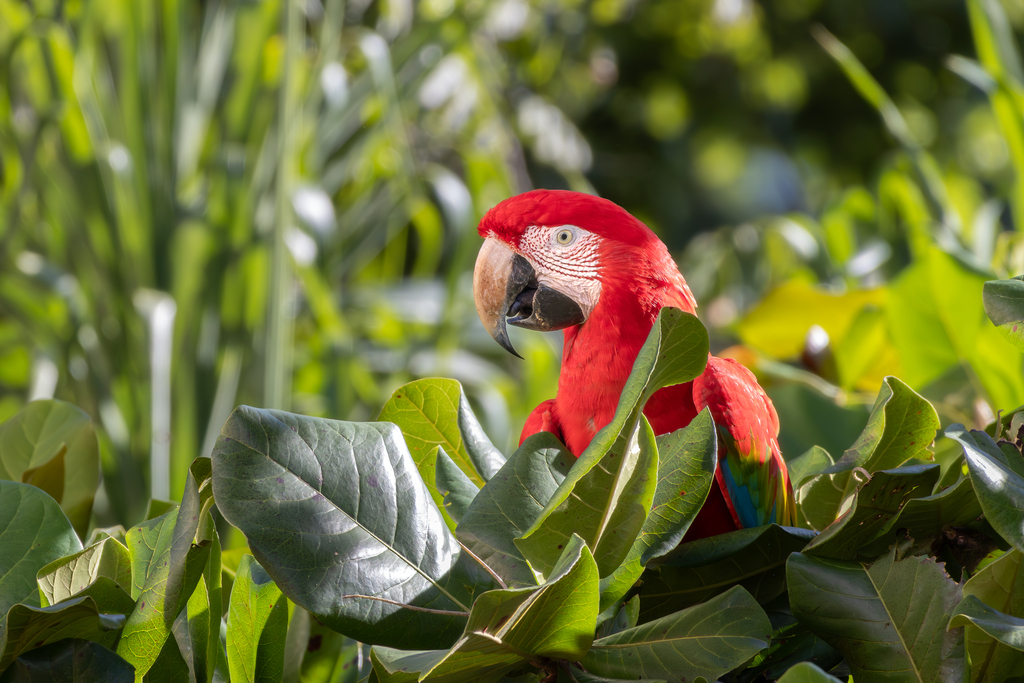
Red-and-green Macaw
Photo © Francisco V. Bezerra Neto
Photo © Francisco V. Bezerra Neto — CC BY-SA 4.0 — Source: iNaturalist photo #675486126Identification
The red-and-green macaw is the largest species within the genus Ara, reaching 90–95 cm in length and weighing between 1,050–1,708 grams. Its plumage is predominantly bright red, with the most distinctive field mark being the upper-wing covert feathers, which are mostly green—a key difference from the similar scarlet macaw, whose wing coverts are predominantly yellow. Another reliable identifying feature is the characteristic pattern of fine red lines around the eyes, formed by rows of tiny feathers on otherwise bare white skin patches. The tail displays iridescent teal feathers surrounded by red. When seen alongside other large macaws, this species' considerable size is immediately apparent.
Range & Habitat
This macaw is widespread across the forests and woodlands of northern and central South America. Historically, its range extended further south into Argentine provinces including Chaco, Corrientes, Formosa, and Misiones, though it was extirpated from Argentina by the 1960s. Recent population recovery efforts in Argentina have shown promise, with birds recolonizing Iguazú National Park in the mid-2010s and spreading into nearby protected areas. A population has also appeared on Trinidad since 1999, possibly representing range expansion or escaped captive birds.
Behaviour & Diet
Red-and-green macaws are monogamous, generally mating for life. Females typically lay two or three eggs in tree cavities, incubating them for approximately 28 days. Young birds fledge roughly 90 days after hatching. The species' specific dietary preferences are not detailed in current field records, though macaws are known to consume seeds, nuts, and fruits from forest vegetation.
Best Time & Places to See It
Northern and central South American forests remain the primary stronghold for this species. For those interested in witnessing reintroduction efforts, Iberá Provincial Reserve in Corrientes Province, Argentina, offers opportunities to see birds released through a collaborative conservation programme by the World Parrot Trust and other organizations. Iguazú National Park and Parque provincial Puerto Península have also become sites of recent colonization.
Photography Tips
The vivid red plumage and contrasting green wing coverts make this macaw visually striking, though the bright reds can present exposure challenges in tropical forest light. Position yourself to capture the distinctive red eye-line markings and iridescent tail feathers, both diagnostic features. Early morning light in forest canopy gaps will reveal the true color palette. When photographing pairs or family groups, the size difference compared to other macaw species becomes an excellent compositional element.
Amacayacu National Park
Amazônia National Park
Anavilhanas National Park
Bahuaja Sonene National Park
Campos Amazónicos National Park
Chapada dos Guimarães National Park
Darién National Park
Emas National Park
Encontro das Águas State Park
Nothing matches these filters.
No community photos yet. Log in to add the first one.
No community observations of this species yet.