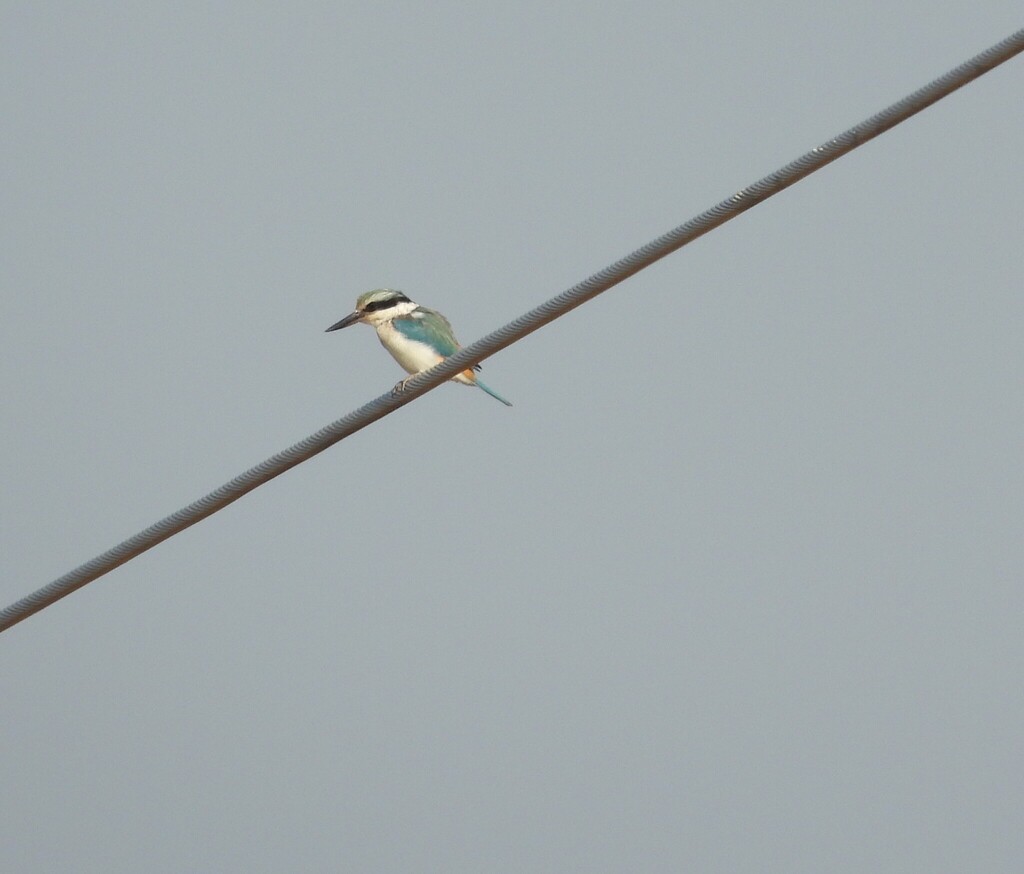
Red-backed Kingfisher
Photo © Mark Clarke
Photo © Mark Clarke — CC BY 4.0 — Source: iNaturalist #291956601Identification
The red-backed kingfisher is a compact kingfisher measuring 20 to 24 cm in length, with males weighing 45–70 g and females slightly lighter at 41–62 g. This species is instantly recognizable by its distinctive chestnut rump, which contrasts beautifully with its bluish-green wings and tail. The crown is streaked green and white, the breast and abdomen are white, and a striking black band runs from the bill through the eyes to the ear coverts. The nape is white, and the iris is dark brown with dark grey legs and feet.
Sexual dimorphism is evident in this species: females are noticeably duller overall, with more heavily streaked crowns, dull turquoise wings, and buff-tinged white areas. Immature birds resemble females but have duller green backs and mantle with speckling on the breast, making them readily distinguishable from adults in the field.
Range & Habitat
The red-backed kingfisher is native to most of Australia, notably absent only from Tasmania and the extreme southwest and southeast of the mainland. It is a year-round resident throughout much of its range, though it acts as a summer visitor to the southeast of the country. The species is moderately common to uncommon, with populations subject to irregular nomadic movements that likely depend on erratic rainfall patterns.
This kingfisher is truly adapted to arid Australia, inhabiting dry forests, mulga and mallee country, spinifex grasslands, and even almost treeless regions—often far from permanent water. During breeding season, birds relocate to river courses where they can access suitable earthy banks for nesting burrows. The species appears to be partly migratory in southern Australia, moving north in winter after the breeding season concludes.
Behaviour & Diet
The red-backed kingfisher employs a classic sit-and-wait hunting strategy, perching conspicuously in trees or on overhead wires before swooping to the ground to capture prey and returning directly to its perch. Its diet is remarkably diverse, comprising various insects including locusts, grasshoppers, beetles, leaf-insects, ants, and caterpillars, alongside spiders, small crustaceans, centipedes, and scorpions. The species also takes small vertebrates such as fish, frogs, tadpoles, lizards, snakes, and occasionally mouse-sized mammals.
Breeding occurs from August to February, with pairs often raising double broods when conditions permit, though drought years may see no breeding. Nests are burrows dug 0.5–1.25 m into steep sloping banks overlooking dry creek-beds or dams; occasionally they use abandoned mine-shafts, hollow branches, or even termite mounds in northern regions. Two to six white, rounded, shiny eggs are laid and incubated by both adults for 20–23 days, with fledglings departing the nest after a further 26–30 days. The species is vocal, particularly during breeding, producing a descending, mournful "kee-ip" whistle repeated from tree-tops and wires, along with harsh alarm calls and parrot-like chatter near the nest.
Best Time & Places to See It
The red-backed kingfisher is best sought in Australia's arid interior and dry forest regions during the breeding season from August to February, when birds are more active and vocal. Summer visitors to southeastern Australia should look for this species during the warmer months. The species' nomadic nature means sightings depend partly on rainfall; wetter seasons may concentrate birds in accessible areas, while drought years can reduce observations.
Look for this kingfisher perched conspicuously on trees, branches, or overhead wires in its preferred dry habitats. River courses and waterways become focal points during breeding season when birds gather to establish nesting burrows, making these locations prime viewing opportunities.
Photography Tips
The red-backed kingfisher's habit of hunting from conspicuous perches makes it relatively approachable for photography. Position yourself to observe potential hunting perches and wait for the bird to make its characteristic ground swoop, capturing the dramatic contrast between its blue-green upperparts and chestnut rump. The black facial band provides excellent compositional contrast against the white face and throat.
The species' vocal nature during breeding season makes locating individuals easier; listen for the distinctive descending "kee-ip" whistle or harsh chatter near nesting sites. River courses during breeding season offer the best opportunities to photograph birds in action as they commute between perches and foraging areas. Aim to capture the striking colour contrasts, particularly the chestnut rump and the distinctive facial markings, which are the species' most recognizable features.
Uluru-Kata Tjuta National Park
Petermann, Australia
+146 birds+10 mammals
Uluru-Kata Tjuta National Park is one of Australia’s most iconic protected areas, renowned for its breathtaking desert landscapes, extraordinary geological formations, and deep cultural significance. Located…
VIEW NATIONAL PARKCarnarvon National Park
Philadelphia, Australia
+179 birds+17 mammals
Across 15,000 square kilometres of inland Queensland, rugged sandstone plateaus rise above eucalypt woodlands and open grasslands, carved by creeks that have worn deep gorges into…
VIEW NATIONAL PARKKakadu National Park
Kakadu, Australia
+273 birds+46 mammals
Kakadu National Park is Australia’s largest national park and one of the world’s most remarkable protected areas, covering nearly 20,000 square kilometres in the tropical north…
VIEW NATIONAL PARKDaintree National Park
Dedin, Australia
+362 birds+37 mammals
Daintree National Park is one of the world’s oldest and most biologically diverse tropical rainforests, protecting an extraordinary landscape where ancient forests meet the Great Barrier…
VIEW NATIONAL PARKGreater Bendigo National Park
Whipstick, Australia
+202 birds+8 mammals
Across the red volcanic plains of inland Victoria, Greater Bendigo National Park sprawls across more than 1,000 square kilometres of eucalyptus woodland, open grassland, and scattered…
VIEW NATIONAL PARKChiltern-Mt Pilot National Park
Australia
+229 birds+12 mammals
Granite ridges and eucalyptus woodlands define this 869-square-kilometre park straddling the border between Victoria and New South Wales, where rugged terrain rises sharply from gentler foothill…
VIEW NATIONAL PARKIkara-Flinders Ranges National Park
Australia
+149 birds+10 mammals
Where ancient quartzite ridges rise across the semi-arid heart of South Australia, Ikara-Flinders Ranges National Park unfolds across nearly two thousand square kilometres of one of…
VIEW NATIONAL PARKLittle Desert National Park
Australia
+200 birds+11 mammals
Across northwestern Victoria's semi-arid interior, sandstone ridges and heathland plateaus rise from red earth in a landscape sculpted by fire and drought rather than water. Little…
VIEW NATIONAL PARKVulkathunha-Gammon Ranges National Park
Australia
+97 birds+8 mammals
Granite ridges and quartzite peaks rise abruptly from the red earth of South Australia's mid-north, their steep slopes carved into gorges where seasonal waterfalls cascade through…
VIEW NATIONAL PARKRinyirru National Park
Lakefield, Australia
+258 birds+7 mammals
Where the savanna grasslands of far north Queensland meet seasonal wetlands and eucalypt woodlands, Rinyirru National Park sprawls across more than 12,500 square kilometres of rugged,…
VIEW NATIONAL PARKLitchfield National Park
Australia
+175 birds+15 mammals
Where weathered sandstone plateaus rise above the savanna woodlands of Australia's Top End, Litchfield National Park unfolds as a landscape of dramatic contrasts shaped by a…
VIEW NATIONAL PARKNitmiluk National Park
Australia
+186 birds+27 mammals
Dramatic sandstone gorges carved by the Katherine River slice through the tropical savanna of Australia's Top End, creating a landscape where escarpments tower above crystalline pools…
VIEW NATIONAL PARKGreat Sandy National Park
Australia
+306 birds+40 mammals
Where coastal dunes rise inland from the Queensland coastline, Great Sandy National Park encompasses a landscape of remarkable ecological diversity shaped by subtropical humid conditions year-round.…
VIEW NATIONAL PARKWooroonooran National Park
Australia
+240 birds+28 mammals
Where the Great Dividing Range rises sharply inland from Queensland's tropical coast, Wooroonooran National Park encompasses a landscape of steep, forested gorges and cascading waterways carved…
VIEW NATIONAL PARKBoodjamulla National Park
Australia
+142 birds+3 mammals
Where red sandstone gorges carve through the semi-arid interior of far north Queensland, Boodjamulla National Park reveals a landscape shaped by seasonal water availability and ancient…
VIEW NATIONAL PARKKosciuszko National Park
Australia
+211 birds+52 mammals
Where the Great Dividing Range reaches its highest peaks in southeastern Australia, Kosciuszko National Park encompasses a landscape of windswept plateaus, rocky ridges, and deep river…
VIEW NATIONAL PARKMungo National Park
Australia
+135 birds+7 mammals
Across the semi-arid inland plains of New South Wales, where sparse shrubland and scattered grassland stretch beneath enormous skies, lies a landscape shaped by ancient geological…
VIEW NATIONAL PARKMurray-Sunset National Park
Australia
+205 birds+2 mammals
Across the semi-arid borderlands of northwestern Victoria, where the Murray River defines the state's edge, sprawls a landscape of remarkable resilience and subtle beauty. Murray-Sunset National…
VIEW NATIONAL PARKKalbarri National Park
Australia
+157 birds+6 mammals
Where ochre cliffs and weathered gorges slice through Western Australia's semi-arid interior, Kalbarri National Park reveals a landscape shaped by millions of years of erosion and…
VIEW NATIONAL PARKKarijini National Park
Australia
+117 birds+5 mammals
Ochre ridges and rust-coloured gorges slice through the Pilbara's ancient landscape, where Karijini National Park sprawls across a wilderness of iron-rich plateaus and plunging ravines carved…
VIEW NATIONAL PARKCape Range National Park
Australia
+159 birds+15 mammals
Where arid limestone ridges plunge toward turquoise waters, Cape Range National Park frames one of Australia's most dramatic desert-ocean interfaces. The park's spine—a stark, weathered range…
VIEW NATIONAL PARKPurnululu National Park
Australia
+114 birds
Towering sandstone domes and dramatic gorges carved by seasonal watercourses define this remote corner of the Kimberley, where ancient rock formations create a maze of narrow…
VIEW NATIONAL PARKNo community photos yet. Log in to add the first one.
No community observations of this species yet.