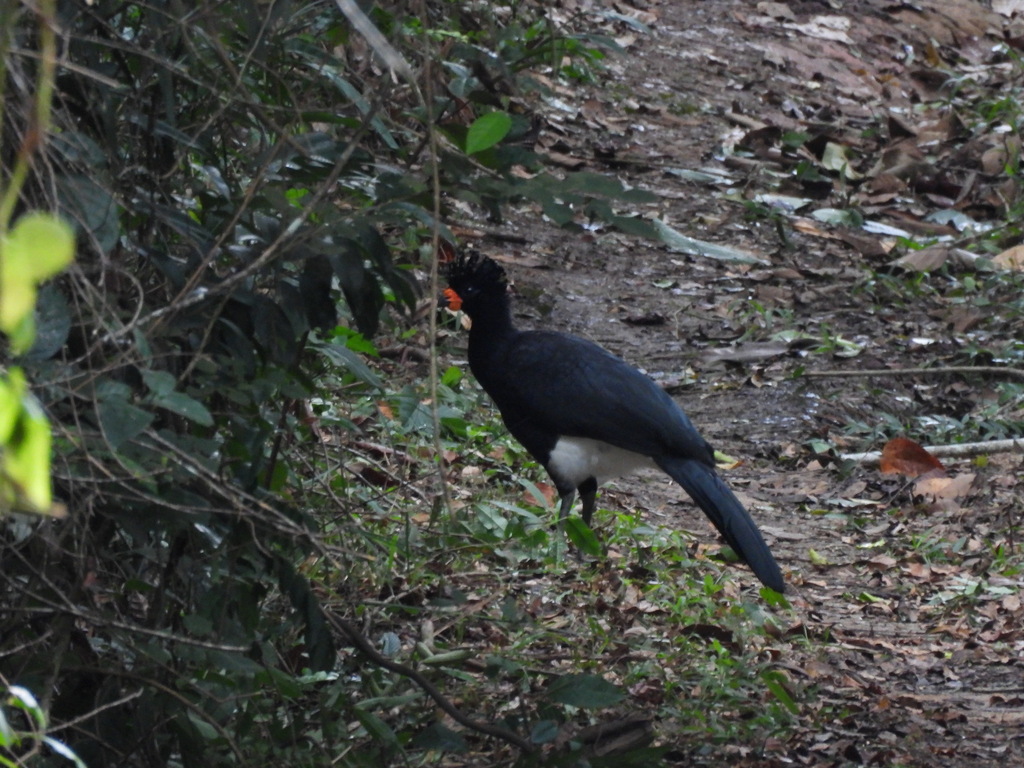
Red-billed Curassow
Photo © sheylarossi
Photo © sheylarossi — CC BY-SA 4.0 — Source: iNaturalist #296636564Identification
The red-billed curassow is a large galliform bird, reaching 82 to 92 centimetres in length. Males are unmistakable: they display pure black upper parts crowned with a prominent black crest, contrasting sharply with white underparts. The most distinctive feature is the bright red bill adorned with conspicuous red wattles and knobs at its base. Females are more subtly patterned, with black upper parts and a black-and-white barred crest, reddish-brown wings heavily barred and mottled with black, and reddish-brown or ochre underparts. Crucially, females lack the red bill ornaments of males. The species can be distinguished from related curassows by its less bluish-black plumage compared to the wattled curassow, and its less purplish-black appearance versus the black curassow.
Range & Habitat
The red-billed curassow is endemic to lowland Atlantic Forest habitat in southeastern Brazil, occurring in the states of Espírito Santo, Bahia, and Minas Gerais. Once more widespread, its range has contracted dramatically due to the conversion of virgin forest into agricultural land and plantations. The species may have been extirpated from Minas Gerais entirely. Today it survives only in protected reserves, where populations continue to face pressure from illegal hunting and trapping for the bird trade. Conservation efforts include a captive breeding programme, with individuals being reintroduced to Rio de Janeiro.
Behaviour & Diet
The red-billed curassow is predominantly a ground-dwelling species, foraging on the forest floor and lower vegetation. Its diet consists of seeds, fruits, buds, and small invertebrates. During the breeding season, males produce loud, distinctive "boom" calls, which can be heard in September and October—a useful identifier for birdwatchers. Females are notably productive breeders, typically laying clutches of one to four eggs. The young fledge by the end of the year, allowing successful pairs to raise young within a single calendar year.
Best Time & Places to See It
The red-billed curassow is now found almost exclusively within protected reserves in Espírito Santo and Bahia, making access limited and requiring arrangement through local conservation organizations. The best time to locate this species is during the breeding season from September to October, when males are vocal and more easily detected by their loud booming calls. Given the bird's endangered status and declining populations, sightings cannot be guaranteed, and visitors should work with experienced local guides familiar with remaining populations and reserve access protocols.
Photography Tips
The red-billed curassow's striking sexual dimorphism makes photographing both males and females rewarding. Males, with their glossy black plumage, white underparts, and brilliant red facial ornaments, are particularly photogenic in good light. Ground-level shooting angles will capitalize on the bird's terrestrial habits and help isolate individuals against forest understory backgrounds. Early morning light will best reveal the vivid red coloration of the male's bill and wattles. Patience and slow, deliberate movements are essential, as this ground-dwelling species is wary and easily disturbed.
Nothing matches these filters.
No community photos yet. Log in to add the first one.
No community observations of this species yet.