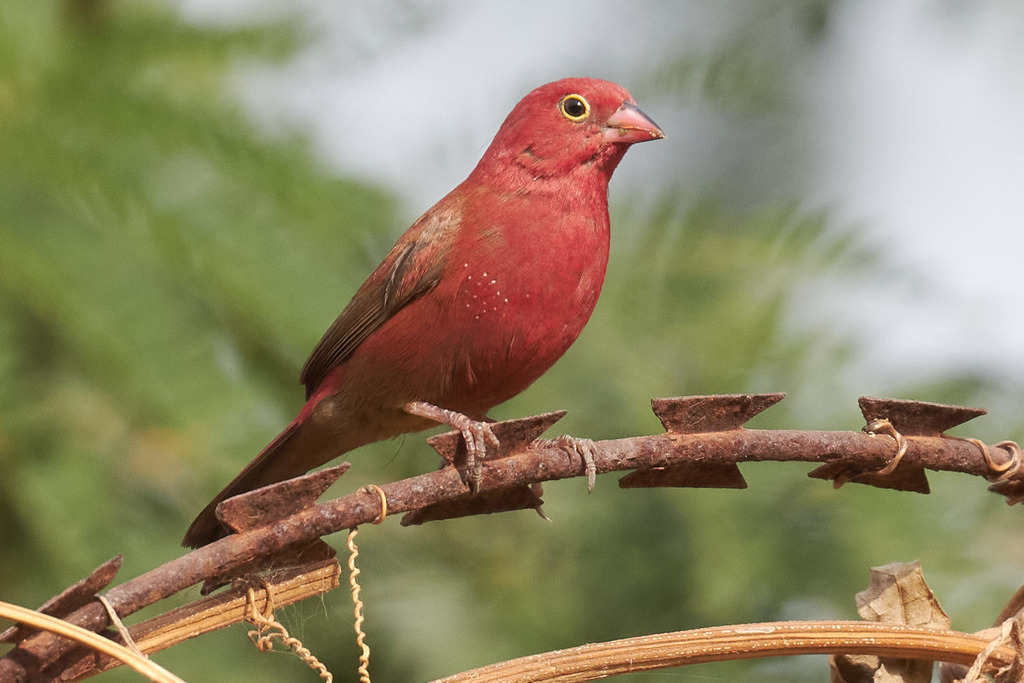
Red-billed Firefinch
Photo © andygpos
Photo © andygpos — CC BY 4.0 — Source: iNaturalist photo #471356129Identification
The red-billed firefinch is a tiny seed-eating bird measuring just 10 cm in length, making it easy to overlook despite its striking plumage. Adult males are unmistakable, displaying entirely scarlet red plumage except for brown wings—a dazzling combination that makes them among Africa's most eye-catching small birds. Both sexes share a distinctive pink bill and yellow eye-ring. Females are more subdued, with uniformly brown upperparts and buff underparts, though they retain the characteristic red patches in front of both eyes and the pink bill that identify them as firefinches.
Range & Habitat
This widespread and abundant species is a resident breeding bird across most of Sub-Saharan Africa, with an estimated global extent of occurrence of 10,000,000 km². Six subspecies are recognized, ranging from West African populations in Mauritania and Senegal through the Sahel, East Africa, and down to southern populations in Mozambique and South Africa. The species has also been introduced to southern Algeria, where it is currently expanding northward, though an earlier introduction to Egypt did not establish permanently.
The red-billed firefinch is a gregarious bird that thrives in open grassland and cultivated areas, and is often found around human habitation alongside other small finches such as the red-cheeked cordon-bleu. It builds a large domed grass nest with a side entrance, constructed low in a bush, wall, or thatch, where it lays three to six white eggs.
Behaviour & Diet
True to its family of waxbills and allies, the red-billed firefinch is primarily a seed-eater, feeding mainly on grain and other seeds. It is a distinctly social bird, often encountered in small flocks. The species has characteristic vocalizations: a soft and familiar "queet-queet" call that is a recognizable sound across African landscapes, and a rising song described as "chick-pea-pea-pea." One ecological note of interest is that the nest of this species is sometimes parasitised by the village indigobird, which may lay its own eggs within the firefinch's carefully constructed home.
Best Time & Places to See It
The red-billed firefinch's status as a resident breeding bird means it is present year-round throughout its range, making it accessible to travellers visiting Sub-Saharan Africa at any season. Its abundance and preference for open grasslands and cultivated areas near human settlements make it one of the more reliably encountered small birds. Look for it in areas with scattered bushes and thatch structures, particularly in villages and agricultural regions where grain cultivation provides abundant food.
Photography Tips
The brilliant scarlet plumage of males offers excellent photographic opportunities, particularly in early morning light when colors are most vibrant. The bird's small size and gregarious nature mean that patient photographers may capture multiple individuals in a single frame. Focus on males for the most striking images, using their distinctive red and brown coloration against natural backgrounds. The species' familiarity with human habitation means it can often be approached more closely than wilder species, though a telephoto lens will still be valuable for capturing fine detail of the eye-ring and bill coloration.
Bwindi Impenetrable National Park
Lake Mburo National Park
Mabamba Swamp
Murchison Falls National Park
Queen Elizabeth National Park
Aberdare National Park
Abijata-Shalla Lakes National Park
Addo Elephant National Park
Amboseli National Park
Nothing matches these filters.
No community photos yet. Log in to add the first one.
No community observations of this species yet.