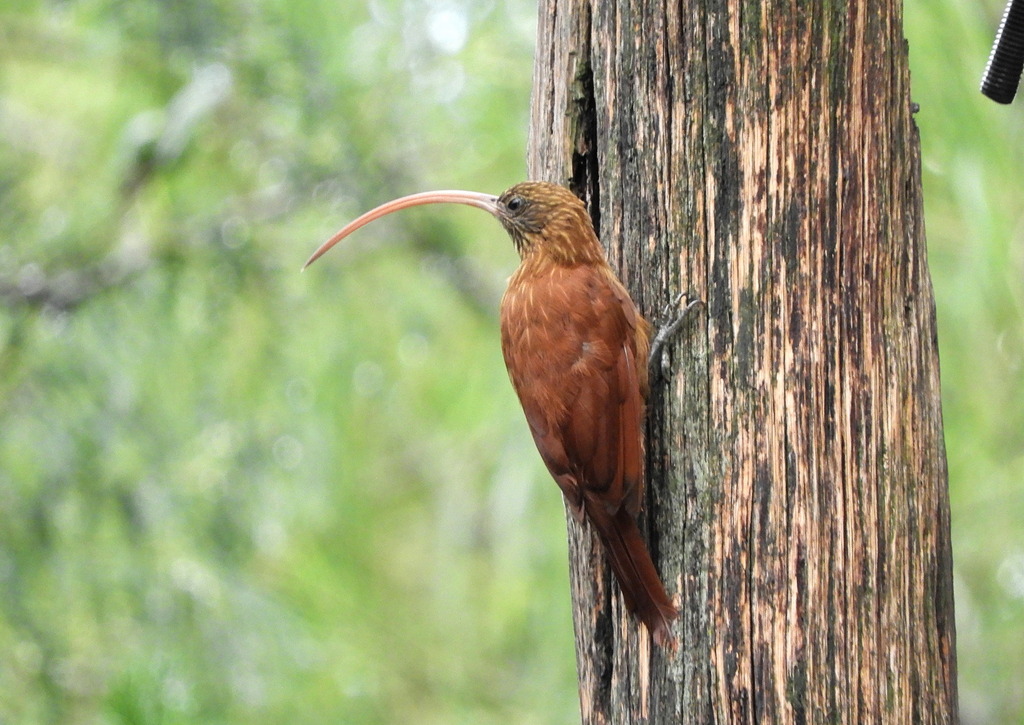
Red-billed Scythebill
Photo © Pablo H Capovilla
Photo © Pablo H Capovilla — CC BY 4.0 — Source: iNaturalist photo #474466457Identification
The red-billed scythebill is a slim, medium-sized woodcreeper measuring 22 to 28 cm in length and weighing 30 to 55 grams. Its most striking feature is an exceptionally long, slender, dramatically curved bill—bright red or reddish-brown in colour, often with a dusky tip and base. The sexes are identical in plumage. Adults display reddish olive-brown crowns, napes, and backs with whitish to ochraceous spots edged in black. The rump is cinnamon-rufous, while flight feathers and tail are rufous-chestnut. The underparts are slightly lighter brown than the back, with buff streaking on the breast that narrows towards the belly. The throat and chin are white with thin brownish streaks. Eyes are dark brown to hazel, and legs are grayish-olive to dull pea-green. Juveniles are duller overall, with less defined streaking and a noticeably darker, shorter bill.
Range & Habitat
The red-billed scythebill is found across a vast range spanning nine countries: Panama, Colombia, Venezuela, Ecuador, Peru, Brazil, Bolivia, Paraguay, and Argentina. The species comprises 12 subspecies, each occupying specific regions from coastal areas to the Amazon Basin. The bird inhabits diverse wooded landscapes, including Gran Chaco woodland, gallery forest, cerrado, caatinga, and secondary forest. In Amazonia, it favours seasonally flooded várzea and igapó forests alongside riverside canebrakes. Elevations range mostly below 1,200 metres, though the species reaches 1,900 metres in Ecuador and 2,100 metres in Venezuela.
Behaviour & Diet
The red-billed scythebill is believed to be a year-round resident throughout its range. Its diet consists chiefly of arthropods, which it forages for using its characteristically long, curved bill—a specialised adaptation for extracting prey from bark and wood crevices in typical woodcreeper fashion.
Best Time & Places to See It
Since the red-billed scythebill is a year-round resident, it can be observed throughout the year across its range. The species is most readily found in open to semi-open wooded habitats, including gallery forests, cerrado, and secondary growth. Travellers exploring the Amazon Basin, particularly in regions with várzea and igapó forests, or visiting the cerrado regions of Brazil have good opportunities to encounter this species. Different subspecies occupy distinct geographic regions, so location within the bird's range will determine which subspecies you encounter.
Photography Tips
The red-billed scythebill's distinctive curved bill and rufous colouration make it visually striking for photography. The bird's preference for semi-open woodlands and secondary forests provides better lighting conditions than dense primary forest. Look for it working along branches and tree trunks in its characteristic woodcreeper manner. The bright red bill contrasts well against the bird's olive-brown and rufous plumage, making it an attractive photographic subject. Early morning and late afternoon light will best showcase the warm tones of its upperparts and the vivid colouration of its bill.
Emas National Park
Brazil
+333 birds+23 mammals
Across the high plateaux of central Brazil, where the cerrado grasslands roll toward distant horizons under an immense sky, Emas National Park anchors one of South…
VIEW NATIONAL PARKYasuní National Park
Aguarico, Ecuador
+601 birds+43 mammals
Where the western Amazon basin converges with Ecuador's Orellana Province, lowland rainforest reaches toward the horizon in an unbroken canopy of staggering botanical density. Yasuní National…
VIEW NATIONAL PARKCerros de Amotape National Park
District of San Jacinto, Ecuador
+246 birds+1 mammals
Arid mountains rise abruptly from Peru's northwestern frontier, their slopes clothed in xerophytic scrubland and seasonal deciduous forest that transforms these Andean foothills into one of…
VIEW NATIONAL PARKPodocarpus National Park
Zamora, Ecuador
+496 birds+6 mammals
Where the Andes descend toward the Amazon basin, Podocarpus National Park sprawls across nearly 2,800 square kilometres of the most biodiverse terrain in Ecuador's southern highlands.…
VIEW NATIONAL PARKSumaco Napo-Galeras National Park
Loreto, Ecuador
+563 birds+4 mammals
Where Ecuador's Amazon transitions into cloud forest, a massive shield volcano rises from the emerald lowlands of Orellana Province, anchoring one of the continent's most biodiverse…
VIEW NATIONAL PARKNatural Serranía de los Yariguíes National Park
El Carmen de Chucurí, Colombia
+320 birds+3 mammals
Where the northern cordilleras of Colombia rise toward cloud forest, the Serranía de los Yariguíes unfolds across nearly 1,820 square kilometers of some of the most…
VIEW NATIONAL PARKMorrocoy National Park
Municipio Silva
+290 birds
Where the Caribbean coast of northwestern Venezuela meets protected coastal waters, a mosaic of mangrove forests, sandy beaches, and coral reef systems defines Morrocoy National Park.…
VIEW NATIONAL PARKEl Tamá National Park
Toledo, Colombia
+435 birds
Where the Andes descend toward the Caribbean coastal lowlands of northern Colombia, El Tamá National Park sprawls across nearly 3,800 square kilometres of montane forest, cloud…
VIEW NATIONAL PARKNatural Sierra de la Macarena National Park
Vista Hermosa, Colombia
+566 birds+15 mammals
Across nearly 20,000 square kilometres of Colombia's Meta Department, the terrain rises from lowland savanna into Andean foothills through a mosaic of gallery forests, palm-fringed wetlands,…
VIEW NATIONAL PARKUbajara National Park
Brazil
+122 birds+1 mammals
Granite peaks rise sharply from the humid tropical forests of northeastern Brazil, where Ubajara's 234 square kilometres straddle the transition between Atlantic rainforest and drier cerrado…
VIEW NATIONAL PARKIlha Grande National Park
Brazil
+233 birds
Across the subtropical plateaus and Atlantic forest remnants of southern Brazil, a vast protected landscape spanning nearly 4,600 square kilometers safeguards one of the continent's most…
VIEW NATIONAL PARKSerra do Teixeira National Park
Brazil
+160 birds+5 mammals
Rugged plateaus and deep escarpments define this 3,112-square-kilometre sweep of the Brazilian Northeast, where the crystalline bedrock of the Borborema Plateau rises abruptly from the surrounding…
VIEW NATIONAL PARKChapada dos Guimarães National Park
Brazil
+450 birds+1 mammals
Where weathered sandstone plateaus rise above the cerrado grasslands of central Brazil, Chapada dos Guimarães National Park protects 624 square kilometres of ecological transition zone that…
VIEW NATIONAL PARKPantanal Matogrossense National Park
Brazil
+322 birds+17 mammals
Where the flooded forests of central Brazil meet vast seasonally inundated grasslands, Pantanal Matogrossense National Park sprawls across nearly 2,900 square kilometers of one of the…
VIEW NATIONAL PARKAnavilhanas National Park
Brazil
+468 birds+8 mammals
Across the Rio Negro in central Amazonas, an archipelago of over a thousand islands rises from the world's largest rainforest river system, creating a labyrinth of…
VIEW NATIONAL PARKSerra do Divisor National Park
Brazil
+448 birds+10 mammals
Where the western Amazon meets the Andes foothills, Serra do Divisor National Park sprawls across one of South America's most biodiverse and least accessible frontiers. Spanning…
VIEW NATIONAL PARKYanachaga–chemillén National Park
Palcazu, Peru
+639 birds+6 mammals
Where the eastern slopes of Peru's central cordillera plunge into cloud forest, Yanachaga–Chemillén National Park protects nearly three thousand square kilometres of montane wilderness that few…
VIEW NATIONAL PARKManu National Park
Manu, Peru
+892 birds+26 mammals
Across the eastern slopes of the Peruvian Andes, tropical rainforest descends into the Amazon basin with a complexity that few terrestrial ecosystems match. Manu National Park…
VIEW NATIONAL PARKBahuaja Sonene National Park
San Pedro de Putina Punco, Peru
+602 birds+8 mammals
Where the Madre de Dios and Heath rivers converge in southeastern Peru rises one of South America's most biodiverse wilderness regions: a vast protected realm of…
VIEW NATIONAL PARKCordillera Azul National Park
Pampa Hermosa, Peru
+322 birds+1 mammals
Where the eastern Andes descend into the western Amazon basin, Cordillera Azul National Park sprawls across nearly 38,000 square kilometres of some of Peru's most pristine…
VIEW NATIONAL PARKChagres National Park
Caimitillo, Panama
+486 birds+19 mammals
Where the Chagres River carves through the humid tropics of central Panama, a vast montane and lowland forest sprawls across more than 2,300 square kilometers, anchoring…
VIEW NATIONAL PARKDarién National Park
Tucutí, Panama
+534 birds+13 mammals
Where the spine of Central America crumbles into wetland and rainforest, Darién National Park sprawls across more than 20,000 square kilometres of some of the tropics'…
VIEW NATIONAL PARKRío Pilcomayo National Park
Argentina
+271 birds+13 mammals
Where the Río Pilcomayo cuts through northeastern Argentina's subtropical lowlands, a sprawling mosaic of wetlands, grasslands, and seasonally flooded forests creates one of South America's most…
VIEW NATIONAL PARKParque Provincial Pampa del Indio
Laguna Limpia, Argentina
+231 birds+4 mammals
Across the flat horizons of Chaco Province, where the Paraná River system spills into vast wetlands and grasslands, Parque Provincial Pampa del Indio protects one of…
VIEW NATURE RESERVEChaco National Park
Municipio de Presidencia de la Plaza, Argentina
+258 birds+7 mammals
Across the humid subtropical lowlands of northeastern Argentina, where the Paraná River basin feeds vast seasonal wetlands and gallery forests, Chaco National Park protects one of…
VIEW NATIONAL PARKNo community photos yet. Log in to add the first one.
No community observations of this species yet.