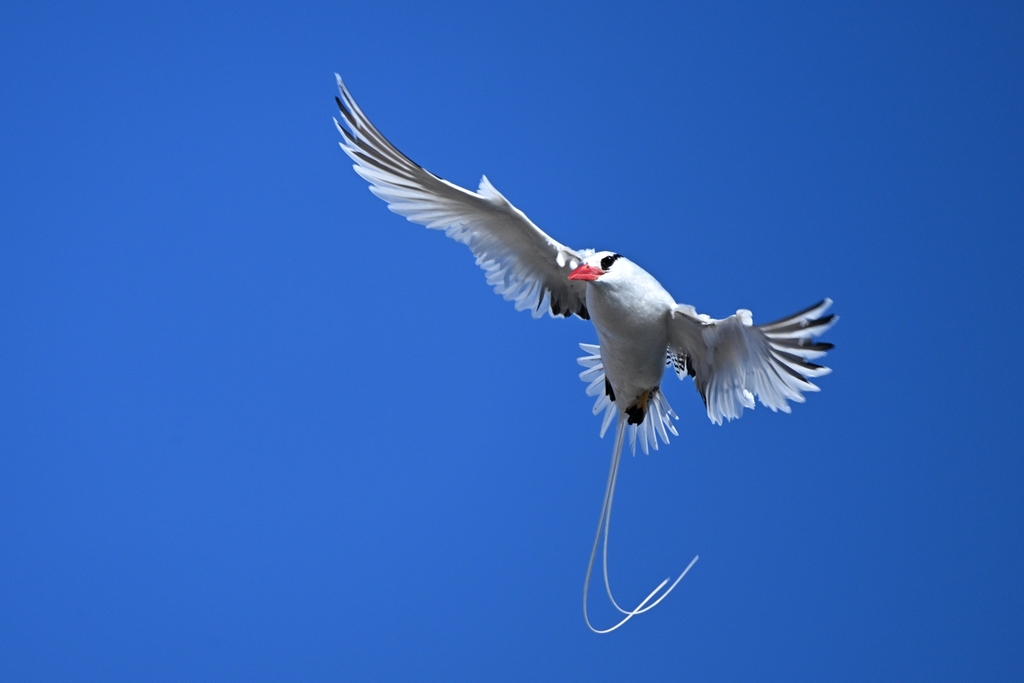
Red-billed Tropicbird
Photo © Charlotte Kirchner
Photo © Charlotte Kirchner — CC BY 4.0 — Source: iNaturalist photo #559080599Identification
The red-billed tropicbird is an elegant tropical seabird measuring 90 to 105 cm in length, though this includes distinctive tail streamers that can be about two times the bird's body length—males typically have longer streamers than females. At first glance, it superficially resembles a tern, with a wingspan of 99 to 106 cm. The plumage is predominantly white, with black wing tips and a finely barred black back that gives it a distinctive appearance. A striking black mask extends from above the lores to the sides of the nape, and the tail feathers display black shaft streaks. The bill is unmistakably red, while the legs and base of the central toe are orange-yellow. Three subspecies are recognized: the nominate form found in the southern Atlantic, P. a. indicus in Indian Ocean waters with a smaller size and more orange bill, and P. a. mesonauta in the eastern Atlantic, Pacific, and Caribbean with a rosy plumage tinge.
Range & Habitat
This tropicbird ranges across the tropical Atlantic, eastern Pacific, and Indian Oceans, with different subspecies occupying distinct regions. The nominate subspecies inhabits the southern Atlantic Ocean, while indicus frequents waters off the Middle East and the Indian Ocean. The subspecies mesonauta ranges through the eastern portions of both the Atlantic and Pacific Oceans and the Caribbean. These seabirds nest in loose colonies on cliff faces, selecting scrape nesting sites that offer easy takeoff access—a critical adaptation for birds that depend on launching from elevated positions into open water.
Behaviour & Diet
Red-billed tropicbirds are skilled hunters that feed on fish and squid, diving from the air directly into the water to catch their prey. Interestingly, they sometimes employ a kleptoparasitic strategy, following surface-feeding predators and seizing prey that these hunters drive to the surface. Nesting occurs in loose colonies, with a single egg incubated by both sexes for approximately six weeks. Weather and pollution can influence hatching success, though weather has minimal effect on chick fledging rates. Once chicks fledge, parents typically cease visiting the nest, and the young birds depart on their own.
Best Time & Places to See It
The red-billed tropicbird's wide tropical distribution across three ocean basins offers numerous opportunities for wildlife travellers. The species maintains colonies along coastal cliff habitats throughout its range, making it accessible in the Caribbean, off the coasts of Brazil and Mexico, and across Indian Ocean territories. While the species is classified as least-concern by the IUCN, populations are thought to be declining in some areas, particularly in Brazil and Mexico where it is considered threatened. Visiting established nesting sites during breeding season offers the best chances of observation.
Photography Tips
Photographing red-billed tropicbirds rewards patience and positioning. The birds' distinctive elongated tail streamers create striking compositional elements—aim to capture their full length against open sky or ocean. When photographing at nesting colonies on cliff faces, position yourself to backlight the birds, which will emphasize their white plumage and the delicate tail streamers. Diving sequences offer dramatic action shots; tracking birds as they plunge into water captures their hunting prowess. The black mask and red bill provide excellent focal points for close-up portraits. Early morning light often illuminates the subtle black barring on their backs and wings. Patience is essential, as loose colony spacing means birds may be scattered across cliff faces, requiring careful positioning to isolate individual subjects against clean backgrounds.
Corcovado National Park
Puerto Jiménez, Costa Rica
+444 birds+48 mammals
Where the Osa Peninsula juts into the Pacific, rainforest descends almost to the tide line, and Corcovado National Park protects one of Central America's most intact…
VIEW NATIONAL PARKManuel Antonio National Park
Quepos, Costa Rica
+426 birds+22 mammals
Where tropical rainforest descends steeply to a rocky Pacific coastline, Manuel Antonio National Park distills Central American biodiversity into one of Costa Rica's most compressed and…
VIEW NATIONAL PARKNatural Utría National Park
Alto Baudó (Pie de Pató), Colombia
+372 birds+11 mammals
Where the Chocó's coastal mountains plunge toward the Pacific, Utría National Park preserves one of Colombia's most biodiverse and least-visited wilderness expanses. Sprawling across 1,287 square…
VIEW NATIONAL PARKParque Nacional de Galápagos
Santo Tomás, Ecuador
+139 birds+23 mammals
Volcanic peaks and weathered lava fields dominate this remote archipelago in the Pacific, where the interplay of cold ocean currents and tropical latitude creates an ecological…
VIEW ISLAND & ARCHIPELAGOCoiba National Park
Montijo, Panama
+260 birds+10 mammals
An archipelago of volcanic and sedimentary islands rises from the Pacific waters off Panama's southwestern coast, its densest rainforest canopy unbroken for millennia. Coiba National Park…
VIEW NATIONAL PARKEl Vizcaíno
Laguna San Ignacio, Mexico
+317 birds+29 mammals
Where the Baja California peninsula thins into a tapestry of salt lagoons and coastal desert, one of Mexico's most biodiverse reserves sprawls across half a million…
VIEW BIOSPHERE RESERVEParque Nacional Isla Isabel
Santiago Ixcuintla, Mexico
+107 birds+2 mammals
A volcanic island sanctuary rises from the Pacific waters off Nayarit's coast, where three dormant cones define a landscape of sharp ridges, coastal cliffs, and sheltered…
VIEW NATIONAL PARKDry Tortugas National Park
Monroe County, United States
+211 birds+1 mammals
Seventy miles west of Key West, where the Gulf of Mexico surrenders to the Atlantic, lies a constellation of low coral keys that rise barely above…
VIEW NATIONAL PARKVirgin Islands National Park
Cruz Bay, United States
+119 birds+3 mammals
Coral reef and mangrove ecosystems define the tropical maritime landscape of this national park, where St. John's mountainous spine rises sharply from turquoise bays fringed with…
VIEW NATIONAL PARKPea Island National Wildlife Refuge
Dare County, United States
+356 birds+15 mammals
Where the Outer Banks taper toward the Atlantic, a sliver of barrier island creates a microcosm of coastal ecology. Pea Island National Wildlife Sanctuary spans over…
VIEW WILDLIFE SANCTUARYKīlauea Point National Wildlife Refuge
Kilauea, United States
+79 birds+1 mammals
At the northernmost tip of Kauai, where the Pacific trades collide with volcanic rock, Kīlauea Point National Wildlife Sanctuary crowns a dramatic headland overlooking one of…
VIEW WILDLIFE SANCTUARYMarino Ballena National Park
Bahía Ballena, Costa Rica
+336 birds+8 mammals
Where mangrove forests meet coral-fringed shorelines along Costa Rica's southern Pacific coast, Marino Ballena National Park encompasses a marine and terrestrial mosaic that ranks among Central…
VIEW NATIONAL PARKNo community photos yet. Log in to add the first one.
No community observations of this species yet.