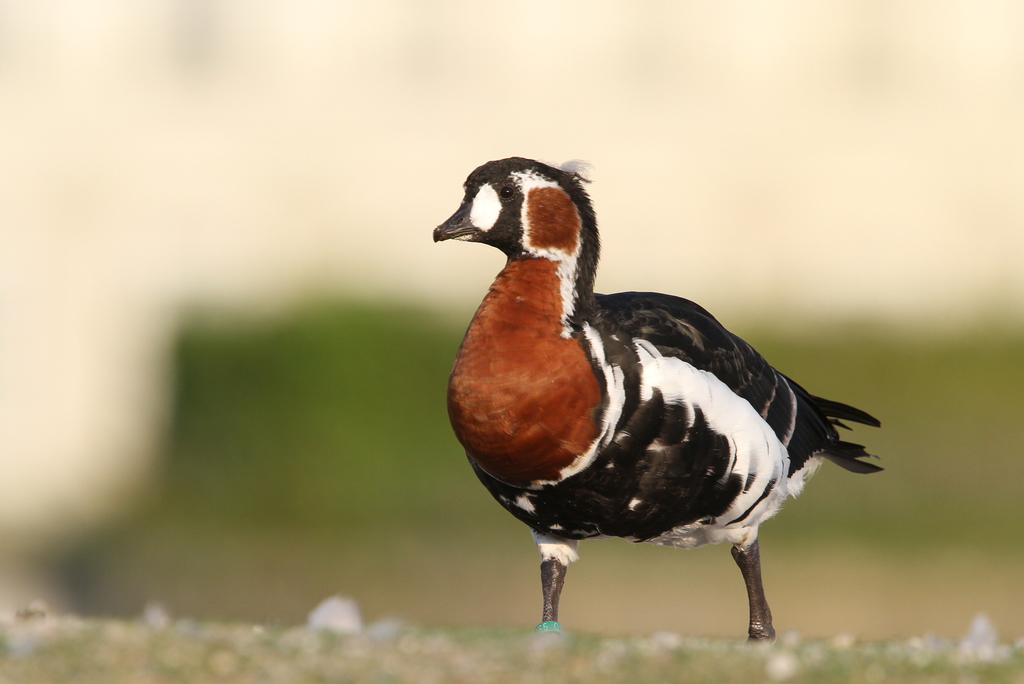
Red-breasted Goose
Photo © Christoph Moning
Photo © Christoph Moning — CC BY 4.0 — Source: iNaturalist photo #94322294Identification
The red-breasted goose is a brightly marked, unmistakable species measuring 53–56 cm in length with a wingspan of 1.16–1.35 m. Like all members of the genus Branta, it is distinguished by dark sooty plumage relieved by white markings, setting it apart from the grey geese of the genus Anser. The species is sexually dimorphic, with males weighing 1.2–1.62 kg and females 1.05–1.13 kg. Despite its distinctive appearance, the red-breasted goose can be surprisingly difficult to locate among flocks of brant geese, particularly at long distances when the red breast markings tend to appear dark.
Range & Habitat
This Eurasian goose breeds in Arctic Siberia, primarily on the Taymyr Peninsula, with smaller populations in the Gyda and Yamal peninsulas. The species is highly migratory, with most of the population wintering along the northwestern shores of the Black Sea in Bulgaria, Romania, and Ukraine, occasionally extending further southwest to Greece, while some birds winter in Azerbaijan. The red-breasted goose is a rare vagrant to Ireland and other western European areas, though escaped birds from captive collections appear fairly frequently outside their natural range.
Historically, large numbers wintered in Kirov Bay in the Caspian Sea until the 1960s, when agricultural changes rendered the area unsuitable. The species successfully adapted by shifting its wintering strategy to Bulgaria and the Dobrogea region of Romania. Archaeological evidence, including Late Pleistocene remains found in Bulgaria and depictions in ancient Egyptian paintings such as the famous Meidum Geese, indicates this species has occupied its range for millennia.
Behaviour & Diet
Red-breasted geese employ a remarkable anti-predation strategy by nesting in close proximity to the eyries of birds of prey, particularly snowy owls, peregrine falcons, and rough-legged buzzards. This association provides protection from mammalian predators such as Arctic foxes, with the safety of a nest increasing the closer it is positioned to a raptor's nest. The geese also nest on river islands and in colonies, with typical colonies comprising around four pairs depending on food availability and raptor density. During incubation, females remain within 1.5 km of their cryptic, well-hidden nests while males guard from a distance. Incubation lasts 23–25 days, and eggs measure 6.3–7.4 cm in length and 4.2–4.7 cm in width.
The species communicates through honking and hissing, particularly in aggressive situations. While wintering, red-breasted geese feed primarily on grasses, leaves, and seeds. The Taimyr Gull represents the main predator threat to eggs and goslings, particularly at nests on river islands.
Best Time & Places to See It
The red-breasted goose is best observed during winter, when populations concentrate along the northwestern Black Sea coast, particularly in Bulgaria, Romania, and Ukraine. Winter roosts support the majority of the global population, with over 80 percent gathering at just five sites. The species is a rare vagrant to western European locations including Ireland, where it occasionally appears among flocks of brent or barnacle geese.
Photography Tips
Photographing red-breasted geese requires patience and careful approach, as they are timid birds. During breeding season in Arctic Siberia, the dramatic nesting behaviour near raptor eyries provides compelling photographic opportunities, though access to these remote regions is challenging. In winter, large concentrations along the Black Sea offer better accessibility for photographers. The species' brightly marked plumage is striking in good light, though the red breast can appear darker at distance, so closer range photography is preferable for capturing field marks accurately. Early morning light often provides optimal conditions for photographing the contrasting black and white markings against the distinctive rufous breast.
Lower Saxon Wadden Sea National Park
Norderney, Germany
+193 birds+12 mammals
Where the North Sea meets the German coast, a vast expanse of tidal mudflats, salt marshes, and shallow waters creates one of Europe's most dynamic estuarine…
VIEW NATIONAL PARKHamburgisches Wattenmeer National Park
Hamburg, Germany
+206 birds+6 mammals
Where the North Sea exhales across the Elbe estuary, the tidal mudflats of Hamburgisches Wattenmeer National Park emerge twice daily in a landscape of extraordinary ecological…
VIEW NATIONAL PARKLower Oder Valley National Park
Schwedt/Oder, Germany
+216 birds+21 mammals
Where the Oder River winds through northeastern Brandenburg, the Lower Oder Valley National Park protects one of Central Europe's most vital wetland systems. This sprawling mosaic…
VIEW NATIONAL PARKVorpommersche Boddenlandschaft National Park
Küstengewässer einschließlich Anteil am Festlandso, Germany
+230 birds+19 mammals
Where the Baltic coast dissolves into a labyrinth of shallow lagoons and coastal wetlands, Vorpommersche Boddenlandschaft National Park protects one of northern Europe's most dynamic and…
VIEW NATIONAL PARKSchleswig-Holsteinisches Wattenmeer National Park
Germany
+378 birds+49 mammals
Where the North Sea ebbs and flows across a vast expanse of exposed mud and sand, the Schleswig-Holsteinisches Wattenmeer National Park reveals one of Europe's most…
VIEW NATIONAL PARKSouth Downs National Park
Chichester, United Kingdom
+298 birds+45 mammals
Chalk downland ridges rise and fall across the South Downs, their open grasslands and beech hangers creating a mosaic of habitats that has shaped human settlement…
VIEW NATIONAL PARKDanube Delta Biosphere Reserve
Tulcea, Romania
+277 birds+27 mammals
Where the Danube surrenders to the Black Sea, a vast labyrinth of channels, reed beds, and freshwater lakes sprawls across nearly 13,400 square kilometers of eastern…
VIEW NATIONAL PARKHortobágy National Park
Hortobágy, Hungary
+260 birds+17 mammals
Across the North Great Plain of Hungary stretches one of Europe's most expansive semi-natural grassland systems, where horizon-wide vistas of steppe and wetland create a landscape…
VIEW NATIONAL PARKFertő–hanság National Park
Fertőszéplak, Hungary
+246 birds+11 mammals
Where the Austro-Hungarian plains meet the foothills of Western Transdanubia, nearly 900 square kilometres of wetland, reed bed, and mixed woodland form one of Central Europe's…
VIEW NATIONAL PARKLahemaa National Park
Lääne-Viru County, Estonia
+237 birds+25 mammals
Where the Baltic coast meets temperate forest in northwestern Estonia, Lahemaa National Park sprawls across more than 1,300 square kilometers of deeply character-filled terrain. Coastal wetlands…
VIEW NATIONAL PARKSłowiński National Park
Smołdzino, Poland
+217 birds+16 mammals
Where the Baltic shoreline surrenders to vast inland dunes and freshwater lagoons, Słowiński National Park spans nearly 610 square kilometres of one of Europe's most dynamic…
VIEW NATIONAL PARKUjście Warty National Park
Gorzów County, Poland
+212 birds+9 mammals
Where the Warta River spreads into its delta before joining the Oder, wetland and woodland merge into one of central Europe's most vital ecological crossroads. Ujście…
VIEW NATIONAL PARKBiebrza National Park
Goniądz, Poland
+242 birds+33 mammals
Where the Narew River sprawls across northeastern Poland's flatlands, Biebrza National Park unfolds as one of Europe's largest and most ecologically vital wetland complexes. Encompassing roughly…
VIEW NATIONAL PARKKerkini Lake National Park
Serres, Greece
+291 birds+18 mammals
Where the Strymon River widens into a sprawling freshwater lake hemmed by the Rhodope Mountains, Kerkini National Park unfolds across northern Greece as one of southeastern…
VIEW NATIONAL PARKLindisfarne National Nature Reserve
Holy Island, United Kingdom
+240 birds+13 mammals
Windswept tidal flats and rocky outcrops define this reserve on Holy Island, where the North Sea's relentless rhythm shapes both landscape and wildlife. The terrain shifts…
VIEW NATURE RESERVEHolkham National Nature Reserve
North Norfolk, United Kingdom
+235 birds+11 mammals
Where Norfolk's coastal flatlands meet the North Sea, Holkham National Nature Reserve unfolds across nearly 4,000 hectares of some of England's most dynamic and least predictable…
VIEW NATURE RESERVERibble Estuary National Nature Reserve
Southport, United Kingdom
+197 birds+17 mammals
Where the Ribble flows into the Irish Sea, a landscape of mudflats, salt marshes and shallow pools creates one of northwest England's most dynamic estuarine ecosystems.…
VIEW NATURE RESERVENo community photos yet. Log in to add the first one.
No community observations of this species yet.