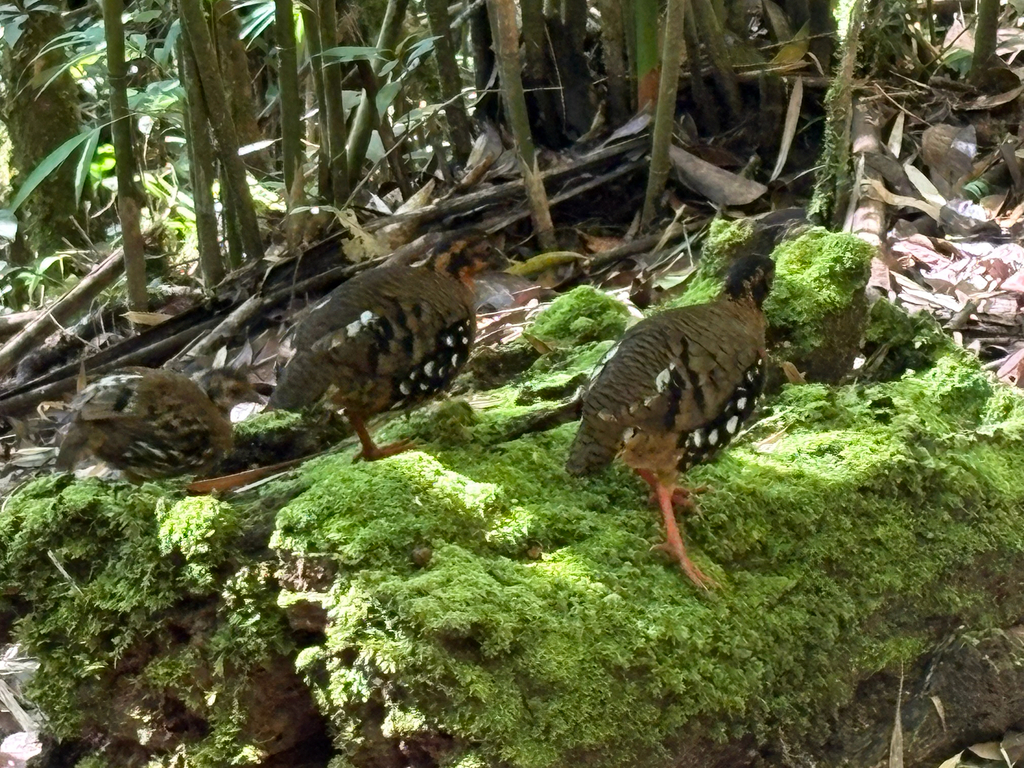
Red-breasted Partridge
Photo © 黃美滿
Photo © 黃美滿 — CC BY 4.0 — Source: iNaturalist #289717106Identification
The red-breasted partridge is a compact bird, measuring approximately 27 cm in length and weighing around 270 g. Males display more vibrant plumage than females, with a distinctive bright chestnut breast that gives the species its common name. The crown and nape are blackish with brown spotting, while a grey or rufous supercilium and a blackish-brown eye-stripe frame the face. The cheeks and throat are rufous, and red bare skin is visible around the throat, usually sparsely feathered. The belly is whitish, flanks are black and white, and the upperparts are brown with blackish barring. The bird has grey eyes, a black beak, and pink legs.
Range & Habitat
This species is endemic to the island of Borneo, where it inhabits the hill and montane forests of north-central regions, including parts of Sabah, Sarawak, North Kalimantan, and northern Central Kalimantan. The red-breasted partridge shows a strong preference for elevations between 600 and 1,800 metres, making it a bird of the highlands. Within its range, it favours primary and secondary forests, particularly areas with abundant bamboos and dense thickets, where it finds shelter and feeding opportunities.
Behaviour & Diet
These partridges are social birds that feed in small groups, foraging actively through thickets, along forest roads, and near rivers in search of food. Their diet comprises seeds, fruits, and insects. The red-breasted partridge is vocal, producing distinctive calls that involve a duet between two birds—one giving rising chu notes while the other produces falling cuckoo notes. This coordinated calling helps maintain group cohesion within the dense forest habitat. The birds roost in bushes at night, though relatively little is known about their breeding behaviour.
Best Time & Places to See It
The red-breasted partridge is found exclusively in Borneo's highland forests, making it an endemic species of particular interest to birdwatchers visiting the island. While the IUCN assesses it as least-concern, habitat loss from logging poses a threat to populations. For the best chance of encountering this species, focus your search in primary or secondary montane forests between 600 and 1,800 metres elevation, especially areas with thick bamboo stands and forest margins. Early morning visits to forest roads and river valleys where the birds forage may yield sightings.
Photography Tips
The red-breasted partridge's preference for thickets and dense forest understory makes it a challenging subject for wildlife photographers. The bird's striking chestnut breast contrasts beautifully with its darker upperparts and provides excellent compositional potential. Work with higher ISO settings and fast lenses to compensate for the dim forest light. Patience is essential—listen for the distinctive duet calls to locate birds, then position yourself quietly along forest roads or river edges where foraging groups may emerge into more open areas. The subtle differences in plumage between males and females offer opportunities for comparative photography.
No community photos yet. Log in to add the first one.
No community observations of this species yet.