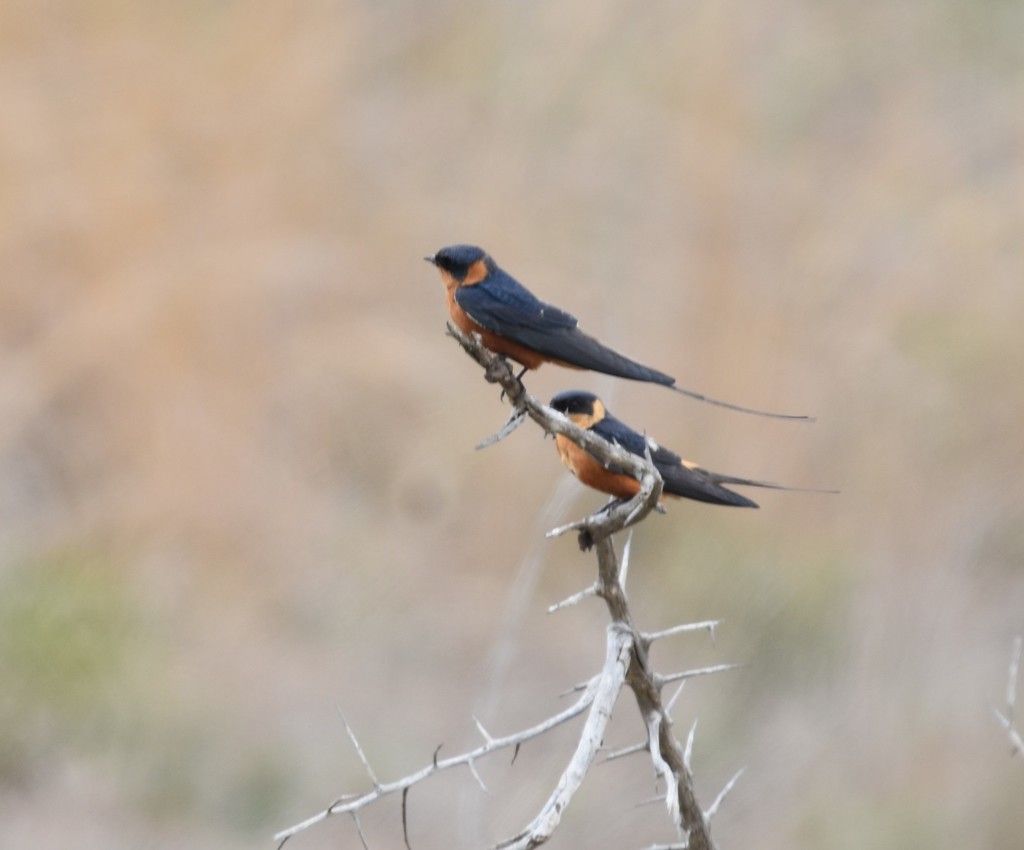
Red-breasted Swallow
Photo © Justin Ponder
Photo © Justin Ponder — CC BY 4.0 — Source: iNaturalist #104537638Identification
The red-breasted swallow is a distinctive small swallow with striking plumage that sets it apart in the field. It features a blue crown and mantle that contrasts sharply with rufous rump and underparts. The dark crown extends below the eye, and notably, there is no white on the underwing—a useful feature for distinguishing it from similar species. Compared to the closely related mosque swallow, the red-breasted swallow is slightly smaller but sports noticeably longer tail streamers. Juveniles can be confused with red-rumped swallows but show blue on the side of the head rather than the dull red seen in that species.
Range & Habitat
This species is found throughout Sub-Saharan Africa, with a range extending from the Eastern Cape north to northern Namibia and southern Angola in the west, and Mozambique in the east. A disjunct population exists from Senegal south to northern Angola and east to Uganda, southwestern Kenya, and northwestern Tanzania. The red-breasted swallow is highly migratory across most of its range. In southern Africa, it arrives as a summer visitor and nests between July and March, with most birds migrating to equatorial Africa, though some remain year-round. In parts of its northern range, particularly from southeastern Nigeria to Gabon, populations appear to be resident, arriving primarily during the rainy season.
The species favors dry open country habitats and is replaced by the mosque swallow in more wooded areas. It shows remarkable adaptability in choosing nest sites, constructing closed mud nests with tubular entrances in cavities, beneath bridges, in deserted buildings, tree holes, or caves. Modern infrastructure has benefited the species, which has increasingly adopted railway bridges and similar structures for nesting.
Behaviour & Diet
Red-breasted swallows are generally solitary birds, with pairs rarely breeding in groups. Clutches typically consist of three eggs. These aerial insectivores almost exclusively catch their prey in flight, with the species rarely landing on the ground; instead, they perch on wires and twigs between feeding forays. Their flight is characteristically slow and buoyant. Unfortunately, the nests of red-breasted swallows are frequently usurped by white-rumped swifts, a common challenge shared with closely related red-rumped and mosque swallows.
Best Time & Places to See It
For birdwatchers in southern Africa, the best time to observe red-breasted swallows is during the breeding season from July to March, when they are most active and visible. In equatorial regions and parts of the northern range, they may be encountered during or shortly after the rainy season. Look for them in open, dry country habitats, scanning the skies and watching perches like wires and low branches where they rest between feeding flights. Areas with suitable nesting structures—particularly where bridges or suitable cavities exist—offer the highest likelihood of encounters.
Photography Tips
Capturing images of red-breasted swallows presents the typical challenges of swallow photography: these are swift, aerial birds. Patient scanning of open areas and bridge structures during peak activity periods (dawn and dusk) increases your chances. Position yourself with good light behind the birds and use a fast shutter speed (at least 1/1000th second) to freeze their buoyant flight. The contrast between their blue upperparts and rufous underparts photographs beautifully in clear light. Focus on perched birds on wires or branches, where you can compose thoughtfully and capture their distinctive field marks, particularly the dark crown, blue mantle, and absence of white on the underwing.
Serengeti National Park
Tanzania
+558 birds+57 mammals
Across Tanzania's northern plateau, where volcanic soils meet acacia woodland and open grassland, unfolds one of Earth's most dynamic ecosystems. The Serengeti National Park sprawls across…
VIEW NATIONAL PARKMapungubwe National Park
Musina Local Municipality, South Africa
+358 birds+29 mammals
Where the Limpopo River cuts through sandstone ridges at the convergence of South Africa, Botswana, and Zimbabwe, Mapungubwe National Park preserves a landscape of profound ecological…
VIEW NATIONAL PARKChobe National Park
Botswana
+446 birds+45 mammals
Where the Chobe River cuts a sinuous path through northern Botswana, the landscape transforms into one of Africa's most dynamic wetland-savanna mosaics. This national park encompasses…
VIEW NATIONAL PARKKhaudum National Park
Botswana
+213 birds+13 mammals
Where the Okavango's northern tributaries meander through miombo woodland and riverine forest, Khaudum National Park unfolds across a landscape of profound ecological richness and isolation. This…
VIEW NATIONAL PARKVirunga National Park
Uganda
+418 birds+13 mammals
Where the Western Rift Valley fractures the landscape of North Kivu, Virunga National Park sprawls across terrain as geologically dramatic as it is ecologically vital. Volcanic…
VIEW NATIONAL PARKBwindi Impenetrable National Park
Kanyashogi, Uganda
+603 birds+26 mammals
Steep ridges cloaked in montane forest rise from Uganda's southwestern borderlands, where the landscape grows so dense and tangled that early explorers named it impenetrable. At…
VIEW NATIONAL PARKKidepo Valley National Park
Uganda
+478 birds+24 mammals
Where the Narus and Kidepo rivers carve through northeastern Uganda's semi-arid lowlands, a landscape of sparse acacia woodland, grassland, and riverine thickets creates one of East…
VIEW NATIONAL PARKMurchison Falls National Park
Uganda
+608 birds+33 mammals
Where the Victoria Nile compresses through a narrow gorge and explodes across a 45-meter precipice, the landscape speaks in thunder. Murchison Falls National Park sprawls across…
VIEW NATIONAL PARKMgahinga Gorilla National Park
Cyanika, Uganda
+429 birds+6 mammals
Where the Virunga Mountains rise steeply from the Uganda–Rwanda–Democratic Republic of Congo frontier, montane forest cloaks the volcanic slopes in a dense, moisture-laden embrace. Mgahinga Gorilla…
VIEW NATIONAL PARKToro-Semliki Proposed National Park
Uganda
+474 birds+5 mammals
Where the Albertine Rift's western escarpment rises above the Semliki River valley, a vast mosaic of forest, savanna and wetland converges to create one of East…
VIEW NATIONAL PARKMabamba Swamp
Memere, Uganda
+464 birds+2 mammals
Across the Central Region of Uganda spreads one of Africa's most biodiverse freshwater wetlands, a sprawling nature reserve of roughly 283 square kilometres where papyrus swamps…
VIEW NATURE RESERVEPilanesberg National Park
Moses Kotane Local Municipality, South Africa
+364 birds+49 mammals
Granite peaks and volcanic ridges rise unexpectedly from the savanna floor across this 734-square-kilometre expanse in the North West province, creating a landscape of profound ecological…
VIEW NATIONAL PARKMokala National Park
Siyancuma Local Municipality, South Africa
+246 birds+35 mammals
Across the semi-arid savanna of the Northern Cape, where red earth meets sparse acacia woodland and open grassland punctuated by rocky outcrops, lies a landscape shaped…
VIEW NATIONAL PARKKruger National Park
Ba-Phalaborwa Local Municipality, South Africa
+540 birds+91 mammals
Across the low-lying savanna of northeastern South Africa unfolds one of Africa's largest and most ecologically intact protected areas, where acacia woodlands merge into mopane scrub…
VIEW NATIONAL PARKIthala Game Reserve
uPhongolo Local Municipality, South Africa
+328 birds+26 mammals
Rolling thornbush savanna and acacia woodland dominate the landscape of this 494-square-kilometre national park in KwaZulu-Natal's uPhongolo Local Municipality, where granite outcrops punctuate grassland plateaus and…
VIEW NATIONAL PARKMarakele National Park
Modimolle Local Municipality, South Africa
+341 birds+36 mammals
Granite ridges and sprawling grasslands dominate this 1,176-square-kilometre reserve in Limpopo's heartland, where bushveld transitions between rocky outcrops and open savanna. The park's rugged topography creates…
VIEW NATIONAL PARKCamdeboo National Park
Camdeboo Local Municipality, South Africa
+272 birds+24 mammals
Granite ridges and weathered sandstone cliffs rise across a semi-arid landscape where the Karoo transitions into the eastern escarpment of South Africa, creating Camdeboo National Park's…
VIEW NATIONAL PARKZiwa Rhino and Wildlife Ranch
Nakasongola, Uganda
+359 birds+11 mammals
Where papyrus wetlands merge into sprawling savanna, Uganda's central landscape opens into one of East Africa's most vital rhino recovery zones. Ziwa Rhino and Wildlife Ranch…
VIEW WILDLIFE SANCTUARYKhaudum National Park
Namibia
+221 birds+13 mammals
Where the Kavango River flows through northeastern Namibia, vast miombo woodlands and riverine forests create one of southern Africa's most remote and biodiverse wilderness corridors. Khaudum…
VIEW NATIONAL PARKNkasa Rupara National Park
Namibia
+283 birds+17 mammals
Where the Zambezi's floodplains spill across the border between Namibia and Botswana, Nkasa Rupara National Park unfolds across 518 square kilometers of wetland and woodland mosaic.…
VIEW NATIONAL PARKBwabwata National Park
Namibia
+377 birds+35 mammals
Where the Kavango River winds through northeastern Namibia, vast floodplains and dense riparian woodland create one of southern Africa's most ecologically dynamic protected landscapes. Spanning 14,249…
VIEW NATIONAL PARKEtosha National Park
Namibia
+356 birds+58 mammals
Across northern Namibia's stark semi-arid plateau, a vast shallow depression transforms seasonally into one of Africa's most dramatic wildlife theaters. Etosha National Park, encompassing more than…
VIEW NATIONAL PARKWaterberg Plateau National Park
Okambukonde, Namibia
+198 birds+27 mammals
Where ancient sandstone cliffs rise 200 metres above the surrounding bushveld, a fortress of geology creates one of southern Africa's most compelling ecosystems. The plateau's steep…
VIEW NATIONAL PARKRuma National Park
Suba, Kenya
+250 birds+8 mammals
Where the Winam Gulf narrows toward the Kenyan mainland, Ruma National Park rises as a sanctuary of evergreen woodland set within the humid tropics of Homa…
VIEW NATIONAL PARKNo community photos yet. Log in to add the first one.
No community observations of this species yet.